
SSC CGL Syllabus & Exam Pattern | Tier 1 & 2 (2026)
SSC CGL Syllabus
1. Section-wise weightage
| Sr. No. | Section | Tier 1 | Tier 2 |
|---|---|---|---|
| 1 | Quantitative Aptitude (Maths) | 25% | 23% |
| 2 | General Intelligence & Reasoning | 25% | 23% |
| 3 | English Language & Comprehension | 25% | 35% |
| 4 | General Awareness | 25% | 19% |
| 5 | Computer Knowledge Test | – | Qualifying |
2. Topic-wise weightage
Each sections has been broken down into important topics in the following table:
| Section | Topic | Tier 1 | Tier 2 |
|---|---|---|---|
| Quant | Geometry | 3% | 2% |
| Quant | Profit Loss | 3% | 2% |
| Quant | Mensuration | 3% | 2% |
| Quant | Ratio | 2% | 1% |
| Quant | Algebra | 2% | 3% |
| Quant | Trigonometry | 2% | 2% |
| Quant | Time and Work | 2% | 1% |
| Quant | Average and Mixture | 2% | 2% |
| Quant | Percentage | 2% | 2% |
| Quant | Simplification | 1% | 3% |
| Quant | Number system | 1% | 1% |
| Quant | Compund Interest | 1% | 1% |
| Quant | Speed, distance time | 1% | 1% |
| Quant | Data Interpretation | 0% | 0% |
| Quant | Probability | 0% | 0% |
| Quant | Statistics | 0% | 0% |
| Reasoning | Analogy | 7% | 2% |
| Reasoning | Series | 6% | 1% |
| Reasoning | Blood relation | 4% | 1% |
| Reasoning | Coding Decoding | 3% | 2% |
| Reasoning | Visual reasoning | 2% | 5% |
| Reasoning | Verbal Reasoning | 1% | 7% |
| Reasoning | Puzzle | 1% | 3% |
| Reasoning | Direction | 1% | 1% |
| Reasoning | Seating Arrangement | 0% | 1% |
| Verbal | Grammar | 10% | 10% |
| Verbal | Vocb | 8% | 7% |
| Verbal | RC | 5% | 7% |
| Verbal | Parajumble | 2% | 5% |
| Verbal | Cloze test | 0% | 5% |
| Verbal | Word Test | 0% | 1% |
| GA | General Knowledge | 13% | 8% |
| GA | Current Affairs | 8% | 5% |
| GA | General Science | 4% | 6% |
Points to note:
- 0% weightage does not mean the topic will never appear in the SSC CGL exam. It only indicates that the topic has been rarely tested in previous papers.
- Topic-wise weightages are derived from an analysis of previous SSC CGL exam papers. Candidates are advised to prepare all topics thoroughly, as SSC may introduce unexpected questions.
- Coordinate Geometry has been included under Geometry to provide a simplified and consolidated view of the syllabus.
- Verbal Reasoning includes Syllogism and Statement–Conclusion type questions.
SSC CGL Exam Pattern
The SSC CGL Exam is conducted in two main stages: Tier 1 and Tier 2. Both Tier 1 and Tier 2 are administered as Computer-Based Tests (CBT) featuring objective multiple-choice questions. Tier 1 is qualifying exam, while Tier 2 is the selection round.
The core syllabus includes four main subjects: General Intelligence & Reasoning, English, Quantitative Aptitude, and General Awareness. Additionally, candidates targeting specific positions must take domain-related papers. Below is a summary of the exam structure:
Exam Structure
| Tier | Exam Type | Mode |
| Tier 1 (Qualifying round) | Objective MCQs covering – General Intelligence & Reasoning – English Comprehension – Quantitative Aptitude (Maths) and – General Awareness | Computer-Based (Online) |
| Tier 2 (Final selection round) | – Paper I (compulsory for all candidates) – Paper II (for JSO post candidates) – Paper III (for Assistant Audit Officer/Assistant Accounts Officer candidates) – Objective MCQs, except for Module-II of Section-III in Paper I | Computer-Based (Online) |
Tier 1 Exam Pattern
Below is the updated exam pattern for both stages.
Tier 1 is the initial stage and serves as a qualifying exam. Although marks from Tier 1 are not included in the final merit list, candidates must clear the cut-off to move on to Tier 2.
- Paper has 100 multiple-choice questions for 200 marks
- Four sections: General Intelligence & Reasoning, General Awareness, Quantitative Aptitude, and English Comprehension.
- Each section contains 25 questions.
- Candidates have 60 minutes (1 hour) to complete the exam.
- There is a penalty of 0.50 marks for every incorrect response.There is no sectional timing.
| Subject | Number of Questions | Total Marks |
| General Intelligence & Reasoning | 25 | 50 |
| General Awareness | 25 | 50 |
| Quantitative Aptitude | 25 | 50 |
| English Comprehension | 25 | 50 |
| Total | 100 | 200 |
Tier 2 Exam Pattern
SSC CGL Tier 2 is the final and most important stage of the selection process. It consists of Paper I (mandatory for all posts) and Paper II (only for candidates applying for Junior Statistical Officer – JSO posts).
| Paper | Posts |
| Paper I | Mandatory for all posts |
| Paper II | Only for Junior Statistical Officer (JSO) |
The SSC CGL Tier 2 consists of Paper I being held over two sessions—Session I and Session II—in separate days/shifts. All candidates who pass Paper I must appear in both sessions. Session I covers Section I, Section II, and Module I of Section III, while Session II includes Module II of Section III. Candidates are required to clear all sections of Paper I to qualify.
| Paper | Section | Module | Sections | No. of Questions | Marks | Time Duration |
| Paper 1 | Section-I | Module-I | Mathematical Abilities | 30 | 90 | 1 hour |
| Module-II | Reasoning & General Intelligence | 30 | 90 | |||
| Section-II | Module-I | English Language and Comprehension | 45 | 135 | 1 hour | |
| Module-II | General Awareness | 25 | 75 | |||
| Section-III | Module-I | Computer Proficiency | 20 | 60 (Qualifying) | 15 minutes | |
| Module-II | Data Entry Speed Test (DEST) | – | Qualifying | 15 minutes | ||
| Paper 2 | – | – | Statistics | 100 | 200 | 2 hours |
Paper I Summary
- Total Questions: 155
- Total Marks: 390
- Computer Proficiency & DEST are qualifying in nature
- Candidates must qualify in all sections
Negative Marking (Paper I)
- 1 mark deducted for each wrong answer in:
- Mathematical Abilities
- Reasoning & General Intelligence
- English Language & Comprehension
- 0.50 mark deducted for each wrong answer in:
- General Awareness
- No negative marking in Computer Proficiency Test & DEST
Negative Marking (Paper II)
- 0.50 mark deducted for every incorrect answer
- Paper II marks are considered only for JSO candidates
Prepare SSC CGL Syllabus – with Adaptive Practice!
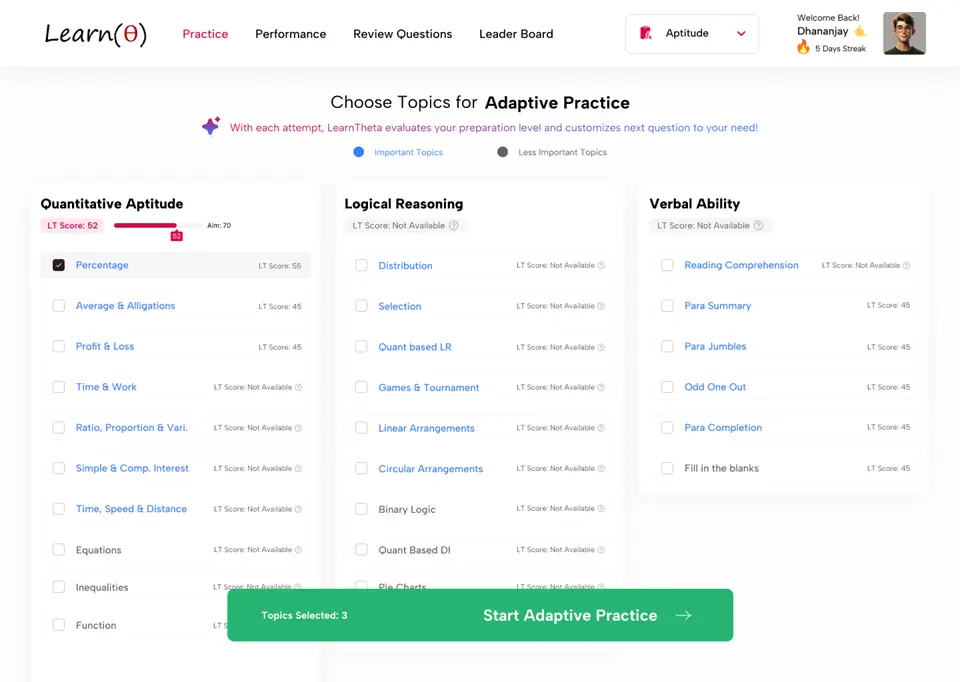
✅ All Topics at One Place
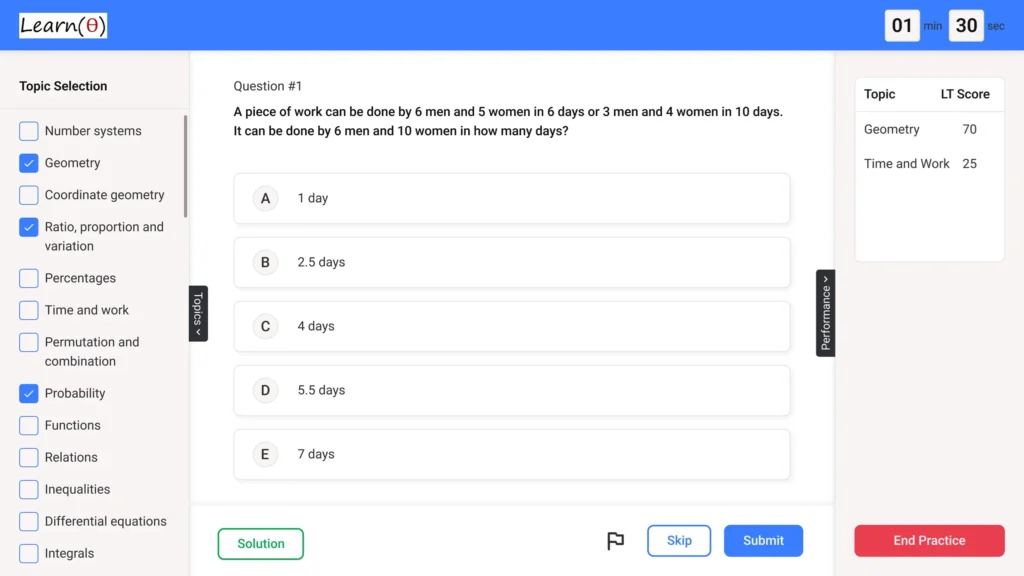
🤖 Adaptive Question Practice
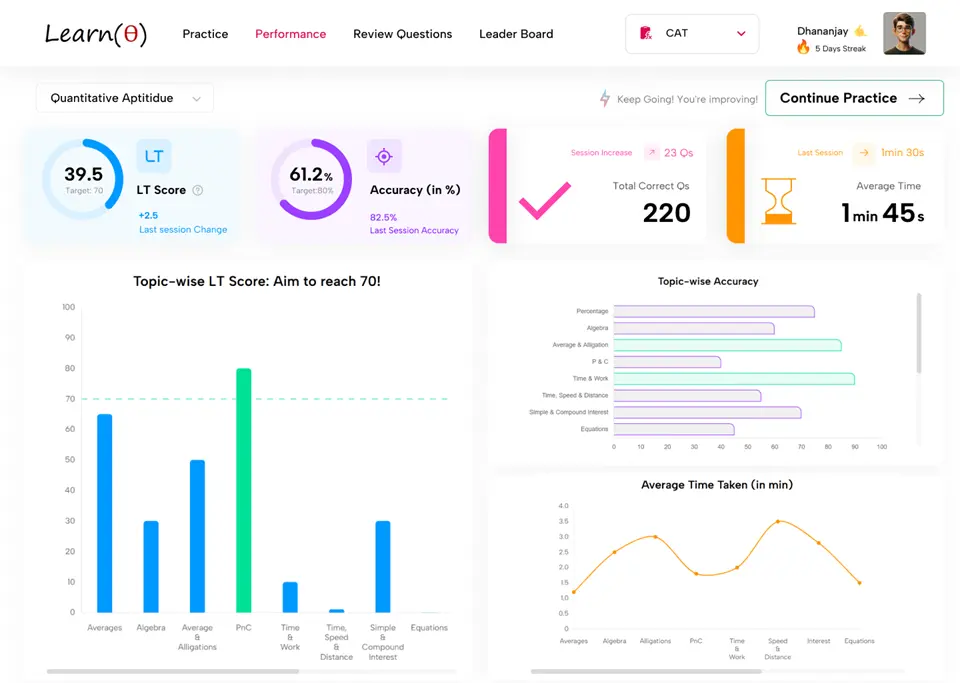
📊 Progress and Insights
SSC CGL Normalization Process
Since SSC CGL is conducted in multiple shifts on different days, the difficulty level of question papers may vary slightly. To ensure fairness, SSC follows a normalization process before declaring results.
Why Normalization is Applied
- Exam is conducted in multiple shifts
- Difficulty level may differ across shifts
- Ensures no candidate is disadvantaged due to a tougher shift
How Normalization Works
- Raw marks obtained by candidates are converted into normalized scores
- Statistical formula is used by SSC
- Final merit and cut-off are decided based on normalized marks
- Candidates are ranked according to normalized scores, not raw marks
Important Points
- Normalization applies to both Tier 1 and Tier 2
- The exact formula is decided and applied by SSC
- Final scorecard shows normalized marks
SSC CGL Syllabus in depth
Tier 1 Syllabus in depth
The syllabus for Tier 1 covers the following subjects:
1. General Intelligence and Reasoning
This section assesses your ability to think logically and solve problems through both verbal and non-verbal questions. It evaluates skills like pattern recognition, analytical reasoning, and decision making. Focus Areas in this section frequently include Series, Coding-Decoding, and Analogy.
| General Intelligence & Reasoning | Difficulty | Priority |
| Analogy | High | High |
| Coding Decoding | High | High |
| Word Test | Medium | Medium |
| Venn Diagrams | Medium | Medium |
| Missing Number | Medium | Medium |
| Alphanumerical Series | High | High |
| Syllogism | Medium | Medium |
| Visual Reasoning | Medium | Medium |
2. General Awareness
Scoring well in the General Awareness section can make a significant difference during the SSC CGL exam, it is highly rewarding for those who prepare thoroughly, yet can be tricky for those who overlook it. Focus Areas include Science + Static GK. Static GK is more frequent than dynamic current affairs.
| General Awareness Topics | Difficulty | Priority |
| History (Ancient, Medieval, Modern) | High | High |
| Geography (India & World – Physical + Political) | High | High |
| Polity (Constitution, Parliament, Fundamental Rights) | High | High |
| Economics (Basic Concepts, Budget, Inflation, RBI) | Medium | Medium |
| General Science (Physics, Chemistry, Biology – Class 6–10 level) | High | High |
| Current Affairs (Last 6–8 months) | High | High |
| Government Schemes & Committees | Medium | Medium |
| Sports, Awards & Honours | Medium | Low to Medium |
| Books & Authors | Low | Low |
| Important Days | Low | Low |
3. Quantitative Aptitude (Numerical Ability/ Maths)
This section measures your proficiency in mathematics, focusing on accuracy, speed, and problem-solving abilities. It primarily consists of questions that require both calculations and the application of concepts. Focus Areas include Mensuration, Profit-Loss, and Percentage.
| Quantitative Aptitude Topics | Difficulty | Priority |
| Number System | High | High |
| Simplification | Medium | Medium |
| Ratio & Proportion | Medium | High |
| Percentage | Medium | High |
| Average and Mixture | Low | Medium |
| Simple & Compound Interest | Low | High |
| Profit and Loss | High | High |
| Time and Work | Medium | High |
| Time, Speed & Distance | Medium | High |
| Algebra | High | High |
| Geometry | High | Medium |
| Mensuration | Medium | Medium |
| Trigonometry | Medium | Medium |
| Data Interpretation | High | High |
4. English Comprehension
This segment evaluates a candidate’s grasp of English, including grammar, vocabulary, and reading skills. It tests the ability to understand, interpret, and analyze language effectively. Focus Areas include Grammar-based error spotting and cloze test.
| English Comprehension Topics | Difficulty | Priority |
| Reading Comprehension | High | High |
| Cloze Test | High | High |
| Fill in the Blanks | Medium | High |
| Find Error | High | High |
| Synonyms Antonyms | Low | High |
| One Word Substitution | Medium | Medium to High |
| Idioms & Phrases | Medium | Medium |
| Active & Passive Voice | Medium | Medium |
| Direct & Indirect Speech | Medium | Medium |
| Parajumbles | High | Medium |
| Spelling | Low | Low to Medium |
Exam Preparation Tips for Tier 1:
- Focus on maintaining a balance between speed and accuracy instead of trying to answer every question.
- Give proper attention to the General Awareness section, as it provides the highest score-to-time advantage.
- Take timed mock tests regularly to improve time management under actual exam conditions.
SSC CGL Tier 2 Syllabus in depth
Topics for Tier 1 and tier 2 exams are same, thoguht the level of questions would be slightly tougher. A lot of coachings try to package same topics with different names just to sell tier 1 and tier 2 courses separately, so be aware of that. There is literally no difference.
1. Mathematical Abilities (Module I of Session I of Paper I)
2. General Intelligence and Reasoning (Module-II of Section-I of Paper-I)
3. English Language & Comprehension (Module-I of Section-II of Paper-I)
4. General Awareness (Module-II of Section-II of Paper-I)
5. Computer Proficiency (Module-I of Section-III of Paper-I)
| Syllabus Topics | Sub-Topics |
| Computer Fundamentals | Structure and organization of a computer Central Processing Unit (CPU) Input and output devices Computer memory and its organization Backup storage devices Ports and connectors Windows Explorer usage Common keyboard shortcuts |
| Software | Basics of Windows Operating System along with Microsoft Office applications such as MS Word, Excel, and PowerPoint |
| Internet and Email | Internet usage and email management including web browsing, searching, downloading and uploading files, managing email accounts, and e-banking |
| Networking and Security | Fundamentals of networking and cybersecurity Devices for Networking and communication protocols Security risks like hacking, viruses, worms, Trojans, and methods to prevent them |
SSC CGL Tier 2 Syllabus- Paper 2 (Statistics)
Paper-II is applicable only to candidates who have applied for the Junior Statistical Officer (JSO) positions in the Ministry of Statistics and Programme Implementation and for the Statistical Investigator Grade II role in the office of the Registrar General of India (Ministry of Home Affairs). These candidates must have also been shortlisted in Tier-I for these specific posts to be eligible for Paper-II.
This paper focuses on advanced-level statistics topics relevant to these roles, while Paper-I is mandatory for all SSC CGL candidates regardless of the post applied for.
| Topic | Priority | Approximate Weightage (Number of Questions) |
| Collection, Classification, and Presentation of Statistical Data | High | 4-6 |
| Measures of Central Tendency | High | 3-5 |
| Measures of Dispersion (Common Measures) | High | 2-4 |
| Moments, Skewness, and Kurtosis | Medium | 1-2 |
| Correlation and Regression | Medium | 1-3 |
| Probability Theory | Medium to High | 2-4 |
| Random Variable and Probability Distributions | Medium | 1-3 |
| Sampling Theory | Medium | 1-2 |
| Statistical Inference | Medium | 1-3 |
| Analysis of Variance | Low to Medium | 1-2 |
| Time Series Analysis | Low | 0-1 |
| Index Numbers | Low | 0-1 |
SSC CGL Minimum Qualifying Marks
Candidates must secure the minimum qualifying marks prescribed by SSC to move to the next stage of the examination.
Minimum Qualifying Marks (Category-wise)
| Category | Minimum Qualifying Marks |
|---|---|
| UR (General) | 30% |
| OBC / EWS | 25% |
| SC / ST / PwBD | 20% |
Important Points
- These qualifying marks apply to Tier 1 and Tier 2.
- In Tier 2 Paper I, candidates must clear each section separately.
- Merely securing minimum qualifying marks does not guarantee selection.
- Final selection depends on:
- Cut-off marks
- Normalized scores
- Number of vacancies
- Category-wise merit
Check Cut Off Trends
SSC CGL Final Merit & Post Allocation Process
The final selection in SSC CGL is based primarily on performance in Tier 2.
Preparation of Final Merit List
- Tier 1 is qualifying in nature; its marks are not included in final merit.
- Final merit is prepared based on:
- Tier 2 Paper I marks (for all candidates)
- Tier 2 Paper II marks (only for JSO candidates)
- Computer Proficiency Test and DEST are qualifying in nature.
- Candidates must clear all required sections and qualifying tests.
- Merit list is prepared using normalized scores.
Post Allocation Process
Post allocation is done after the final result based on the following factors:
- Candidate’s rank in the final merit list
- Category (UR/OBC/SC/ST/EWS/PwBD)
- Post preferences filled during application
- Availability of vacancies in each post
Important Points About Post Preference
- Candidates must carefully fill post preferences during the application process.
- Higher-ranked candidates get preference for top posts.
- Once a post is allotted and accepted, it cannot be changed.
- Document verification is conducted before final appointment.
SSC CGL Salary Structure & Career Growth
SSC CGL offers attractive salary packages along with job stability, allowances, and regular promotions under the 7th Pay Commission.
SSC CGL Salary Structure (As per 7th Pay Commission)
| Pay Level | Pay Scale | Common Posts |
|---|---|---|
| Level 4 | ₹25,500 – ₹81,100 | Tax Assistant, Upper Division Clerk |
| Level 5 | ₹29,200 – ₹92,300 | Auditor, Accountant |
| Level 6 | ₹35,400 – ₹1,12,400 | Inspector (Income Tax, GST), Assistant Section Officer |
| Level 7 | ₹44,900 – ₹1,42,400 | Assistant Audit Officer, Assistant Accounts Officer |
| Level 8 | ₹47,600 – ₹1,51,100 | Certain senior posts |
Salary Components
SSC CGL salary includes:
- Basic Pay
- Dearness Allowance (DA)
- House Rent Allowance (HRA)
- Transport Allowance (TA)
- Medical Benefits
- Pension & Other Government Benefits
Approximate In-Hand Salary
| Pay Level | Approximate In-Hand Salary |
|---|---|
| Level 4 | ₹30,000 – ₹35,000 |
| Level 5 | ₹35,000 – ₹40,000 |
| Level 6 | ₹45,000 – ₹55,000 |
| Level 7 | ₹60,000 – ₹70,000 |
| Level 8 | ₹65,000 – ₹75,000 |
(In-hand salary may vary depending on city classification: X, Y, or Z city.)
Career Growth & Promotion
SSC CGL posts offer structured promotions and departmental exams for career advancement.
Income Tax Inspector
- Income Tax Inspector
- Income Tax Officer
- Assistant Commissioner
- Deputy Commissioner
Assistant Section Officer (ASO)
- Assistant Section Officer
- Section Officer
- Under Secretary
- Deputy Secretary
Auditor
- Auditor
- Senior Auditor
- Audit Officer
- Senior Audit Officer
Key Benefits of SSC CGL Jobs
- Regular promotions
- Salary increments
- Government accommodation (in some posts)
- Job security
- Work-life balance (varies by department)
- Pension benefits
Essential Tips for SSC CGL Preparation
- Understand the Exam Pattern: Familiarize yourself thoroughly with the number of questions, total marks, time duration for each section, and the marking scheme including negative marking, to strategize your approach effectively.
- Create a Detailed Study Plan: Allocate specific time slots for each subject and topic based on their weightage and your proficiency. Incorporate regular revision sessions to reinforce concepts and avoid last-minute cramming.
- Practice Previous Year Question Papers: Solving past SSC CGL papers helps you get accustomed to the exam’s difficulty level, question types, and time management, boosting your confidence and performance.
- Enhance Speed and Accuracy: Focus on increasing your problem-solving speed while minimizing mistakes. This balance is crucial since high accuracy with rapid solving is required to clear competitive cut-offs.
- Stay Updated with Current Affairs: Dedicate daily time to reading newspapers, news websites, and monthly current affairs magazines to cover national, international, sports, economy, and government schemes updates.
- Identify and Improve Weak Areas: Analyse your performance in mock tests and practice papers to spot weak subjects or topics. Devote extra time to these areas with targeted practice and concept revision.
- Regular Mock Tests and Analysis: Consistently attempt full-length mock exams under real exam conditions. Review your mistakes carefully and understand the solutions to improve your weaknesses. Practicing mock tests can help build confidence before exam.
- Build Strong Conceptual Clarity: Do not rely solely on rote learning; focus on understanding fundamental concepts in quantitative aptitude, reasoning, English language, and general awareness for long-term retention.
- Time Management Practice: Develop skills to manage time efficiently during the exam so that you can attempt all questions without rushing or leaving any section incomplete.
- Focus on Shortcuts and Tricks: Learn shortcut methods and problem-solving tricks for quantitative and reasoning sections to save valuable time during the exam.
- Maintain Health and Mindset: Ensure proper sleep, balanced diet, and regular breaks during study to keep your mind fresh and focused. Stay positive and confident throughout your preparation journey.
SSC CGL is highly competitive, and a well-structured and consistent preparation strategy is vital for success. Emphasizing frequent revision, practicing mock tests, and keeping updated with current affairs will enhance your chances significantly. Maintaining discipline and a positive attitude will help you stay motivated and perform at your best on exam day.
SSC CGL Exam FAQs
Q1: What are the qualification requirements for SSC CGL?
The minimum qualification varies depending on the post, but generally, candidates must hold a bachelor’s degree from a recognized university. Certain posts, such as Junior Statistical Officer or Statistical Investigator Grade-II, may require specific educational backgrounds or subject criteria like mathematics or statistics.
Q2: Is Tier 1 considered only a qualifying exam?
Yes, the Tier 1 exam is qualifying in nature. The marks obtained in Tier 1 do not contribute to the final merit list but clearing it is mandatory to advance to Tier 2.
Q3: Which tier holds the greatest importance for the final selection?
Tier 2, specifically Paper 1, is the most significant. It is mandatory for all posts and carries the highest weightage in determining the final merit.
Q4: Can candidates succeed in SSC CGL without attending coaching classes?
Definitely. Many aspirants clear SSC CGL by following a disciplined study routine, practicing mock tests regularly, and thoroughly covering the official syllabus, without the need for coaching.
Q5: Which are the highest-ranking positions available through SSC CGL?
Some of the top posts that candidates can aspire to through SSC CGL include:
- Income Tax Auditor
- Assistant Law Enforcement Officer in the Emergency Department
- Assistant Section Officer (ASO) in the Ministry of External Affairs
- Deputy Inspector in the Central Bureau of Investigation (CBI)
- Goods and Services Tax (GST) Inspector
- Deputy Auditor at the Comptroller and Auditor General (CAG)
- District Accountant
SSC CGL Questions
Question Tricks & Shortcuts
LearnTheta Adaptive Practice Demo
Refer SSC CGL Previous Year Question Papers | SSC CGL Free Mock Tests | SSC CGL Topic wise Questions
Preparing for Bank exams? Refer Bank Exam Syllabus
Crack SSC CGL Faster and Smarter – with LearnTheta’s AI-Practice!
✅ All Topics at One Place
🤖 Adaptive Question Practice
📊 Progress and Insights