
Mathematical Inequalities: Bank Exam Practice Questions (SBI, IBPS, RRB, PO & Clerk)
Q. 1 Direction: In the following question assuming the given statements to be true, find which of the conclusion among given conclusions is/are definitely true and then give your answers accordingly. Statements: A < B ≤ C = D > E Conclusions: I. A < D II. C > E
Check Solution
Ans: B
Explanation:
From the statements, we have:
A < B ≤ C = D > E
We can rewrite this as:
A < B and B ≤ C and C = D and D > E
Conclusion I: A < D. Since A < B ≤ C = D, then A < D is true.
Conclusion II: C > E. Since C = D > E, then C > E is true.
Therefore, both I and II are true.
Q. 2 Direction: In the following question assuming the given statements to be True, find which of the conclusion among given conclusions is/are definitely true. Statements: P > Q = R; R < S ≤ T Conclusions: I. P > S II. Q < T
Check Solution
Ans: E
Explanation:
From the statements:
1. P > Q = R => P > Q and Q = R
2. R < S ≤ T => R < S and S ≤ T
Combining, we get: P > Q = R < S ≤ T
Conclusion I: P > S
Since P > Q = R and R < S, then P > R and since R < S, it is not always true that P > S. For example, if P = 10, Q = R = 5, S = 6, T = 7, then P > S (10 > 6). But if P=6, Q=R=1, S=5, T=10, then P < S (6 < 5). However, there exists a case where P > S, so P is not *definitely* greater than S. This conclusion is not always true.
Conclusion II: Q < T
Since Q = R and R < S ≤ T, therefore Q < S and S ≤ T. Thus, Q < T.
Therefore, only conclusion II is true.
Q. 3 Direction: In the following question assuming the given statements to be true, find which of the conclusion(s) among given conclusions is/are definitely true. Statement: P ≤ Q < R = S > T Conclusions: I. Q < T II. R > P
Check Solution
Ans: C
Explanation: Let’s analyze the given statement and the conclusions.
Statement: P ≤ Q < R = S > T
Conclusion I: Q < T. From the statement, Q < R = S > T. We cannot directly compare Q and T. The relationship between Q and T is undefined. Therefore, this conclusion is false.
Conclusion II: R > P. From the statement, P ≤ Q < R. Since P is less than or equal to Q, and Q is less than R, it implies that R > P. Therefore, this conclusion is true.
Q. 4 Direction: In the following questions assuming the given statements to be true, find which of the conclusion among given some conclusion is/are definitely true and then give your answers accordingly:
Statement: P ≥ Q = R < S ≤ T < V
Conclusions:
l. T > Q
ll. P > S
Check Solution
Ans: D
Explanation: Let’s analyze the given statements and conclusions.
Statement: P ≥ Q = R < S ≤ T < V
Conclusion I: T > Q. We can trace the relationship from Q to T: Q = R < S ≤ T. Therefore, T > R, and since Q = R, T > Q. This conclusion is true.
Conclusion II: P > S. We can trace the relationship from P to S: P ≥ Q = R < S. Since the relationship between P and Q allows for equality (P ≥ Q), and the relationship from Q to S is strictly less than, we cannot definitively say P > S. It is possible P = Q = R < S.
Therefore, only conclusion I follows.
Q. 5 Directions : In the following question assuming the given statements to be true, find which of the conclusion among given conclusions is/are definitely true and then give your answers accordingly.
Statements: P ≤ Q; R = S; Q > T ≥ R; S > U
Conclusions:
I. P < S
II. U < Q
III. R > P
Check Solution
Ans: A
Explanation:
Let’s analyze the statements and conclusions:
Statements:
1. P ≤ Q
2. R = S
3. Q > T ≥ R
4. S > U
Conclusions:
I. P < S
II. U < Q
III. R > P
* **Conclusion I: P < S**
* From P ≤ Q and Q > T ≥ R and R = S, we can infer P ≤ Q > T ≥ S. We can’t definitively say P < S, but we know it's not impossible, so this can be true in some cases.
* Let’s check with some values. If P = 1, Q = 2, T = 1.5, R = S = 1, U = 0. Then, P < S is true.
* **Conclusion II: U < Q**
* From S > U and Q > T ≥ R = S, we can deduce Q > S > U. Thus, Q > U, so U < Q. This conclusion is definitely true.
* **Conclusion III: R > P**
* From P ≤ Q and Q > T ≥ R, and R=S. We can’t be sure R > P. P could be equal to R.
* Let’s check with some values. If P = 1, Q = 2, T = 1.5, R = S = 1, U = 0. Then, R > P is false.
The only conclusion that is definitely true is II.
Q. 6 Given some facts (A > B > C and C ≥ D), determine which of the provided conclusions (I. A > D and II. A = D) must be true.
Check Solution
Ans: A
Explanation: We are given A > B > C and C ≥ D. This implies that A > C. Since C can be greater than or equal to D, we know that A must be greater than D (because A > C and C can be D or > D). Thus, A > D is definitely true. We cannot conclude A = D because A > C and C can be greater than D or equal to D.
Correct Option: A
Q. 7 Given the following symbol definitions: * \* = equal to * \# = greater than or equal to * % = less than * & = greater than * $ = less than or equal to And given the statements: A % B, C & D, F \* E # C, D % A Determine which of the following conclusions are true: I. D % B II. E & A III. F & D
Check Solution
Ans: D
Explanation: Let’s translate the given statements and analyze the conclusions.
Statements:
1. A % B => A < B
2. C & D => C > D
3. F \* E # C => F = E >= C
4. D % A => D < A
Now, let’s evaluate the conclusions:
I. D % B => D < B
From statement 1: A < B. From statement 4: D < A. Therefore, D < A < B. Thus, D < B. This conclusion is TRUE.
II. E & A => E > A
From statement 3: F = E >= C. From statement 2: C > D. From statement 4: D < A. Therefore, E >= C > D < A. This relationship doesn't guarantee that E > A. This conclusion might be false.
III. F & D => F > D
From statement 3: F = E >= C. From statement 2: C > D. Therefore, F = E >= C > D, meaning F > D. This conclusion is TRUE.
Since we are asked which of the following conclusions are true, we need to choose between I, II, and III. We found that statement I and statement III are true.
We must check the conclusion again to verify if there is an error.
I. D < B. A < B, and D < A. So, D < B. TRUE.
II. E > A. F=E>=C, C>D and D
So, the question is ambiguous since more than one correct conclusion may result based on the analysis of provided statements. Conclusion I and III are valid.
Correct Option: D
Next Chapter: Mensuration
Practice: Bank Exam Questions (SBI, IBPS, RRB PO & Clerk)
Crack Bank Exams – with LearnTheta’s AI Platform!

✅ All Topics at One Place
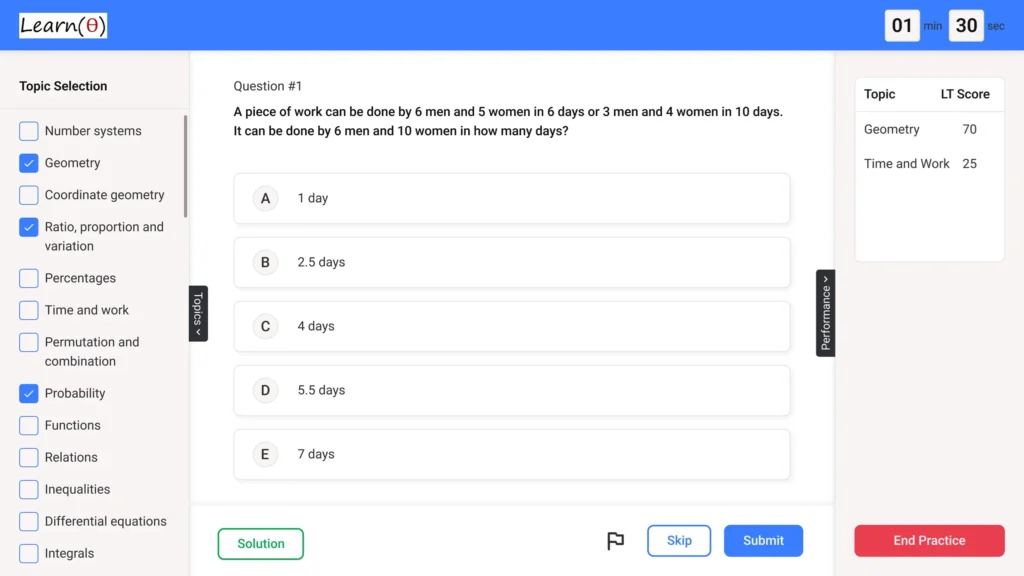
🤖 Adaptive Question Practice

📊 Progress and Insights