
SSC CGL 2025-26 Tier 2 Question Paper – Practice Free!
Q. 1 The height of a pyramid is 8 m, and the base of the pyramid is a square whose diagonal is \(\sqrt{512}\) m. Find the approximate volume of the pyramid.
Check Solution
Ans: A
Explanation:The volume of a pyramid is given by the formula \(V = \frac{1}{3} \times \text{base area} \times \text{height}\).
The base of the pyramid is a square. Let the side length of the square be \(s\). The diagonal of the square is given by \(d = s\sqrt{2}\).
We are given that the diagonal \(d = \sqrt{512}\) m.
So, \(s\sqrt{2} = \sqrt{512}\).
Squaring both sides, we get \((s\sqrt{2})^2 = (\sqrt{512})^2\), which simplifies to \(2s^2 = 512\).
Dividing by 2, we find \(s^2 = 256\).
The area of the square base is \(s^2 = 256 \text{ m}^2\).
The height of the pyramid is given as \(h = 8\) m.
Now, we can calculate the volume of the pyramid:
\(V = \frac{1}{3} \times \text{base area} \times \text{height} = \frac{1}{3} \times 256 \text{ m}^2 \times 8 \text{ m}\).
\(V = \frac{2048}{3} \text{ m}^3\).
\(V \approx 682.67 \text{ m}^3\).
Looking at the options, 683 m\(^3\) is the closest approximation.
Correct_Option:A
Q. 2 A set of n values X_1, X_2, …, X_n has a standard deviation of 5. The standard deviation of n values X_1 – 7, X_2 – 7, …, X_n – 7 will be:
Check Solution
Ans: B
Explanation:The standard deviation measures the dispersion or spread of a set of data points around their mean. When a constant value is subtracted from each data point in a set, the mean of the set also shifts by that same constant value. However, the differences between the data points and the mean remain unchanged. Since the standard deviation is calculated based on these differences, it is unaffected by the subtraction of a constant.
Correct_Option:B
Q. 3 Simplify: (tan^2 θ – sin^2 θ) / (2 + tan^2 θ + cot^2 θ)
Check Solution
Ans: C
Explanation:We simplify the numerator and denominator separately.
Numerator:
tan^2 θ – sin^2 θ = (sin^2 θ / cos^2 θ) – sin^2 θ
= sin^2 θ (1 / cos^2 θ – 1)
= sin^2 θ (sec^2 θ – 1)
= sin^2 θ tan^2 θ
Denominator:
2 + tan^2 θ + cot^2 θ
We know that tan^2 θ + 1 = sec^2 θ and cot^2 θ + 1 = csc^2 θ.
So, 2 + tan^2 θ + cot^2 θ = 1 + tan^2 θ + 1 + cot^2 θ
= sec^2 θ + csc^2 θ
= 1 / cos^2 θ + 1 / sin^2 θ
= (sin^2 θ + cos^2 θ) / (sin^2 θ cos^2 θ)
= 1 / (sin^2 θ cos^2 θ)
Now, divide the numerator by the denominator:
(sin^2 θ tan^2 θ) / (1 / (sin^2 θ cos^2 θ))
= sin^2 θ tan^2 θ * sin^2 θ cos^2 θ
= sin^2 θ * (sin^2 θ / cos^2 θ) * sin^2 θ cos^2 θ
= sin^2 θ * sin^2 θ * sin^2 θ
= sin^6 θ
Correct_Option:C
Q. 4 A rectangle is such that its area is 48 cm^2 and its perimeter is 28 cm. If a rhombus is formed by joining the midpoints of the sides of this rectangle, what is the area of the rhombus?
Check Solution
Ans: C
Explanation:Let the length and width of the rectangle be \(l\) and \(w\) respectively.
Given area of rectangle = \(l \times w = 48 \, \text{cm}^2\).
Given perimeter of rectangle = \(2(l+w) = 28 \, \text{cm}\), which implies \(l+w = 14 \, \text{cm}\).
When the midpoints of the sides of a rectangle are joined, a rhombus is formed. The diagonals of this rhombus are equal to the length and width of the rectangle.
Let the diagonals of the rhombus be \(d_1\) and \(d_2\). So, \(d_1 = l\) and \(d_2 = w\).
The area of a rhombus is given by \(\frac{1}{2} \times d_1 \times d_2\).
Area of rhombus = \(\frac{1}{2} \times l \times w\).
Since \(l \times w = 48 \, \text{cm}^2\), the area of the rhombus is \(\frac{1}{2} \times 48 \, \text{cm}^2 = 24 \, \text{cm}^2\).
The perimeter information is not needed to solve for the area of the rhombus.
Correct_Option:C
Q. 5 If the marks scored by the students in a class test out of 50 then, Find the Median of the following data:
| Marks | Frequency |
| 0-10 | 5 |
| 10-20 | 8 |
| 20-30 | 6 |
| 30-40 | 6 |
| 40-50 | 5 |
Check Solution
Ans: B
Quick Method
The total count of observations (N) is 30, so N/2 equals 15.
The cumulative frequency surpasses 15 within the 20-30 range (5 + 8 = 13, followed by 13 + 6 = 19).
Applying the formula directly: Median = Lower Boundary + [ (N/2 − Cumulative Frequency of Previous Class) ÷ Frequency of Median Class ] × Interval Width
Median = 20 + [ (15 − 13) ÷ 6 ] × 10
Median = 20 + 3.33 = 23.33
Thus, the result is 23.3 marks.
Step-by-Step Approach
Given:
Total frequency (N) = 5 + 8 + 6 + 6 + 5 = 30
Value of N/2 = 30 ÷ 2 = 15
Determining Cumulative Frequencies (cf):
⇒ 0-10: 5
⇒ 10-20: 5 + 8 = 13
⇒ 20-30: 13 + 6 = 19 (This is the median class as cf ≥ 15)
⇒ 30-40: 19 + 6 = 25
⇒ 40-50: 25 + 5 = 30
Formula Employed:
Median = L + [ (N/2 − cf) ÷ f ] × h
Where L = Lower boundary of the median class = 20
cf = Cumulative frequency of the class before the median class = 13
f = Frequency of the median class = 6
h = Width of the class interval = 10
Calculation:
⇒ Median = 20 + [ (15 − 13) ÷ 6 ] × 10
⇒ Median = 20 + (2 ÷ 6) × 10
⇒ Median = 20 + 10 ÷ 3
⇒ Median = 20 + 3.33
⇒ Median = 23.33
Supplemental Information
Mode for Grouped Data
Mode = L + [ (f 1 − f 0 ) ÷ (2 × f 1 − f 0 − f 2 ) ] × h, where f 1 is the frequency of the modal class, f 0 is the frequency of the class preceding the modal class, and f 2 is the frequency of the class succeeding the modal class.
Mean for Grouped Data
Mean = (Σf i x i ) ÷ Σf i , where x i represents the midpoints of the respective class intervals.
Empirical Relationship
In distributions that are moderately skewed, the relationship between measures of central tendency is: Mode = 3 × Median − 2 × Mean.
Q. 6 The given table shows the number of people in different age groups. Find the mean age of the given number of people.
| Class interval of age (in years) | Number of people (f) |
|---|---|
| 25 – 29 | 10 |
| 30 – 34 | 12 |
| 35 – 39 | 8 |
| 40 – 44 | 5 |
| 45 – 49 | 15 |
| 50 – 54 | 10 |
| 55 – 59 | 15 |
Check Solution
Ans: D
Efficient Calculation Method
1. Select a Trial Mean (A): Choose 42 as the assumed mean, representing the middle class mark.
2. Calculate Deviations (dᵢ): Determine the difference between each class mark and the assumed mean (A). These are: -15, -10, -5, 0, +5, +10, +15.
3. Sum of Weighted Deviations (Σfᵢdᵢ): Multiply each deviation by its corresponding frequency and sum these products: (-15 × 10) + (-10 × 12) + (-5 × 8) + (0 × 5) + (5 × 15) + (10 × 10) + (15 × 15) = -150 – 120 – 40 + 0 + 75 + 100 + 225 = +90.
4. Total Frequency (Σfᵢ): Add up all the frequencies: 10 + 12 + 8 + 5 + 15 + 10 + 15 = 75.
5. Calculate the Mean: Apply the formula: Mean = A + (Σfᵢdᵢ ÷ Σfᵢ) = 42 + (90 ÷ 75) = 42 + 1.2 = 43.2.
Therefore, the accurate answer is 43.2 years.
Standard Approach
Given Information:
The data includes frequencies associated with specific age ranges.
Formula Utilized:
Mean = Sum of (frequency × class mark) ÷ Total frequency
Where,
Class Mark (xᵢ) = (Lower Limit of Interval + Upper Limit of Interval) ÷ 2
Step-by-Step Calculation:
* Class Marks (xᵢ): The midpoints of the age intervals are calculated: 27, 32, 37, 42, 47, 52, 57.
* Frequencies (fᵢ): The given frequencies for each interval are: 10, 12, 8, 5, 15, 10, 15.
* Products (fᵢ × xᵢ): Each class mark is multiplied by its corresponding frequency: 270, 384, 296, 210, 705, 520, 855.
* Total Frequency (Σfᵢ): The sum of all frequencies is 10 + 12 + 8 + 5 + 15 + 10 + 15 = 75.
* Sum of Products (Σfᵢxᵢ): The sum of all the calculated products is 270 + 384 + 296 + 210 + 705 + 520 + 855 = 3240.
* Calculate the Mean: Mean = 3240 ÷ 75 = 43.2.
Supplementary Details
Class Mark Definition:
The midpoint of any class interval serves as its representative value. It is calculated as: Class Mark = (Lower Limit + Upper Limit) ÷ 2.
Direct Method for Calculating the Mean:
The formula used is Mean = Σ(fᵢxᵢ) ÷ Σfᵢ, where xᵢ represents the class marks and fᵢ denotes the corresponding frequencies.
Assumed Mean Method for Calculating the Mean:
The formula employed here is Mean = A + (Σfᵢdᵢ ÷ Σfᵢ), with A being the assumed mean and dᵢ calculated as the difference between a class mark and the assumed mean (dᵢ = xᵢ − A).
Q. 7 In a triangle \( \Delta PQR, \angle R = 62^\circ \). The perpendicular bisector of PQ at S meets QR at T. If \( \angle TPR = 38^\circ \), what is the measure of \( \angle PQR \)?
Check Solution
Ans: C
Efficient Approach
Since point T is on the perpendicular bisector of line segment PQ, the distances from T to P and T to Q are equal, i.e., TP = TQ. This makes triangle TPQ an isosceles triangle, which implies that the angles opposite the equal sides are also equal: ∠TQP = ∠TPQ.
The angle ∠PQR is identical to ∠TQP. Consequently, the entire angle at P in triangle PQR can be expressed as the sum of ∠PQR and ∠TPR, which is ∠PQR + 38°.
Applying the angle sum property to the main triangle PQR, where the sum of all interior angles is 180°:
∠P + ∠Q + ∠R = 180°
(∠PQR + 38°) + ∠PQR + 62° = 180°
2 × ∠PQR + 100° = 180°
2 × ∠PQR = 180° – 100°
2 × ∠PQR = 80°
Therefore, ∠PQR = 40°.
The correct answer is 40°.
Alternative Method
Given:
Angle R = 62°
Angle TPR = 38°
ST is the perpendicular bisector of side PQ, with S on PQ and T on QR.
Key Principles Used:
1. A point on the perpendicular bisector of a segment is equidistant from the segment’s endpoints.
2. In an isosceles triangle, angles opposite equal sides are equal.
3. The sum of the interior angles of a triangle is 180°.
Step-by-step Calculation:
1. As T lies on the perpendicular bisector of PQ, TP = TQ.
2. Triangle TPQ is therefore isosceles, and ∠TQP = ∠TPQ.
3. Let ∠PQR be represented by x. Since Q, T, and R are collinear, ∠TQP is the same as ∠PQR, meaning ∠TQP = x.
4. Consequently, ∠TPQ = x.
5. The total angle at vertex P in the larger triangle PQR is the sum of ∠TPQ and ∠TPR, which is x + 38°.
6. Using the angle sum property for triangle PQR:
∠P + ∠Q + ∠R = 180°
(x + 38°) + x + 62° = 180°
2x + 100° = 180°
2x = 180° – 100°
2x = 80°
x = 40°
Supplementary Insights
* Perpendicular Bisector Theorem: A point resides on the perpendicular bisector of a line segment if and only if it is equidistant from both ends of the segment. This principle directly establishes isosceles triangles within larger geometric figures.
* Properties of Isosceles Triangles: In any triangle with two equal sides, the angles opposite these sides are also equal. The altitude drawn to the unequal side also functions as an angle bisector, a median, and a perpendicular bisector.
* Angle Sum Property: Regardless of its shape or dimensions, the total measure of the three interior angles of any triangle is always 180°.
Q. 8 A, B, and C invest in a business in the ratio 2:3:5. After 4 months, A increases his capital by 50%, B decreases his capital by \( \frac{1}{3} \), and C leaves the capital unchanged. At the end of the year, if the total profit is Rs. 33,000, find the share of B.
Check Solution
Ans: D
### Quick Method
A’s investment segments: (Initial investment × duration) + (New investment × duration)
A’s investment segments = (2 × 4 months) + (3 × 8 months) = 8 + 24 = 32
B’s investment segments: (Initial investment × duration) + (New investment × duration)
B’s investment segments = (3 × 4 months) + (2 × 8 months) = 12 + 16 = 28
C’s investment segments: (Consistent investment × total duration)
C’s investment segments = 5 × 12 months = 60
Profit Ratio (A : B : C) = 32 : 28 : 60
Simplify the ratio by dividing by the greatest common divisor:
Profit Ratio (A : B : C) = 8 : 7 : 15
Total profit units: Sum of the ratio parts = 8 + 7 + 15 = 30 units
Total profit value: Rs. 33,000
Value of 1 unit: Rs. 33,000 / 30 = Rs. 1,100
B’s share of the profit: (B’s ratio part × value of 1 unit)
B’s share = 7 × Rs. 1,100 = Rs. 7,700
Therefore, the correct answer is Rs. 7,700.
### Alternative Approach
Given Information:
Initial investment proportions = 2 : 3 : 5
Total profit earned over the year = Rs. 33,000
Formula Employed:
Profit Ratio = Ratio of Effective Capitals
Effective Capital = Sum of (Capital Invested × Duration of Investment in months)
Calculations:
Let the initial capitals of A, B, and C be represented by 2x, 3x, and 5x, respectively.
After the first 4 months:
A’s capital adjusts: 2x + (50% of 2x) = 2x + x = 3x
B’s capital adjusts: 3x – (1/3 of 3x) = 3x – x = 2x
C’s capital remains at 5x for the entire year.
Calculating the effective capital for the full 12 months:
A’s effective capital = (Initial capital × first 4 months) + (Adjusted capital × remaining 8 months)
A’s effective capital = (2x × 4) + (3x × 8) = 8x + 24x = 32x
B’s effective capital = (Initial capital × first 4 months) + (Adjusted capital × remaining 8 months)
B’s effective capital = (3x × 4) + (2x × 8) = 12x + 16x = 28x
C’s effective capital = (Consistent capital × total 12 months)
C’s effective capital = 5x × 12 = 60x
Profit Ratio (A : B : C) = 32x : 28x : 60x
Dividing by x, the ratio becomes: 8 : 7 : 15
Total parts of the ratio: 8 + 7 + 15 = 30 parts
B’s share of the profit: (B’s ratio part / Total ratio parts) × Total profit
B’s share = (7 / 30) × Rs. 33,000 = 7 × Rs. 1,100 = Rs. 7,700
### Supplementary Insights
Types of Partnerships:
* Simple Partnership: Investments are made for the same duration. The profit distribution directly mirrors the investment ratio.
* Compound Partnership: Investment durations vary. The profit ratio is calculated by considering both the capital and the time it was invested (e.g., C₁T₁ : C₂T₂).
Partner Roles:
* Active Partner: Actively involved in business operations. They may receive a fixed salary or a portion of the profit before the remainder is distributed based on investment.
* Sleeping Partner: Primarily an investor, not involved in daily management.
Modifications to Capital Mid-Term:
When a partner changes their investment amount during the partnership term (by adding or withdrawing), their total contribution is calculated by summing the product of each distinct capital amount and the precise duration it was held.
Q. 9 What is the value of 3/2 (cos 39°/sin 51°) – sqrt(sin^2 39° + sin^2 51°) ?
Check Solution
Ans: D
Swift Approach
Recognize that 39° and 51° are complementary angles, as their sum is 90°.
Employ the direct trigonometric properties: cos θ / sin(90° − θ) = 1 and sin 2 θ + sin 2 (90° − θ) = 1.
Substitute these directly into the given expression: 3/2 × (1) − √1
This simplifies to: 3/2 − 1 = 1/2
Therefore, the answer is 1/2.
Alternative Method
Given Expression: 3/2 × (cos 39° / sin 51°) − √(sin 2 39° + sin 2 51°)
Relevant Formulas:
sin(90° − θ) = cos θ
sin 2 θ + cos 2 θ = 1
Steps:
Express 51° as (90° − 39°).
This means sin 51° = sin(90° − 39°) = cos 39°.
Consequently, sin 2 51° = sin 2 (90° − 39°) = cos 2 39°.
Substitute these equivalent forms back into the original expression:
3/2 × (cos 39° / cos 39°) − √(sin 2 39° + cos 2 39°)
Simplify to: 3/2 × (1) − √(1)
This leads to: 3/2 − 1
Further calculation yields: (3 − 2) / 2 = 1/2
Further Insights
Trigonometric Identities
The foundational Pythagorean identities include: sin 2 θ + cos 2 θ = 1, 1 + tan 2 θ = sec 2 θ, and 1 + cot 2 θ = cosec 2 θ.
Complementary Angles
Angles that sum to 90° are complementary. Key relationships include: sin(90° − θ) = cos θ, tan(90° − θ) = cot θ, and sec(90° − θ) = cosec θ.
Supplementary Angles
Angles that sum to 180° are supplementary. Key relationships include: sin(180° − θ) = sin θ, and cos(180° − θ) = −cos θ.
Q. 10 The base of a right pyramid is an equilateral triangle with side 10 cm, and its vertical height is 24 cm. Find the volume (in cm^3) of the pyramid.
Check Solution
Ans: A
Efficient Method
The volume of any pyramid can be calculated using the formula:
Volume = (1/3) × Area of the Base × Height
For a pyramid with an equilateral triangle as its base, the area is found using:
Base Area (Equilateral Triangle) = (√3 / 4) × (side)²
Given the side length of the base is 10 cm, the base area is:
Base Area = (√3 / 4) × (10)² = (√3 / 4) × 100 = 25√3 cm²
Now, substituting the base area and the given height of 24 cm into the volume formula:
Volume = (1/3) × 25√3 × 24 = 25√3 × 8 = 200√3 cm³
Therefore, the correct volume is 200√3 cm³.
Alternative Approach
Provided Information:
* Side length of the equilateral triangular base (a) = 10 cm
* Vertical height of the pyramid (h) = 24 cm
Formulas Utilized:
* Volume of a Pyramid = (1/3) × Base Area × Height
* Area of an Equilateral Triangle = (√3 / 4) × a²
Step-by-step Calculations:
1. Calculate the area of the base:
Area of the base = (√3 / 4) × (10)²
Area of the base = (√3 / 4) × 100
Area of the base = 25√3 cm²
2. Calculate the volume of the pyramid:
Volume of the pyramid = (1/3) × 25√3 × 24
Volume of the pyramid = 25√3 × 8
Volume of the pyramid = 200√3 cm³
Supplemental Details
Lateral Surface Area of a Pyramid:
This is the combined area of all the triangular sides. It’s calculated as:
LSA = (1/2) × Perimeter of the Base × Slant Height.
Total Surface Area of a Pyramid:
This represents the entire surface area of the pyramid. It’s calculated as:
TSA = Lateral Surface Area + Base Area.
Volume of a Cone:
A cone’s volume follows a similar principle to a pyramid, being exactly one-third the volume of a cylinder with the same base radius and height. The formula is:
V = (1/3) × πr²h.
Q. 11 At what rate of interest per annum will a sum of ₹15,625 amount to ₹19,683 in 1 year 6 months, if the interest is compounded half-yearly?
Check Solution
Ans: C
Efficient Approach
The given duration of 1.5 years equates to 3 compounding periods of six months.
The ratio of the final amount to the initial principal is 19683 / 15625, which simplifies to (27 / 25) cubed.
This indicates that the growth factor for each six-month period is 27 / 25.
The interest rate for a six-month period is calculated as ((27 – 25) / 25) * 100, resulting in 8%.
Consequently, the annual interest rate is 8% multiplied by 2, which is 16%.
Therefore, the correct annual rate is 16%.
Alternative Method
Given:
Principal (P) = ₹15,625
Amount (A) = ₹19,683
Time (T) = 1 year and 6 months = 1.5 years
Formula Used:
For half-yearly compounding: A = P(1 + R/200)^(2T), where R represents the annual interest rate.
Calculations:
The number of half-yearly periods (n) is 1.5 * 2 = 3.
Substituting the values into the formula:
19683 = 15625 * (1 + R/200)^3
Rearranging the equation:
19683 / 15625 = (1 + R/200)^3
Recognizing the perfect cubes:
(27 / 25)^3 = (1 + R/200)^3
Taking the cube root of both sides:
27 / 25 = 1 + R/200
Isolating R/200:
R/200 = (27 / 25) – 1
R/200 = 2 / 25
Solving for R:
R = (2 * 200) / 25
R = 400 / 25
R = 16
Additional Information
Compound Interest Formula:
A = P(1 + R/100)^n, where A is the final amount, P is the principal, R is the interest rate per period, and n is the number of periods.
Half-Yearly Compounding:
When interest is compounded semi-annually, the stated annual interest rate is divided by two (R/2), and the time period in years is doubled (2T) to determine the number of compounding periods.
Effective Annual Rate (EAR):
This represents the actual annual return on an investment when interest is compounded multiple times a year. The formula is EAR = (1 + R/n)^n – 1. For an annual rate of 16% compounded semi-annually, the EAR is (1.08)^2 – 1 = 16.64%.
Q. 12 A hemispherical tank is full of water. It is connected to a pipe that empties it at a rate of 7 litres per second. How much approximate time (in minutes) will it take to empty half the tank if the internal radius of the tank is 2.1 meters? (Use pi = 22/7 and 1 m^3=1000 liters)
Check Solution
Ans: A
Quick Method
Volume to be drained = Half of the tank’s volume
Volume to be drained = ½ × (⅔ × π × r³) = ⅓ × π × r³
Calculated Volume = ⅓ × (22/7) × (2.1)³ = 9.702 m³ = 9702 Litres
Time needed = Total Volume / Emptying Rate = 9702 Litres / 7 Litres/second = 1386 seconds
Time in minutes = 1386 seconds / 60 seconds/minute = 23.1 minutes ≈ 23 minutes
Thus, the answer is approximately 23 minutes.
Step-by-Step Method
Given:
Inner radius of the tank (r) = 2.1 meters
Rate at which water is emptied = 7 Litres per second
Conversion factor: 1 cubic meter = 1000 Litres
Formula Used:
Volume of a hemisphere = ⅔ × π × r³
Time = Volume / Rate
Calculation:
Total volume of the tank = ⅔ × (22/7) × (2.1 m) × (2.1 m) × (2.1 m)
Total volume = ⅔ × (22/7) × 9.261 m³ = 19.404 m³
Volume of water to be emptied (half the tank’s volume) = 19.404 m³ / 2 = 9.702 m³
Convert volume to Litres: 9.702 m³ × 1000 Litres/m³ = 9702 Litres
Time required in seconds = Total Volume / Emptying Rate = 9702 Litres / 7 Litres/second = 1386 seconds
Convert time to minutes: 1386 seconds / 60 seconds/minute = 23.1 minutes
Therefore, the approximate time to empty half the tank is 23 minutes.
Additional Information
Formula for the volume of a full sphere: V = &frac43; × π × r³
Surface Area of a Hemisphere:
Curved Surface Area (CSA) = 2 × π × r²
Total Surface Area (TSA) (including the base) = 3 × π × r²
Capacity Conversion Units:
Remember these common conversions: 1 m³ = 1000 Litres, and 1 Litre = 1000 cm³. These are crucial for problems involving liquid volumes.
Q. 13 A number is chosen at random from the set {1, 2, 3,…..120}. What is the probability that the number chosen is divisible by 6 or 8 but not divisible by 24?
Check Solution
Ans: B
Efficient Approach
Total items = 120.
Items divisible by 6 = 20.
Items divisible by 8 = 15.
Items divisible by both 6 and 8 (i.e., by their LCM, 24) = 5.
The desired count is for items divisible by 6 exclusively or by 8 exclusively. This can be found by summing the items divisible by 6 and the items divisible by 8, then subtracting twice the count of items divisible by both.
Number of desired items = (Items divisible by 6 – Items divisible by both) + (Items divisible by 8 – Items divisible by both)
Number of desired items = (20 − 5) + (15 − 5) = 10 + 10 = 25.
Alternatively, using the formula for symmetric difference:
Number of desired items = (Count of multiples of 6) + (Count of multiples of 8) – 2 * (Count of multiples of both)
Number of desired items = 20 + 15 – 2 * 5 = 35 – 10 = 25.
The required probability is the ratio of the desired count to the total items.
Required Probability = 25/120.
Therefore, the answer is 25/120.
Alternative Method
Given:
Total number of possible outcomes, n(S) = 120
Formula Utilized:
For the symmetric difference of two sets A and B (elements in A or B, but not both), the number of elements is given by: n(A Δ B) = n(A) + n(B) − 2 × n(A ∩ B).
Probability of an event E is calculated as: P(E) = (Number of Favorable Outcomes) / (Total Number of Outcomes).
Step-by-step Calculation:
Let A represent the set of numbers divisible by 6.
The count of numbers divisible by 6 is: n(A) = 120 ÷ 6 = 20.
Let B represent the set of numbers divisible by 8.
The count of numbers divisible by 8 is: n(B) = 120 ÷ 8 = 15.
Let A ∩ B represent the set of numbers divisible by both 6 and 8, which means they are divisible by their least common multiple (LCM), 24.
The count of numbers divisible by 24 is: n(A ∩ B) = 120 ÷ 24 = 5.
The favorable outcomes are those numbers that are divisible by 6 or by 8, but not by both.
Number of favorable outcomes = n(A) + n(B) − 2 × n(A ∩ B)
Number of favorable outcomes = 20 + 15 − 2 × 5
Number of favorable outcomes = 35 − 10 = 25.
The probability of the event is the ratio of favorable outcomes to the total outcomes.
Probability = 25/120.
Supplementary Information
Probability of an Event
The probability of an event occurring, denoted as P(E), is the fraction of outcomes that are favorable to that event out of all possible outcomes: P(E) = n(E) / n(S).
Union of Two Sets
The total count of distinct elements present in either set A or set B (or both) is calculated using the principle of inclusion-exclusion: n(A ∪ B) = n(A) + n(B) − n(A ∩ B).
Symmetric Difference of Sets
The symmetric difference, denoted as A Δ B, comprises elements that are in set A or set B, but not in their intersection. The count of elements in the symmetric difference is given by: n(A Δ B) = n(A) + n(B) − 2 × n(A ∩ B).
Q. 14 If the mode of the data set {a, a + 2, a + 4, a + 6, a + 6, a + 6, a + 8} is 26, find a.
Check Solution
Ans: B
Shortcut Method
The mode represents the number that occurs most often in a collection of data.
Looking at the provided data, we see that the expression (a + 6) shows up 3 times, which is more than any other value.
Therefore, the Mode is a + 6.
Since the mode is given as 26, we can set up the equation: a + 6 = 26
Solving for a, we get: a = 20
Thus, the correct solution is a = 20.
Alternative Approach
Provided Information:
Data set: {a, a + 2, a + 4, a + 6, a + 6, a + 6, a + 8}
Mode: 26
Underlying Principle:
The mode is defined as the data value that appears with the highest occurrence within a dataset.
Step-by-Step Calculation:
* The term ‘a’ appears 1 time.
* The term ‘a + 2’ appears 1 time.
* The term ‘a + 4’ appears 1 time.
* The term ‘a + 6’ appears 3 times.
* The term ‘a + 8’ appears 1 time.
* Since ‘a + 6’ is the most frequent term (occurring 3 times), it is the mode of this dataset.
* So, Mode = a + 6.
* We are told that the mode is 26.
* Therefore, a + 6 = 26.
* Subtracting 6 from both sides, we find a = 26 − 6 = 20.
Additional Concepts
Mean:
The mean is the average value, calculated by summing all the data points and dividing by the total count of data points.
Median:
The median is the central value when the data is arranged in ascending or descending order. If there’s an even number of data points, it’s the average of the two middle values.
Empirical Relation:
For distributions that are not heavily skewed, the relationship between mean, median, and mode is: Mode = 3 × Median − 2 × Mean.
Bimodal Data:
A dataset can have multiple modes. If two distinct values share the highest frequency, the dataset is called bimodal.
Q. 15 P and Q can do a piece of work in 20 days and 30 days, respectively. They work together for 6 days, and then Q is replaced by R. If the rest of the work is completed by P and R in 8 more days, in how many days can R alone complete 60% of the work?
Check Solution
Ans: B
Quick Calculation Method
First, determine the total amount of work by finding the least common multiple (LCM) of the individual times taken by P and Q, which is 60 units.
Calculate P’s work rate: 60 units / 20 days = 3 units per day.
Calculate Q’s work rate: 60 units / 30 days = 2 units per day.
When P and Q work together, their combined work rate is 3 + 2 = 5 units per day.
In 6 days, P and Q complete 6 days * 5 units/day = 30 units of work.
The remaining work is 60 units – 30 units = 30 units.
This remaining 30 units of work are completed by P and R in 8 days.
So, the combined work rate of P and R is 30 units / 8 days = 3.75 units per day.
Since P’s work rate is 3 units per day, R’s work rate is 3.75 units/day – 3 units/day = 0.75 units per day.
The task is to find how long it takes R to complete 60% of the total work.
60% of 60 units is (60/100) * 60 = 36 units.
The time R needs to complete 36 units of work is 36 units / 0.75 units/day = 48 days.
Therefore, the answer is 48 days.
Alternative Approach
Given:
P takes 20 days to finish the work.
Q takes 30 days to finish the work.
P and Q collaborate for 6 days.
P and R then complete the remaining work in 8 days.
Step-by-step calculation:
The daily output of P and Q working together is (1/20 + 1/30) = (3/60 + 2/60) = 5/60 = 1/12 of the work per day.
In 6 days, P and Q complete 6 * (1/12) = 6/12 = 1/2 of the work.
The remaining work is 1 – 1/2 = 1/2 of the total work.
This remaining half of the work is finished by P and R in 8 days.
So, P and R together complete 1/2 of the work in 8 days. Their combined daily output is (1/2) / 8 = 1/16 of the work per day.
We know P’s daily output is 1/20 of the work.
Therefore, R’s daily output is the combined output of P and R minus P’s output: (1/16) – (1/20) = (5/80) – (4/80) = 1/80 of the work per day.
Now, we need to calculate the time R takes to complete 60% of the work.
60% of the work is 60/100 = 3/5 of the total work.
The time for R to do 3/5 of the work is (3/5) / (1/80) = (3/5) * 80 = 240/5 = 48 days.
Supplemental Information
Pipes and Cisterns: This topic operates on the same principles as Time and Work. Filling pipes contribute positively to efficiency, while emptying pipes or leaks reduce it.
Work and Wages: Compensation is distributed according to the amount of work performed. If individuals work for the same duration, their earnings are directly proportional to their efficiency.
Alternating Day Work: When individuals work on alternate days, calculate the total work done over a two-day cycle. Then, multiply this by the largest whole number of cycles possible before the completion deadline, and finally, assign the remaining work sequentially.
Q. 16 The base of a right prism is an isosceles trapezium with parallel sides measuring 10 cm and 20 cm, and non-parallel sides measuring 13 cm each. The volume of the prism is 3240 cm3. What is the total surface area of the prism?
Check Solution
Ans: D
Efficient Approach
1. Determine Trapezium Height:
The height of the trapezium is found using the Pythagorean theorem:
Height = √(13² – 5²) = 12 cm
2. Calculate Base Area:
The area of the trapezium base is:
Area = 1/2 × (10 + 20) × 12 = 180 cm²
3. Find Prism Height:
The height of the prism is the total volume divided by the base area:
Prism Height = 3240 ÷ 180 = 18 cm
4. Compute Total Surface Area (TSA):
The TSA is calculated as:
TSA = (2 × Base Area) + (Perimeter × Prism Height)
TSA = (2 × 180) + (10 + 20 + 13 + 13) × 18
TSA = 360 + 1008 = 1368 cm²
Therefore, the correct answer is 1368 cm².
Step-by-Step Solution
Given Information:
* Parallel sides of the isosceles trapezium base: a = 10 cm, b = 20 cm
* Length of non-parallel sides: c = 13 cm
* Volume of the right prism: V = 3240 cm³
Formulas Used:
* Area of a trapezium = 1/2 × (Sum of parallel sides) × Height
* Volume of a prism = Area of the base × Height of the prism
* Total Surface Area (TSA) of a prism = 2 × (Area of the base) + (Perimeter of the base) × Height of the prism
Calculations:
1. Find the base of the right-angled triangle:
When a perpendicular is dropped from the vertices of the shorter parallel side to the longer parallel side, it forms a right-angled triangle. The base of this triangle is half the difference between the parallel sides:
Base of triangle = (20 − 10) ÷ 2 = 5 cm
2. Calculate the height of the trapezium (h_t):
Using the Pythagorean theorem, with the non-parallel side as the hypotenuse and the base of the triangle and trapezium height as the other two sides:
h_t = √(13² – 5²) = √(169 – 25) = √144 = 12 cm
3. Calculate the Area of the trapezium base:
Area = 1/2 × (10 + 20) × 12 = 1/2 × 30 × 12 = 180 cm²
4. Calculate the Perimeter of the trapezium base:
Perimeter = 10 + 20 + 13 + 13 = 56 cm
5. Determine the Height of the prism:
Using the volume formula:
3240 cm³ = 180 cm² × Height of prism
Height of prism = 3240 ÷ 180 = 18 cm
6. Calculate the Lateral Surface Area (LSA):
LSA = Perimeter of base × Height of prism
LSA = 56 cm × 18 cm = 1008 cm²
7. Calculate the Total Surface Area (TSA):
TSA = (2 × Area of base) + LSA
TSA = (2 × 180 cm²) + 1008 cm²
TSA = 360 cm² + 1008 cm² = 1368 cm²
Additional Information
Properties of a Right Prism:
A right prism is a three-dimensional shape characterized by two identical and parallel polygon bases. Its lateral faces are rectangles and are perpendicular to these bases.
Formula for Prism Volume:
The volume of any prism is consistently calculated as the product of its base area and its height (V = Base Area × Height). This principle applies regardless of the shape of the base.
Characteristics of an Isosceles Trapezium:
An isosceles trapezium is a four-sided figure with one pair of parallel sides. Its non-parallel sides are equal in length, resulting in equal base angles and equal diagonals.
Understanding Total Surface Area (TSA):
The TSA of any prism is the sum of its Lateral Surface Area (LSA) and twice the area of its base. The LSA is determined by multiplying the perimeter of the base by the prism’s height.
Q. 17 In an equilateral triangle, the circumcenter coincides with which of the following?
Check Solution
Ans: B
Streamlined Approach
Due to the inherent perfect symmetry of an equilateral triangle, its medians, altitudes, angle bisectors, and perpendicular bisectors are all identical.
This means that the key triangle centers—the Centroid, Circumcenter, Incenter, and Orthocenter—all converge at a single location.
Consequently, the circumcenter is precisely the same point as the centroid.
Therefore, the centroid of the triangle is the correct answer.
Alternative Strategy
Premise:
An equilateral triangle possesses equal sides and 60° angles.
Key Principles:
* The circumcenter is defined as the meeting point of the perpendicular bisectors of the triangle’s sides.
* The centroid is defined as the meeting point of the triangle’s medians.
Derivation:
* A median is a line segment from a vertex to the midpoint of the opposite side.
* A perpendicular bisector is a line that crosses the midpoint of a side at a 90° angle.
* In an equilateral triangle, the line drawn from a vertex to the midpoint of the opposite side naturally forms a 90° angle with that side due to its symmetry.
* This establishes that the medians and perpendicular bisectors are, in fact, the same lines.
* As a result, the centroid (where medians intersect) and the circumcenter (where perpendicular bisectors intersect) are, by definition, the same point.
Further Insights
Centroid:
This is the intersection of all three medians. It consistently divides each median in a 2:1 ratio from the vertex and represents the triangle’s center of mass.
Circumcenter:
This is the intersection of the perpendicular bisectors. It is equidistant from all three vertices and is the center of the circle that passes through all vertices.
Orthocenter & Incenter:
The orthocenter is where altitudes meet, and the incenter is where angle bisectors meet. In an equilateral triangle, both of these points perfectly align with the centroid and circumcenter.
Euler Line:
In any non-equilateral triangle, the orthocenter, centroid, and circumcenter lie on a straight line known as the Euler line. For an equilateral triangle, this line collapses into a single point.
Q. 18 A sphere of radius 21 cm is cut into 8 identical pieces by making three mutually perpendicular cuts through its center (one along each axis). Find the total surface area of each piece in cm2.
Check Solution
Ans: B
Efficient Calculation Method
When a sphere with radius ‘r’ is divided into eight equal portions by three planes intersecting at its center at right angles, each portion is known as a spherical octant.
The total surface area of one such piece is composed of its curved surface and three flat quadrant areas.
Total Surface Area = (Curved Surface Area of 1/8th Sphere) + (Area of 3 Flat Quadrants)
Total Surface Area = (1/8 * 4πr²) + 3 * (1/4 * πr²)
Total Surface Area = (1/2 * πr²) + (3/4 * πr²)
Total Surface Area = (2/4 * πr²) + (3/4 * πr²)
Total Surface Area = 5/4 * πr²
Given the radius ‘r’ is 21 cm, the area is calculated as follows:
Area = 5/4 * π * (21)²
Area = 5/4 * π * 441
Area = (5 * 441π) / 4
Area = 2205π / 4
Area = 551.25π cm²
Therefore, the correct answer is 551.25π cm².
Alternative Calculation Approach
Provided:
Sphere’s radius, r = 21 cm.
The sphere is sectioned into 8 identical pieces (octants) by three planes perpendicular to each other.
Formulas Utilized:
Surface area of a sphere = 4πr²
Area of a circle = πr²
Step-by-step Calculation:
The sphere is divided into 8 equal spherical octants.
The Total Surface Area (TSA) of each piece = Curved Surface Area + Flat Surface Area.
Curved surface area of one octant = (Total curved surface area of sphere) / 8 = 4πr² / 8 = πr²/2.
The three mutually perpendicular cuts create 3 flat surfaces for each octant.
Each flat surface is equivalent to a quarter (1/4th) of a circle’s area, which is πr²/4.
Total area of the flat surfaces = 3 * (πr²/4) = 3πr²/4.
TSA of one octant = (Curved surface area) + (Total flat surface area)
TSA = πr²/2 + 3πr²/4
TSA = 2πr²/4 + 3πr²/4
TSA = 5πr²/4
Substituting r = 21 cm:
TSA = 5/4 * π * (21)²
TSA = (5 * 441π) / 4
TSA = 2205π / 4 = 551.25π cm²
Supplementary Information
* Hemisphere (1 Cut): When a sphere is halved, the TSA of each hemisphere is 3πr² (Curved area 2πr² + Base area πr²).
* Quarter Sphere (2 Cuts): When cut by two perpendicular planes, 4 identical pieces are formed. The TSA of each quarter is 2πr² (Curved area πr² + 2 flat semi-circles πr²).
* Spherical Octant (3 Cuts): Formed by three mutually perpendicular cuts through the center, yielding 8 identical pieces. The TSA of each octant is 5πr²/4.
Q. 19 If a chord of a circle subtends an angle of 60 degrees at the circumference of the circle, then what is the ratio of the radius of the circle and the length of the chord respectively?
Check Solution
Ans: B
Quick Method
Applying the Extended Sine Rule for a circle: Length of Chord = 2 × Radius × sin(angle at circumference).
Here, the angle at the circumference is θ.
Chord Length = 2 × r × sin(60°) = 2 × r × (√3 ÷ 2) = r√3
The desired ratio is Radius : Chord = r : r√3 = 1 : √3.
Thus, the correct answer is 1 : √3.
Alternative Approach
Given:
* Angle subtended by the chord at the circumference = 60°
* Radius of the circle = r
Formulas Utilized:
* Angle at the center = 2 × Angle at the circumference.
* sin(θ) = Opposite side ÷ Hypotenuse
Calculations:
* The angle subtended by the chord at the center, ∠AOB = 2 × 60° = 120°.
* In triangle OAB, OA = OB = r (as they are radii).
* Draw a perpendicular OD from the center O to the chord AB.
* In the right-angled triangle OAD, ∠AOD = 120° ÷ 2 = 60°.
* Using trigonometry, sin(60°) = AD ÷ OA
* Substituting values: √3 ÷ 2 = AD ÷ r
* Solving for AD: AD = (r√3) ÷ 2
* The full length of chord AB = 2 × AD = 2 × ((r√3) ÷ 2) = r√3.
* The ratio of the radius to the length of the chord = r : r√3 = 1 : √3.
Supplementary Information
Extended Sine Rule: For any triangle inscribed within a circle, the ratio of a side to the sine of its opposite angle is equal to the diameter of the circle (i.e., a / sinA = 2R).
Angle at Center Theorem: The angle subtended by an arc at the center of a circle is twice the angle subtended by the same arc at any point on the circumference.
Chord Bisection Theorem: A perpendicular line drawn from the center of a circle to a chord divides the chord into two equal segments and also bisects the angle subtended by the chord at the center.
Q. 20 The expenditure of a company on five heads A, B, C, D and E is in proportion to 3:5:7:11:? respectively. The expenditure on E is equal to the arithmetic mean of the expenditures on A and D. If the expenditure on C exceeds that on B by ₹18,000, find the total expenditure (₹) of the company.
Check Solution
Ans: B
Simplified Approach
The expenditure is distributed among A, B, C, and D in the ratio 3 : 5 : 7 : 11.
The expenditure for E is calculated as the average of A and D’s expenditure: (3 + 11) ÷ 2 = 7 units.
The total expenditure is the sum of all parts: 3 + 5 + 7 + 11 + 7 = 33 units.
The difference between C’s and B’s expenditure is 7 – 5 = 2 units, which amounts to ₹18,000.
Therefore, 1 unit is equivalent to ₹18,000 ÷ 2 = ₹9,000.
The total expenditure is 33 units × ₹9,000/unit = ₹2,97,000.
The final answer is ₹2,97,000.
Alternative Method
Given:
The ratio of expenses for A, B, C, and D is 3 : 5 : 7 : 11.
The expense for E is the average of the expenses for A and D.
The difference in expenses between C and B is ₹18,000.
Calculations:
Let the expenses for A, B, C, D, and E be represented by 3x, 5x, 7x, 11x, and Ex respectively.
The expense for E is calculated as (3x + 11x) ÷ 2 = 14x ÷ 2 = 7x.
The difference between the expense of C and the expense of B is 7x – 5x = 2x.
Given that 2x = ₹18,000, then x = ₹18,000 ÷ 2 = ₹9,000.
The total expense is the sum of all individual expenses: 3x + 5x + 7x + 11x + 7x = 33x.
Substituting the value of x, the total expense = 33 × ₹9,000 = ₹2,97,000.
Additional Information
Arithmetic Mean: The arithmetic mean of two numbers is their average, found by summing them and dividing by two.
Proportions and Common Multipliers: When values are presented in a ratio (e.g., a : b : c), their actual values can be expressed as ax, bx, and cx, where ‘x’ serves as a common multiplier.
Compound Ratio: To combine independent ratios like a : b and c : d, multiply the corresponding terms to get the compound ratio (a × c) : (b × d).
Q. 21 If x + 1/x = 2*sqrt(3), then find the value of x^3 + 1/x^3.
Check Solution
Ans: C
Efficient Technique
A direct formula exists for this scenario: When the sum of a variable and its reciprocal is represented by ‘k’ (i.e., x + 1/x = k), the sum of their cubes (x³ + 1/x³ ) can be calculated as k³ – 3k.
In this specific problem, k is given as 2√3.
Applying the formula:
Result = (2√3)³ – 3(2√3)
Result = 24√3 – 6√3
Result = 18√3
Therefore, the definitive answer is 18√3.
Alternative Approach
We are given:
x + 1/x = 2√3
The algebraic identity utilized is:
(a + b)³ = a³ + b³ + 3ab(a + b)
Step-by-step computation:
By cubing both sides of the initial equation:
(x + 1/x)³ = (2√3)³
Expanding the left side:
x³ + 1/x³ + 3 * x * (1/x) * (x + 1/x) = 8 * 3√3
Simplifying the equation:
x³ + 1/x³ + 3(2√3) = 24√3
x³ + 1/x³ + 6√3 = 24√3
Isolating the term for the sum of cubes:
x³ + 1/x³ = 24√3 – 6√3
x³ + 1/x³ = 18√3
Supplementary Information
* Quadratic Identity: If x + 1/x = k, then x² + 1/x² can be found using k² – 2.
* Negative Power Identity: If x – 1/x = k, then x³ – 1/x³ is calculated as k³ + 3k.
* Fifth Power Calculation: To determine x⁵ + 1/x⁵, multiply the results of (x² + 1/x²) and (x³ + 1/x³), and then subtract the value of (x + 1/x).
Q. 22 If 3x – ky + 8 = 0 and 9x – 18y + 20 = 0 have no solution, find k.
Check Solution
Ans: B
Quick Method
For a system of linear equations to have no solution, the ratio of the coefficients of ‘x’ must be equal to the ratio of the coefficients of ‘y’.
Ratio of x-coefficients: 3 divided by 9 = 1/3
Ratio of y-coefficients: negative k divided by negative 18 = k/18
Setting these ratios equal: k/18 = 1/3, which gives k = 6.
Therefore, the correct answer is 6.
Alternative Approach
Given equations:
Equation 1: 3x – ky + 8 = 0
Equation 2: 9x – 18y + 20 = 0
General condition for no solution in two linear equations a₁x + b₁y + c₁ = 0 and a₂x + b₂y + c₂ = 0:
a₁/a₂ = b₁/b₂ ≠ c₁/c₂
Identifying coefficients:
a₁ = 3, b₁ = -k, c₁ = 8
a₂ = 9, b₂ = -18, c₂ = 20
Applying the condition:
3/9 = (-k)/(-18) ≠ 8/20
1/3 = k/18 ≠ 2/5
Since 1/3 is not equal to 2/5, the condition holds. We now solve for ‘k’ using the equality of the first two ratios:
1/3 = k/18
k = 18 divided by 3
k = 6
Further Information
* Unique Solution (Intersecting Lines): A single point of intersection exists if a₁/a₂ ≠ b₁/b₂.
* Infinite Solutions (Coincident Lines): Lines overlap completely when a₁/a₂ = b₁/b₂ = c₁/c₂.
* No Solution (Parallel Lines): Lines are parallel and never meet if a₁/a₂ = b₁/b₂ ≠ c₁/c₂.
Q. 23 How many integers in the set {1, 2, 3……, 100} have exactly 3 divisors?
Check Solution
Ans: A
Quick Approach
A number possesses precisely three divisors if and only if it is the square of a prime number.
Our task is to identify prime numbers whose squares do not exceed 100.
The prime numbers less than or equal to 10 are 2, 3, 5, and 7.
Squaring these primes yields 4, 9, 25, and 49, respectively.
Consequently, there are exactly 4 such integers within the specified range.
Therefore, the correct answer is 4.
Alternative Method
Given:
The set of integers from 1 to 100.
Formula Employed:
For a number N expressed as its prime factorization N = pᵃ × qᵇ × rᶜ …, the total count of its divisors is calculated as (a + 1) × (b + 1) × (c + 1) …
Calculations:
* To achieve exactly 3 divisors, the product (a + 1)(b + 1)… must equal 3.
* Since 3 is a prime number, it can only be represented as (2 + 1).
* This implies that the number must be of the form N = p², where ‘p’ is a prime number.
* We need to find all such numbers that are less than or equal to 100.
* This translates to p² ≤ 100, which simplifies to p ≤ 10.
* The prime numbers less than or equal to 10 are 2, 3, 5, and 7.
* Their corresponding squares are 2² = 4, 3² = 9, 5² = 25, and 7² = 49.
* The total count of these integers is 4.
Supplementary Information
Total Number of Divisors:
For any integer N = pᵃ × qᵇ, the total number of divisors is computed using the formula (a + 1)(b + 1). This count inherently includes 1 and the number N itself.
Divisors of Perfect Squares:
A perfect square inherently has an odd quantity of divisors. This is due to the fact that all exponents in its prime factorization are even numbers, resulting in each term (exponent + 1) being an odd number. The product of odd numbers is always odd.
Prime Numbers:
A prime number is defined by having precisely two distinct divisors: 1 and the number itself. The number 2 is the sole even prime number; all prime numbers greater than 2 are odd.
Q. 24 A sum of Rs. 4800 is divided among A, B, and C in the ratio 3 : 4 : 5. The share of B is how much more than that of A?
Check Solution
Ans: A
Efficient Approach
1. Combine Ratio Segments: Sum the individual parts of the ratio: 3 + 4 + 5 = 12 segments.
2. Determine Value per Segment: Divide the total amount by the total ratio segments: Rs. 4800 / 12 segments = Rs. 400 per segment.
3. Calculate the Difference in Segments: Find the difference in ratio segments between B and A: 4 segments – 3 segments = 1 segment.
4. Compute the Required Difference: Multiply the difference in segments by the value per segment: 1 segment × Rs. 400/segment = Rs. 400.
Therefore, the answer is Rs. 400.
Alternative Calculation
Provided:
* Total amount: Rs. 4800
* Ratio of allocations for A, B, and C: 3 : 4 : 5
Steps:
* Represent the allocations as multiples of a variable: A = 3x, B = 4x, C = 5x.
* The sum of these allocations equals the total amount: 3x + 4x + 5x = Rs. 4800.
* Combine the terms: 12x = 4800.
* Solve for x: x = 4800 / 12 = 400.
* Calculate the difference between B’s and A’s allocations: 4x – 3x.
* This difference is equal to x.
* Therefore, the difference is Rs. 400.
Supplementary Information
Ratio Fundamentals
When four quantities form a proportion (a is to b as c is to d, or a : b = c : d), the product of the outer terms (extremes) equals the product of the inner terms (means): a × d = b × c.
Middle Term of a Ratio
The mean proportional between two numbers, ‘a’ and ‘b’, is found by taking the square root of their product: √(a × b).
Third Term of a Ratio
For two numbers, ‘a’ and ‘b’, the third proportional, ‘c’, is determined by the relationship a : b = b : c, leading to the formula c = b² / a.
Combined Ratios
To find the compound ratio of two individual ratios, such as a : b and c : d, multiply their corresponding terms: (a × c) : (b × d).
Q. 25 The marks obtained by 9 students in a test are: 5, 8, 7, 9, 6, 7, 8, 7, 10. Determine: (i) Mode of the marks, (ii) Number of students scoring above average.
Check Solution
Ans: D
Quick Approach
1. Arrange the scores in increasing order: 5, 6, 7, 7, 7, 8, 8, 9, 10.
2. The mode is the score that appears most often. Here, 7 appears three times, so the Mode is 7.
3. Calculate the Average: Total Sum / Number of Scores = 67 / 9 ≈ 7.44.
4. Identify scores greater than the average (7.44): 8, 8, 9, 10. There are 4 such scores.
5. Conclusion: The Mode is 7, and 4 students scored above the average.
Alternative Method
Provided Information:
Scores of 9 students: 5, 8, 7, 9, 6, 7, 8, 7, 10
Formula Used:
Average = (Sum of all scores) / (Total number of students)
Steps:
1. Calculate the sum of all scores: 5 + 8 + 7 + 9 + 6 + 7 + 8 + 7 + 10 = 67.
2. The total number of students is 9.
3. Calculate the average score: 67 ÷ 9 ≈ 7.44.
4. To find students who scored above average, look for scores higher than 7.44: 8, 9, 8, 10.
5. The count of students scoring above the average is 4.
6. To find the mode, count how many times each unique score appears:
* 5: 1 time
* 6: 1 time
* 7: 3 times
* 8: 2 times
* 9: 1 time
* 10: 1 time
7. The score with the highest frequency is 7.
8. Therefore, the Mode is 7.
Further Details
Mean (Average)
The mean is found by summing all the numbers in a set and then dividing by the count of those numbers. It signifies the data’s center.
Median
The median is the middle value in a dataset arranged in order. If there’s an odd number of data points, it’s the center number. If there’s an even number, it’s the average of the two middle numbers.
Mode
The mode is the value that occurs most often in a dataset. A dataset can have one mode (unimodal), several modes (multimodal), or no mode if every value appears equally.
Q. 26 The diagonals of three faces of a rectangular parallelepiped that meet at a single corner measure \(\sqrt{5}\) cm, \(\sqrt{10}\) cm, and \(\sqrt{13}\) cm. What is the volume of this parallelepiped?
Check Solution
Ans: D
Shortcut Trick
The relationship between the sum of the squares of three distinct face diagonals and the sum of the squares of the cuboid’s sides is as follows: The sum of the squares of the three face diagonals is twice the sum of the squares of the sides.
* This implies that the sum of the squares of the sides (\(l^2 + w^2 + h^2\)) is half the sum of the squares of the face diagonals: \((5 + 10 + 13) \div 2 = 14\).
* The squares of the individual sides can be found by subtracting the squares of the face diagonals from this sum:
* \(l^2 = 14 – 10 = 4\)
* \(w^2 = 14 – 13 = 1\)
* \(h^2 = 14 – 5 = 9\)
* The lengths of the sides are the square roots of these values: \(l = 2\), \(w = 1\), \(h = 3\).
* The volume of the cuboid is the product of its sides: \(l \times w \times h = 2 \times 1 \times 3 = 6\).
Therefore, the correct volume is 6 cm³.
Alternate Method
Given: The face diagonals of a rectangular parallelepiped (cuboid) are \(\sqrt{5}\) cm, \(\sqrt{10}\) cm, and \(\sqrt{13}\) cm.
Formulas Used:
* The lengths of the face diagonals are given by \(\sqrt{l^2 + w^2}\), \(\sqrt{w^2 + h^2}\), and \(\sqrt{l^2 + h^2}\).
* The volume of a cuboid is calculated as \(l \times w \times h\).
Calculations:
Squaring the given face diagonals leads to the following system of equations:
1. \(l^2 + w^2 = 5\)
2. \(w^2 + h^2 = 10\)
3. \(l^2 + h^2 = 13\)
Adding equations (i), (ii), and (iii):
\(2(l^2 + w^2 + h^2) = 5 + 10 + 13 = 28\)
\(l^2 + w^2 + h^2 = 14\) … (iv)
Now, we can find the squares of the individual sides:
* To find \(l^2\), subtract equation (ii) from (iv): \(l^2 + 10 = 14 \implies l^2 = 4 \implies l = 2\) cm.
* To find \(w^2\), subtract equation (iii) from (iv): \(w^2 + 13 = 14 \implies w^2 = 1 \implies w = 1\) cm.
* To find \(h^2\), subtract equation (i) from (iv): \(h^2 + 5 = 14 \implies h^2 = 9 \implies h = 3\) cm.
Finally, calculate the volume using the determined side lengths:
Volume = \(l \times w \times h = 2 \times 1 \times 3 = 6\) cm³.
Additional Information
* Space Diagonal of a Cuboid: The longest internal distance within a cuboid is its space diagonal, calculated by the formula \(D = \sqrt{l^2 + w^2 + h^2}\).
* Total Surface Area (TSA): The sum of the areas of all six faces of a cuboid is given by TSA = \(2(lw + wh + hl)\).
* Lateral Surface Area (LSA): The area of the four vertical faces (excluding the top and bottom) is calculated as LSA = \(2h(l + w)\).
Q. 27 If \(\frac{\sin \theta}{x} = \frac{\cos \theta}{y}\), then \(\sin \theta – \cos \theta\) is:
Check Solution
Ans: D
Clever Approach
Starting with the given equation: \(\frac{\sin \theta}{x} = \frac{\cos \theta}{y}\)
Rearranging this, we get: \(\frac{\sin \theta}{\cos \theta} = \frac{x}{y}\)
This simplifies to: \(\tan \theta = \frac{x}{y}\)
For a right-angled triangle, we know that \(\tan \theta = \frac{\text{Opposite}}{\text{Adjacent}} = \frac{x}{y}\).
Therefore, we can consider the Opposite side to be \(x\) and the Adjacent side to be \(y\).
Using the Pythagorean theorem, the Hypotenuse can be calculated as: Hypotenuse = \(\sqrt{x^2 + y^2}\)
Now, we can express \(\sin \theta\) and \(\cos \theta\) in terms of these sides:
\(\sin \theta = \frac{\text{Opposite}}{\text{Hypotenuse}} = \frac{x}{\sqrt{x^2 + y^2}}\)
\(\cos \theta = \frac{\text{Adjacent}}{\text{Hypotenuse}} = \frac{y}{\sqrt{x^2 + y^2}}\)
Finally, we can find \(\sin \theta – \cos \theta\):
\(\sin \theta – \cos \theta = \frac{x}{\sqrt{x^2 + y^2}} – \frac{y}{\sqrt{x^2 + y^2}} = \frac{x – y}{\sqrt{x^2 + y^2}}\)
Thus, the correct answer is \(\frac{x – y}{\sqrt{x^2 + y^2}}\).
Alternative Method
Given:
\(\frac{\sin \theta}{x} = \frac{\cos \theta}{y}\)
Formulas Used:
\(\tan \theta = \frac{\sin \theta}{\cos \theta} = \frac{\text{Opposite}}{\text{Adjacent}}\)
\(\sin \theta = \frac{\text{Opposite}}{\text{Hypotenuse}}\)
\(\cos \theta = \frac{\text{Adjacent}}{\text{Hypotenuse}}\)
Hypotenuse = \(\sqrt{\text{Opposite}^2 + \text{Adjacent}^2}\)
Calculations:
From \(\frac{\sin \theta}{x} = \frac{\cos \theta}{y}\), we rearrange to get \(\frac{\sin \theta}{\cos \theta} = \frac{x}{y}\).
This means \(\tan \theta = \frac{x}{y}\).
Let’s represent this in a right-angled triangle where the Opposite side is \(x\) and the Adjacent side is \(y\).
The Hypotenuse will then be \(\sqrt{x^2 + y^2}\).
Now, we substitute these values to find \(\sin \theta\) and \(\cos \theta\):
\(\sin \theta = \frac{x}{\sqrt{x^2 + y^2}}\)
\(\cos \theta = \frac{y}{\sqrt{x^2 + y^2}}\)
Therefore, \(\sin \theta – \cos \theta\) is calculated as:
\(\sin \theta – \cos \theta = \left(\frac{x}{\sqrt{x^2 + y^2}}\right) – \left(\frac{y}{\sqrt{x^2 + y^2}}\right) = \frac{x – y}{\sqrt{x^2 + y^2}}\)
Q. 28 In a right-angled triangle ABC, the angle at B is 90°. If AB = 6 cm and BC = 8 cm, what is the distance between the centroid G and the orthocenter H?
Check Solution
Ans: C
Quick Method
For a triangle with a right angle:
* The orthocenter (H) is located at the corner with the 90-degree angle.
* The circumcenter (O) is found at the middle of the hypotenuse. This means the median from the orthocenter to the circumcenter (HO) is half the length of the hypotenuse.
* The hypotenuse length is calculated using the Pythagorean theorem: √(6² + 8²) = √ (36 + 64) = √100 = 10 cm. Therefore, the median HO = 10 cm / 2 = 5 cm.
* The centroid (G) is situated on this median and divides it in a 2:1 ratio, with the longer segment being towards the vertex.
* The distance HG is 2/3 of the median HO: (2/3) * 5 cm = 10/3 cm.
* The final answer is 10/3 cm.
Alternative Approach
Provided Information:
* A right-angled triangle ABC, with angle B being 90 degrees.
* Side AB = 6 cm, Side BC = 8 cm.
Formulas Used:
* Distance Formula: √((x₂ – x₁)² + (y₂ – y₁)²). This calculates the length between two points on a coordinate plane.
* Centroid Formula: G = ((x₁ + x₂ + x₃)/3, (y₁ + y₂ + y₃)/3). This finds the coordinates of the centroid given the coordinates of the triangle’s vertices.
Steps:
* Let point B be at the origin (0, 0) on a coordinate plane. Since angle B is 90 degrees, the orthocenter H will also be at B(0, 0).
* The coordinates of the vertices can be set up as A(0, 6), B(0, 0), and C(8, 0).
* Using the centroid formula, the coordinates of G are ((0 + 0 + 8)/3, (6 + 0 + 0)/3) = (8/3, 2).
* We need to find the distance between the orthocenter H(0, 0) and the centroid G(8/3, 2), which is the length HG.
* Using the distance formula: HG = √((8/3 – 0)² + (2 – 0)²)
* HG = √( (8/3)² + 2² ) = √(64/9 + 4)
* To add these, we find a common denominator: HG = √( (64 + 36)/9 ) = √(100/9)
* HG = 10/3 cm.
Additional Details
Orthocenter: This is the point where the triangle’s altitudes intersect. In a right-angled triangle, this point is always the vertex where the right angle is located.
Circumcenter: This is the point where the perpendicular bisectors of the triangle’s sides intersect. In a right-angled triangle, this point is precisely in the middle of the hypotenuse.
Euler Line: In any triangle, the orthocenter (H), centroid (G), and circumcenter (O) lie on a single straight line. The centroid divides this line such that the distance from the orthocenter to the centroid (HG) is twice the distance from the centroid to the circumcenter (GO).
Median to Hypotenuse Length: For a right-angled triangle, the median drawn from the right-angle vertex to the hypotenuse is exactly half the length of the hypotenuse.
Q. 29 The weekly expenditure (in dollars) of 5 families on groceries is: Family A = 250, Family B = 400, Family C = 350, Family D = 500, Family E = 300. Determine: (i) Average expenditure, (ii) Family spending above average, (iii) Difference between highest and lowest expenditure.
Check Solution
Ans: B
Shortcut Method
Employing the deviation approach, let’s hypothesize the average to be \(350.
The deviations from this assumed average are: A(−\)100), B(+\(50), C(\)0), D(+\(150), E(−\)50). The sum of these deviations is +\(50.
The actual average is calculated as: \)350 + (+\(50 ÷ 5) = \)350 + \(10 = \)360.
Families whose spending exceeds this actual average of \(360 are B (\)400) and D (\(500).
The difference between the highest and lowest expenditures is: \)500 − \(250 = \)250.
Therefore, the findings are: Average expenditure = \(360, Families spending above average = B and D, Difference = \)250.
Standard Method
Given weekly expenditures:
Family A: \(250
Family B: \)400
Family C: \(350
Family D: \)500
Family E: \(300
Formulas Used:
Average = (Total Sum of Expenditures) ÷ (Total Number of Families)
Difference = Maximum Expenditure − Minimum Expenditure
Calculations:
Total expenditure for all families = \)250 + \(400 + \)350 + \(500 + \)300 = \(1800
Average expenditure = \)1800 ÷ 5 = \(360
Comparing each family’s expenditure to the calculated average (\)360):
Families B (\(400) and D (\)500) spent more than the average.
The highest expenditure was \(500 (Family D).
The lowest expenditure was \)250 (Family A).
The difference between the highest and lowest expenditures is \(500 − \)250 = $250.
Additional Information
Average (Arithmetic Mean): This is the central value of a collection of numbers, found by summing all values and dividing by the count of values.
Deviation Method for Averages: To simplify calculations with large numbers, an assumed average is chosen. Individual differences (deviations) from this assumed average are calculated. The average of these deviations is then added to the assumed average to determine the precise average.
Range: In a dataset, the range is the disparity between the maximum and minimum values, providing insight into the data’s overall spread.
Q. 30 \( \frac{0.1667 \times 0.8333 \times 0.3333}{0.2222 \times 0.6667 \times 0.1250} \) is approximately equal to:
Check Solution
Ans: A
Efficient Calculation Strategy
To quickly solve this problem, approximate the decimal numbers with their closest equivalent standard fractions.
Numerator Calculation:
Multiply the fractional equivalents: 1/6 × 5/6 × 1/3 = 5/108
Denominator Calculation:
Multiply the fractional equivalents: 2/9 × 2/3 × 1/8 = 4/216. This simplifies to 1/54.
Final Expression Evaluation:
Divide the numerator by the denominator: (5/108) ÷ (1/54).
This is equivalent to (5/108) × 54/1, which equals 5/2.
Therefore, the result is 2.5.
The accurate answer is 2.5.
Alternative Approach
Given Expression:
(0.1667 × 0.8333 × 0.3333) ÷ (0.2222 × 0.6667 × 0.1250)
Methodology:
Convert the repeating and standard decimal values into their precise fractional forms to facilitate multiplication and division.
Step-by-Step Conversion:
* 0.1667 is approximately 1/6
* 0.8333 is approximately 5/6
* 0.3333 is approximately 1/3
* 0.2222 is approximately 2/9
* 0.6667 is approximately 2/3
* 0.1250 is exactly 1/8
Substitution into the Expression:
Substitute these fractional values back into the original expression:
Numerator:
(1/6) × (5/6) × (1/3)
= (1 × 5 × 1) / (6 × 6 × 3)
= 5/108
Denominator:
(2/9) × (2/3) × (1/8)
= (2 × 2 × 1) / (9 × 3 × 8)
= 4/216
Simplify Denominator:
4/216 simplifies to 1/54.
Division:
Now, perform the division of the numerator by the denominator:
Result = (5/108) ÷ (1/54)
Result = (5/108) × 54
Result = 5/2
Result = 2.5
Supplementary Information
Common Decimal to Fraction Equivalents:
* For 3: 1/3 ≈ 0.3333, 2/3 ≈ 0.6667
* For Base 6: 1/6 ≈ 0.1667, 5/6 ≈ 0.8333
* For Base 9: 1/9 ≈ 0.1111, 2/9 ≈ 0.2222
* For Base 8: 1/8 = 0.125, 3/8 = 0.375, 5/8 = 0.625, 7/8 = 0.875
Applying the BODMAS Rule in Simplification:
When tackling such simplification problems, substituting repeating decimals with fractions not only speeds up calculations but also preserves accuracy by avoiding intermediate rounding errors.
Q. 31 In a certain language, COMPUTER is coded as OCPMTURE. How is KEYBOARD coded in that code?
Check Solution
Ans: B
The reasoning applied is as follows:
It is observed that:
The word COMPUTER transforms into OCPMTURE.
Following the same pattern:
The word KEYBOARD is transformed into EKBYAODR.
Therefore, the correct choice is ” Option 2 “.
Q. 32 If in a certain code, ALMIRAH is written as BNPMWGO, which word would be written as DNRWLUA?
Check Solution
Ans: B
The numerical equivalents and order of English letters are as follows:
Provided: ALMIRAH is represented as BNPMWGO
The pattern used is:
Following the same principle,
Therefore, CLOSGOT would be represented as DNRWLUA.
Consequently, the right choice is ” Option 2 “.
Q. 33 If ‘+’ means ‘division’, ‘×’ means ‘addition’, ‘-‘ means ‘multiplication’, and ‘÷’ means ‘subtraction’, then find the value of the following expression:
36 – 2 + 4 × 10 ÷ 5
Check Solution
Ans: A
Explanation:The question provides a substitution code for arithmetic operators. We need to replace the given operators with their new meanings and then solve the expression using the standard order of operations (PEMDAS/BODMAS).
Given:
‘+’ means ‘division’ (÷)
‘×’ means ‘addition’ (+)
‘-‘ means ‘multiplication’ (×)
‘÷’ means ‘subtraction’ (-)
The expression is: 36 – 2 + 4 × 10 ÷ 5
Substitute the operators:
36 × 2 ÷ 4 + 10 – 5
Now, solve the expression using the order of operations (from left to right for multiplication and division, then from left to right for addition and subtraction):
1. Multiplication: 36 × 2 = 72
The expression becomes: 72 ÷ 4 + 10 – 5
2. Division: 72 ÷ 4 = 18
The expression becomes: 18 + 10 – 5
3. Addition: 18 + 10 = 28
The expression becomes: 28 – 5
4. Subtraction: 28 – 5 = 23
The value of the expression is 23.
Comparing this with the given options:
Option A: 23
Option B: 34
Option C: 41
Option D: 11
The calculated value matches Option A.
Correct_Option:A
Q. 34 In the following letter sequence, one term is missing. Choose the correct option that will replace the question mark.
EV, GT, JQ, OL,?
Check Solution
Ans: C
The numerical order and assigned value of letters in the English alphabet are as follows:
Consider the sequence: EV, GT, JQ, OL, ?
The underlying principle applied is:
Therefore, VE will occupy the position indicated by the question mark.
Consequently, the correct selection is “Option 3”.
Q. 35 There is a definite relationship between figures A and B. Establish a similar relationship between figures C and D by selecting a suitable figure from the answer set that would replace the question mark (?) in figure D.
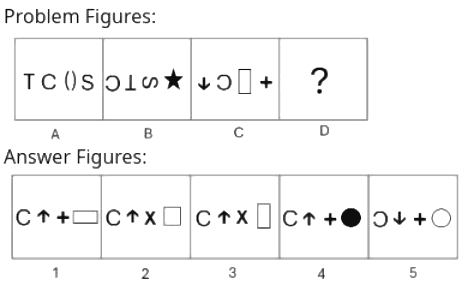
Check Solution
Ans: B
Observing the transformation from the initial configuration to the subsequent one:
* The initial two symbols undergo a 180-degree rotation in a clockwise direction.
* The symbol in the third position is relocated to the fourth position in the new configuration and is filled with a solid dark hue in the shape of a star.
* The symbol in the fourth position moves to the third position and is subjected to a 90-degree clockwise rotation.
Applying the same principles:
* The first two symbols are rotated 180 degrees clockwise.
* The rectangle in the third position is moved to the fourth position and is replaced by a solid dark circle.
* The ‘+’ symbol in the fourth position is moved to the third position and is rotated 90 degrees clockwise.
Therefore, the correct selection is “Option 2”.
Q. 36 P is married to M. W is the wife of S. G is the daughter of A. M is the mother of S. A is the sister of P. How is P related to W?
Check Solution
Ans: D
Explanation:P is married to M. M is the mother of S. Therefore, P is the father of S. W is the wife of S. So, P is the father of S, and W is the wife of S. Thus, P is the father-in-law of W.
Correct_Option:D
Q. 37 Which two numbers need to be swapped to make this equation correct?
20 ÷ 5 × 3 + 10 – 4 = 20
Check Solution
Ans: C
Explanation:The given equation is 20 ÷ 5 × 3 + 10 – 4 = 20. We need to check each option by swapping the given numbers and evaluating the expression according to the order of operations (PEMDAS/BODMAS).
Option A: Swap 20 and 10.
Equation becomes: 10 ÷ 5 × 3 + 20 – 4
= 2 × 3 + 20 – 4
= 6 + 20 – 4
= 26 – 4
= 22. Incorrect.
Option B: Swap 3 and 4.
Equation becomes: 20 ÷ 5 × 4 + 10 – 3
= 4 × 4 + 10 – 3
= 16 + 10 – 3
= 26 – 3
= 23. Incorrect.
Option C: Swap 4 and 5.
Equation becomes: 20 ÷ 4 × 3 + 10 – 5
= 5 × 3 + 10 – 5
= 15 + 10 – 5
= 25 – 5
= 20. Correct.
Option D: Swap 5 and 10.
Equation becomes: 20 ÷ 10 × 3 + 5 – 4
= 2 × 3 + 5 – 4
= 6 + 5 – 4
= 11 – 4
= 7. Incorrect.
Correct_Option:C
Q. 38 Pointing to Sakshi, I said, “She is the daughter of my wife’s son’s brother.” How am I related to Sakshi?
Check Solution
Ans: C
Family Chart:
Input: Facing Sakshi, I stated, “She is the child of my spouse’s son’s sibling.”
Analysis: My spouse’s son is my son. My son’s sibling is my son. Therefore, Sakshi is the child of my son, making me Sakshi’s grandparent.
Conclusion: The correct choice is ” Option 3 “.
Q. 39 From the given options, select the group of letters that, when inserted in order from left to right into the blanks of the incomplete series, will logically complete it.
cd_fc_efcdefcde_cdefcde_cdef
Check Solution
Ans: D
Provided: cd_fc_efcdefcde_cdefcde_cdef
Let’s examine each choice:
1. fcde → This sequence does not exhibit any repeating segments.
2. cddf → This sequence also lacks any repeating segments.
3. efdf → This sequence does not show any repeated patterns.
4. edff → In this sequence, ‘cdef’ appears more than once.
Therefore, the correct selection is “Option 4”.
Q. 40 Directions: In the following question, two statements are given, followed by two conclusions (I and II). Assume the statements to be true even if they appear to contradict general facts. Determine which conclusion(s) logically follow(s) from the statements.
Statements:
All televisions are radios.
Some radios are transistors.
Conclusions:
I. All radios are televisions.
II. Some televisions are transistors.
Check Solution
Ans: A
Explanation:The first statement “All televisions are radios” means that the set of televisions is a subset of the set of radios. This does not imply that all radios are televisions. Therefore, conclusion I is incorrect.
The second statement says “Some radios are transistors”. Since all televisions are radios (from the first statement), some of these televisions, which are also radios, could be among the radios that are transistors. However, it is also possible that the radios that are transistors are *not* televisions. Therefore, we cannot definitively conclude that “Some televisions are transistors”. Conclusion II does not necessarily follow.
Since neither conclusion can be definitively proven from the given statements, neither conclusion follows.
Correct_Option:A
Q. 41 Observe the following table and determine the missing number in the last cell:
| A | B | C | D | Result |
| 5 | 2 | 3 | 10 | 40 |
| 4 | 3 | 5 | 8 | 40 |
| 6 | 4 | 2 | 12 | ? |
Check Solution
Ans: C
The method applied is as follows:
Method: Sum of the four values in a row, then multiplied by two, yields the outcome.
Row 1: Adding the numbers (5 + 2 + 3 + 10) results in 20. Multiplying this sum by 2 gives 40.
Row 2: The sum of the numbers (4 + 3 + 5 + 8) is 20. Doubling this sum produces 40.
Following this pattern:
Row 3: The sum of the numbers (6 + 4 + 2 + 12) is 24. Multiplying this sum by 2 results in 48.
Therefore, ’48’ is the correct value for the question mark.
Q. 42 Select the option that is related to the fifth number in the same way as the second number is related to the first number and the fourth number is related to the third number:
3 : 30 :: 4 : 68 :: 5 : ?
Check Solution
Ans: B
The approach used is:
Approach: The cube of the first number plus the first number equals the second number.
3 : 30 → 3 cubed + 3 = 27 + 3 = 30
4 : 68 → 4 cubed + 4 = 64 + 4 = 68
Following this pattern,
5 : ? → 5 cubed + 5 = ?
⇒ 125 + 5 = ?
⇒ 130 = ?
Q. 43 From the given options, select the group of letters that, when inserted in order from left to right into the blanks of the incomplete series, will logically complete it.
S_ _KB_FH_BSF_K_SF_ _B
Check Solution
Ans: C
Given: S _ _KB_FH_BSF_K_SF_ _B
Let’s examine each provided choice:
1. FHSKBHHK → S FH KB / S FH K B / SF B K H / SF HK B → No recurring sequence is observed.
2. FHSKHKHK → S FH KB / S FH K B / SF H K K / SF HK B → No recurring sequence is observed.
3. FHSKHBHK → S FH KB / S FH K B / SF H K B / SF HK B → The sequence SFHKB appears more than once.
4. FHSHKBHK → S FH KB / S FH H B / SF K K B / SF HK B → No recurring sequence is observed.
Therefore, ‘FHSKHBHK’ logically concludes the sequence.
The correct selection is “Choice 3”.
Q. 44 In the following letter sequence, each group follows a specific pattern. Identify the group of letters that should come next in the sequence.
ZYA, WVD, TSG, QPJ,?
Check Solution
Ans: C
Here’s the paraphrased explanation, maintaining the structure and logic:
The assigned numerical order and corresponding letter values for the English alphabet are as follows:
Provided: ZYA, WVD, TSG, QPJ,?
The pattern observed is:
Therefore, NMM logically follows in the series.
Consequently, the accurate selection is ” Option 3 “.
Q. 45 Select the option that is related to the fifth number in the same way as the second number is related to the first number and the fourth number is related to the third number:
4 : 49 :: 6 : 81 :: 8 : ?
Check Solution
Ans: D
Explanation:The relationship between the first pair of numbers (4 and 49) is that the second number is the square of (the first number + 3). 4 + 3 = 7, and 7 squared is 49. The relationship between the second pair of numbers (6 and 81) is that the second number is the square of (the first number + 3). 6 + 3 = 9, and 9 squared is 81. Applying this pattern to the third pair (8 and ?), we add 3 to the first number: 8 + 3 = 11. Squaring this result gives 11 squared, which is 121.
Correct_Option:D
Q. 46 Instructions: In each of the following, the first and second pair of letters have a specific relationship. Apply the same logic to complete the third pair.
WOODLAND : ZIRXOUQX :: PERIODIC : SYUCRXLW :: MAGAZINE : ?
Check Solution
Ans: D
The numerical assignments and respective values for letters in the English alphabet are as follows:
The systematic approach employed is:
WOODLAND corresponds to ZIRXOUQX
PERIODIC corresponds to SYUCRXLW
Following this pattern,
Therefore, MAGAZINE corresponds to PUJUCCQY.
Q. 47 Identify the word that cannot be constructed using the letters of the given word.
PROCRASTINATE
Check Solution
Ans: B
Explanation:The word PROCRASTINATE has the following letters: P, R, O, C, R, A, S, T, I, N, A, T, E.
Let’s check each option:
A: PATTERN – P, A, T, T, E, R, N. All these letters are present in PROCRASTINATE.
B: PRINTED – P, R, I, N, T, E, D. The letter ‘D’ is not present in PROCRASTINATE.
C: TRACTOR – T, R, A, C, T, O, R. All these letters are present in PROCRASTINATE.
D: PAINTER – P, A, I, N, T, E, R. All these letters are present in PROCRASTINATE.
Therefore, PRINTED cannot be constructed.
Correct_Option:B
Q. 48 How many squares are present in the following figure?
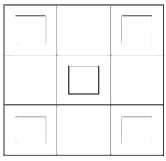
Check Solution
Ans: D
The total count of squares within the provided image is 19.
Consequently, the appropriate choice is “Option 4”.
Q. 49 Each letter in a word is assigned a specific number. From the four given arrangements of these numbers, identify which one represents a meaningful word when the numbers are translated back to their corresponding letters.
N, D, I, O, I, T, C, A, R
1 2 3 4 5 6 7 8 9
Check Solution
Ans: B
Provided:
N
D
I
O
T
C
A
R
1
2
3
4
5
6
7
8
9
Evaluating each choice:
1. 2, 5, 1, 8, 7, 3, 4, 6, 9
This sequence of numbers does not form a recognizable word.
2. 5, 1, 2, 3, 7, 8, 6, 4, 9
This sequence of numbers forms a recognizable word. The word is “INDICATOR”, which signifies something that points to or shows the condition or amount of something.
3. 4, 9, 1, 3, 2, 8, 6, 7, 5
This sequence of numbers does not form a recognizable word.
4. 5, 2, 1, 9, 8, 4, 3, 7, 6
This sequence of numbers does not form a recognizable word.
Therefore, the correct selection is ” Choice 2 “.
Q. 50 How many squares are present in the following figure?
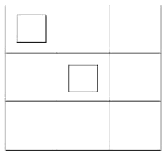
Check Solution
Ans: A
The provided illustration contains 16 squares.
Therefore, the correct selection is “Option 1”.
Q. 51 Two matrices are provided: Matrix I uses row and column numbers 0 to 4. Matrix II uses row and column numbers 5 to 9. A letter is represented by row number, column number (for example, 23 means row 2, column 3 in Matrix I; 66 means row 6, column 6 in Matrix II). From the matrices, find the row-column codes for each letter in DUNG in sequence, and select the correct option from the given alternatives.
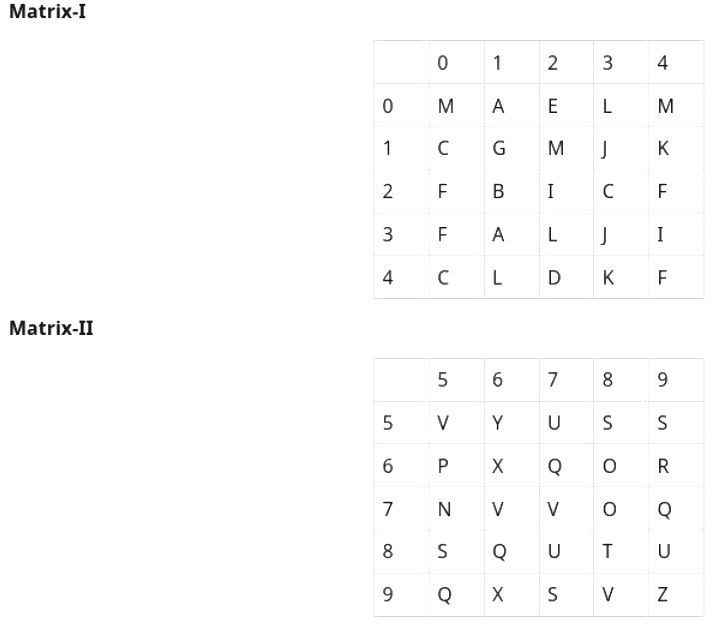
Check Solution
Ans: D
Here’s a breakdown of the provided numerical sequences and their corresponding letter assignments:
1. The numerical set 31, 76, 24, 96 maps to the letters A, V, F, X.
2. The numerical set 20, 59, 41, 88 maps to the letters D, S, L, T.
3. The numerical set 33, 68, 31, 75 maps to the letters J, O, A, N.
4. The numerical set 42, 57, 75, 11 maps to the letters D, U, N, G.
Based on this mapping, the word DUNG is represented by the numerical sequence ’42, 57, 75, 11′. Therefore, the correct option is Option 4.
Q. 52 Two positions of the same dice are shown. Select the number that will be on the face opposite to the one showing the number 6?
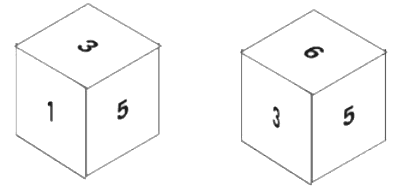
Check Solution
Ans: D
To determine the face opposite to ‘6’, we identify the shared faces across the provided dice. Observing Dice 1 and Dice 2, we see that the numbers ‘3’ and ‘5’ appear on both.
Based on this commonality between Dice 1 and Dice 2:
→ ‘3’ and ‘5’ are the shared faces. Therefore, the number not shared, which is ‘1’, must be on the face opposite to ‘6’.
The correct choice is “Option 4”.
Q. 53 The following series of numbers is given. One number is missing. Study the pattern and find the missing number.
8, 32, 72, 128, ?
Check Solution
Ans: B
The pattern observed is:
The first term is consistently 2.
The second term in the multiplication is a sequence of even numbers squared: 2², 4², 6², 8², 10².
Applying this logic:
2 × 2² = 2 × 4 = 8
2 × 4² = 2 × 16 = 32
2 × 6² = 2 × 36 = 72
2 × 8² = 2 × 64 = 128
2 × 10² = 2 × 100 = 200
Therefore, 200 completes the sequence.
2 × 10² = 2 × 100 = 200
Hence, 200 is the absent value in the progression.
The correct selection is ” Option 2 “.
Q. 54 In the following question, one statement is given, followed by certain inferences. Consider the statement to be true even if it seems to contradict commonly known facts. Read the inferences carefully and decide which of them logically follow(s) from the given statement.
Statement:
Humans cannot match the data processing speed of supercomputers, which perform billions of calculations per second.
Inferences:
I. Humans are less efficient than supercomputers in data processing.
II. Humans and supercomputers differ in their capabilities.
Check Solution
Ans: B
Explanation:The statement explicitly says that humans cannot match the data processing speed of supercomputers. This directly implies that humans are less efficient (Inference I) in this specific task. The statement also highlights a difference in capability between humans and supercomputers regarding data processing speed, thus confirming Inference II. Since both inferences are logically derived from the statement, both follow.
Correct_Option:B
Q. 59 If P denotes ‘+’ , Q means ‘÷’ , R means ‘-‘ and S means ‘×’ , then which of the following equations is correct?
Check Solution
Ans: C
Efficient Solution Approach
Quick Check Strategy:
When evaluating mathematical expressions, prioritize checking operations involving division (represented by ‘Q’). This can rapidly help eliminate answer choices that yield fractional results.
Consider Option 3: The expression `5 Q 10` simplifies to `1/2`. Subsequently, multiplying this by 16 (`16 S`) results in `16 × 1/2 = 8`, which is a whole number. Performing the remaining operations (`8 + 4 − 3`) yields `9`. This result precisely matches the right-hand side (RHS) of the equation.
Therefore, the correct solution is `16 S 5 Q 10 P 4 R 3 = 9`.
Step-by-Step Evaluation:
Operator Mapping:
* `P` corresponds to addition (`+`)
* `Q` corresponds to division (`÷`)
* `R` corresponds to subtraction (`−`)
* `S` corresponds to multiplication (`×`)
Evaluation Method:
The BODMAS rule should be applied to verify each option after substituting the correct operators.
Calculations:
* Option 1: `16 P 5 R 10 S 4 Q 3 = 19`
Substituting operators: `16 + 5 − 10 × 4 ÷ 3`
Applying BODMAS: `21 − 40/3 = 23/3 ≈ 7.66`. This does not equal 19.
* Option 2: `16 S 5 R 10 P 4 Q 3 = 9`
Substituting operators: `16 × 5 − 10 + 4 ÷ 3`
Applying BODMAS: `80 − 10 + 1.33 = 71.33`. This does not equal 9.
* Option 3: `16 S 5 Q 10 P 4 R 3 = 9`
Substituting operators: `16 × 5 ÷ 10 + 4 − 3`
Applying BODMAS: `16 × (1/2) + 4 − 3 = 8 + 4 − 3 = 12 − 3 = 9`. This is correct.
* Option 4: `16 Q 5 P 10 S 4 R 3 = 12`
Substituting operators: `16 ÷ 5 + 10 × 4 − 3`
Applying BODMAS: `3.2 + 40 − 3 = 40.2`. This does not equal 12.
Helpful Notes:
BODMAS Rule:
This rule establishes the definitive sequence for performing mathematical calculations: Brackets, Orders (powers and square roots), Division, Multiplication, Addition, and Subtraction.
Elimination Technique:
Begin by identifying division operations. If a division results in a non-terminating or complex fraction, and the expected final answer is an integer, that option can often be swiftly disregarded.
Symbol Substitution Accuracy:
Ensure that symbols are replaced with their corresponding operators with absolute precision. An incorrect substitution can drastically alter the value of the equation.
Q. 61 The following sentence has been divided into four parts. Identify the part which contains a grammatical error.
If there is no error in the sentence, then select ‘No Error’.
The company will invest more(A) six hundred crores(B) in the next five years to expand(C) its operations in Britain (D).
Check Solution
Ans: B
The correct choice is Option 2.
Key Points:
* The fundamental flaw in the sentence is the absence of the word “than” following “more.”
* When signifying a comparison of quantities or a surplus over a specific threshold, the comparative term “more” necessitates the inclusion of “than.”
* The accurate phrasing should be “invest more than,” which upholds grammatical accuracy and ensures lucidity.
* Consequently, the grammatical mistake resides within section A of the statement.
* This leads to the conclusion that Option 2 is the correct selection.
Corrected Sentence: “The company will invest more than six hundred crores in the next five years to expand its operations in Britain.”
Additional Information:
* Section B: “six hundred crores” is grammatically sound and requires no modification.
* Section C: “in the next five years to expand” is grammatically sound and requires no modification.
* Section D: “its operations in Britain” is grammatically sound and requires no modification.
Q. 62 Given below are four jumbled parts of a sentence. Select the option that gives their correct order.
A) has been attributed by many climate scientists
B) the unprecedented frequency of extreme weather events
C) to the steady rise in global atmospheric temperatures
D) observed across various continents over the last decade
Check Solution
Ans: A
Explanation:The sentence describes a cause-and-effect relationship. The effect is the “unprecedented frequency of extreme weather events observed across various continents over the last decade” (BD). This effect “has been attributed by many climate scientists” (A) “to the steady rise in global atmospheric temperatures” (C). Therefore, the correct order is BDAC.
Correct_Option:A
Q. 63 Select the correct passive form of the given sentence.
The burglar destroyed several items in the room. Even the carpet has been torn.
Check Solution
Ans: D
Explanation:The original sentence consists of two independent clauses. The first clause, “The burglar destroyed several items in the room,” needs to be converted to the passive voice. The subject “The burglar” becomes the agent, and the object “several items” becomes the subject. The past tense verb “destroyed” becomes “were destroyed.” The second clause, “Even the carpet has been torn,” is already in the passive voice. Option D correctly converts the first clause to the passive voice (“Several items in the room were destroyed by the burglar”) and retains the second clause as it is, maintaining the overall meaning and grammatical correctness. Options A, B, and C contain grammatical errors or incorrect passive constructions.
Correct_Option:D
Q. 64 Choose the appropriate antonym of the given word.
Gullibility
Check Solution
Ans: D
Explanation:Gullibility refers to being easily persuaded to believe something. An antonym would be a disposition to doubt or distrust. Skepticism means having doubts or reservations. Trust, naivety, and innocence are all closely related to being easily believing or having faith, making them synonyms or near-synonyms, not antonyms.
Correct_Option:D
Q. 65 In the following question, out of the four alternatives, choose the one which gives the meaning of the given idiom or phrase.
A stitch in time saves nine
Check Solution
Ans: D
Explanation:The idiom “A stitch in time saves nine” means that addressing a small problem promptly can prevent it from becoming a larger, more difficult problem later on. This avoids the need for more extensive repairs or efforts.
Correct_Option:D
Q. 66 Select the most appropriate option to substitute the highlighted segment in the given sentence. If there is no need to substitute it, select ‘No improvement’.
Come quickly if you will catch the train.
Check Solution
Ans: C
The correct choice is ‘If you want to’.
Core Concepts:
The sentence structure involves a conditional clause, necessitating proper verb conjugation to convey the intended message.
The expression “Come quickly if you will catch the train” is grammatically unsound. Conditional clauses introduced by “if” generally avoid “will” unless the intent is to express volition or willingness.
The phrase “If you want to” accurately communicates the sense of immediacy and purpose without grammatical inaccuracies.
Consequently, the most suitable option is the third one.
Completed Sentence: “Come quickly if you want to catch the train.”
Further Details:
Option 1: “If you have” is unsuitable as it does not fit the context of urgency or desired outcome.
Option 2: “If you will have” is incorrect due to its undue complexity and awkward grammatical construction.
Option 4: “No improvement” is not applicable because the initial phrasing of the sentence contains a grammatical defect.
Q. 67 Choose the appropriate synonym of the given word.
Erroneous
Check Solution
Ans: B
Explanation:Erroneous means in a mistaken state or wrong. Fallacious means based on a mistaken belief. Therefore, Fallacious is the most appropriate synonym. Vital means essential. Right and Accurate mean correct.
Correct_Option:B
Q. 68 Select the correct direct form of the given sentence.
He inquired whether the boy’s name was Ahmed.
Check Solution
Ans: D
Explanation:The original sentence is in indirect speech and reports a question. When converting indirect questions that start with “whether” or “if” to direct speech, we use a direct question format. The reporting verb “inquired” becomes “asked”. The conjunction “whether” is removed, and the sentence structure is changed back to a question. The tense also needs to be adjusted from past to present if the original question was in the present tense. Since the indirect speech uses “was”, the original question was likely “Is”.
Correct_Option:D
Q. 69 Select the wrongly spelt word out of the four alternatives.
Check Solution
Ans: D
Explanation:The word “Impetunent” is misspelled. The correct spelling is “Impertinent”.
Correct_Option:D
Q. 70 Select the most appropriate option to substitute the highlighted segment in the given sentence. If there is no need to substitute it, select ‘No improvement’.
Tom was standing besides the schoolhouse poster, when the ball rolled towards him.
Check Solution
Ans: C
The accurate choice is ‘standing beside the schoolhouse poster’.
Key Insights:
The phrase “standing beside” correctly utilizes the past progressive tense, indicating an action in progress at a particular past moment.
The narrative specifies an event occurring at a distinct point in the past (“when the ball rolled towards him”), making the progressive tense fitting for describing the ongoing state at that time.
Option 1 (“stand beside”) and Option 2 (“stood beside”) are unsuitable because they fail to convey an ongoing action.
The option for “No improvement” is incorrect due to the grammatical error in the highlighted word (“besides”), which requires replacement.
Consequently, the accurate selection is Option 3.
Full Sentence: “Tom was standing beside the schoolhouse poster, when the ball rolled towards him.”
Supplementary Details:
Option 1: “stand beside the schoolhouse poster” is flawed because it employs the simple present tense of “stand” instead of the required past progressive form.
Option 2: “stood beside the schoolhouse poster” is incorrect as it does not reflect an action in progress.
Option 4: “No improvement” is incorrect because “besides” represents a grammatical misstep and must be substituted with “beside.”
Q. 71 Choose the most appropriate option to fill the blank in the given sentence.
The tiny deer stood looking at them with ________ eyes.
Check Solution
Ans: D
Explanation:The sentence describes a tiny deer looking at “them”. The word “eyes” is key here. We need an adjective that describes the appearance or quality of the deer’s eyes in this context. “Stationary” means not moving, which could describe the deer’s posture but not its eyes. “Arid” means dry and lacking moisture, which is an unlikely description for a deer’s eyes. “Transparent” means allowing light to pass through, which is not a typical or striking characteristic of animal eyes in this kind of descriptive sentence. “Luminous” means full of light or shining, which is a common and evocative way to describe the bright, often reflective eyes of animals, especially in a slightly poetic or descriptive context.
Correct_Option:D
Q. 72 Select the correctly spelt word out of the four alternatives.
Check Solution
Ans: B
Explanation:The word describes something that is comically or repulsively ugly or distorted. The correct spelling is “Grotesque”. Options A, C, and D contain spelling errors.
Correct_Option:B
Q. 73 In the following question, out of the four alternatives, choose the one which can be substituted for the given words/sentence.
Fear of ugliness.
Check Solution
Ans: B
Explanation:The question asks for a single word that means “fear of ugliness”. Let’s break down the options:
A: Hydrophobia is the fear of water.
B: Cacophobia is the fear of ugliness or unsightly things.
C: Arachnophobia is the fear of spiders.
D: Acrophobia is the fear of heights.
Therefore, Cacophobia is the correct term.
Correct_Option:B
Q. 74 In the following question, out of the four alternatives, choose the one which gives the meaning of the given idiom or phrase.
To strain at a gnat and swallow a camel
Check Solution
Ans: C
Explanation:The idiom “to strain at a gnat and swallow a camel” describes someone who makes a great effort to avoid a very small problem while overlooking or accepting a much larger one. This highlights a disproportionate focus on trivial matters at the expense of significant ones.
Correct_Option:C
Q. 75 Select the correct indirect form of the given sentence.
“Do you suppose you know better than your own father?” jeered his angry mother.
Check Solution
Ans: D
Explanation:The original sentence is a direct question asked by an angry mother. To convert it to indirect speech, we need to:
1. Change the reporting verb “jeered” to “jeered and asked” or simply “jeered” followed by a conjunction suitable for a question.
2. Change the tense of the verb within the reported speech. “Do you suppose” becomes “he supposed” (past tense of suppose) and “know” becomes “knew” (past tense of know).
3. Change the pronoun “you” to “he” (referring to the son).
4. Use “whether” or “if” to introduce the reported question.
Option D correctly applies these changes. Option A incorrectly keeps “did he suppose” and the present tense “know”. Option B uses incorrect past perfect tense and incorrect present perfect tense. Option C incorrectly keeps the original tenses and pronouns.
Correct_Option:D
Q. 76 Choose the option that contains the homonym of the highlighted word in the given sentence.
Please make sure to write your full home address, including the apartment number and zip code, on the top of the application form.
Check Solution
Ans: C
Explanation:A homonym is a word that is spelled and pronounced the same as another word but has a different meaning. The highlighted word “address” in the sentence refers to a place of residence. Option C contains “address” in the sense of a formal speech or statement, which is a different meaning but spelled and pronounced the same.
Correct_Option:C
Q. 77 Select the correct indirect form of the given sentence.
“Call the first witness,” said the judge.
Check Solution
Ans: D
Explanation:The original sentence is a direct command. In indirect speech, commands are usually reported using verbs like “ordered,” “told,” or “asked” followed by an infinitive clause (to + verb). The pronoun “them” is often implied or added for clarity when reporting the command. Option D correctly uses “ordered” and the infinitive “to call,” fitting the structure for reporting a command. Option A uses “asked if,” which is for questions. Option B uses “should be called,” which is passive and less direct for a command. Option C is grammatically incorrect.
Correct_Option:D
Q. 78 Given below are four jumbled parts of a sentence. Select the option that gives their correct order.
A) by the intricate tapestry of
B) the philosopher was captivated
C) that define human existence
D) moral and ethical dilemmas
Check Solution
Ans: C
Explanation:The sentence describes a philosopher being captivated by something. Option B starts with “the philosopher was captivated,” which is a natural beginning for a sentence describing someone’s state of mind or reaction. Following this, option D, “moral and ethical dilemmas,” identifies what captivated the philosopher. Option A, “by the intricate tapestry of,” connects the philosopher’s captivation to the nature of these dilemmas. Finally, option C, “that define human existence,” further elaborates on what these dilemmas relate to. Thus, BADC forms a coherent and grammatically correct sentence.
Correct_Option:C
Q. 79 Select the correct active form of the given sentence.
The massive exterior wall of the old mansion was being painted by the skilled laborers when it suddenly started raining heavily.
Check Solution
Ans: A
Explanation:The original sentence is in the passive voice (“was being painted”). The passive voice emphasizes the object of the action. The active voice emphasizes the doer of the action. To convert to active voice, the object of the passive sentence (“The massive exterior wall of the old mansion”) becomes the object of the active sentence, and the subject of the passive sentence (“the skilled laborers”) becomes the subject of the active sentence. The verb tense in the passive voice is past continuous (“was being painted”). The corresponding active voice past continuous tense is “were painting”. Option A correctly uses the past continuous tense and places the subject (“The skilled laborers”) before the verb (“were painting”). The clause “when it suddenly started raining heavily” remains unchanged as it describes the timing of the action.
Correct_Option:A
Q. 80 The following sentence has been divided into four parts. Identify the part which contains a grammatical error. If there is no error in the sentence, then select ‘No Error’.
The whole family (A)/ would burst into (B)/ peals for laughter. (C)/ No Error (D)
Check Solution
Ans: D
Explanation:The error lies in part (C). The word “peals” is a noun that refers to a loud, prolonged, and usually ringing sound, such as the ringing of bells or a peal of thunder. However, in the context of laughter, the correct word to use is “peals,” which is the plural form of “peal” and refers to a burst of sound. The sentence should read “burst into peals of laughter.” Therefore, the incorrect part is (C).
Correct_Option:D
Q. 81 Select the correct direct form of the given sentence.
I asked Mary if she would lend me a pencil.
Check Solution
Ans: A
Explanation:The original sentence is in indirect speech. The reporting verb is “asked”. The question asked was a polite request, indicated by “would lend me”. This translates to a direct question using “will you” in the imperative or interrogative form. Option A correctly uses the direct speech format with the correct interrogative form and quotation marks. Option B uses “lent” which is the past tense and incorrect in this context. Option C uses “she” which refers to Mary in the third person, not direct address. Option D uses “asked to Mary” which is grammatically incorrect, and “Would you” is a conditional, less direct than “will you” for a simple request in this context.
Correct_Option:A
Q. 82 Choose the most appropriate option to fill the blank in the given sentence.
Radium ___________ rays that can damage the eyes.
Check Solution
Ans: C
Explanation:The phrasal verb “gives off” means to emit or release something, such as a smell, heat, or in this case, rays. The other options are not appropriate in this context. “Gives away” means to give something as a gift or to reveal a secret. “Gives over” means to hand something to someone else or to stop doing something. “Gives up” means to surrender or abandon something.
Correct_Option:C
Q. 83 Select the correct active form of the given sentence.
Why was such a letter written by your brother?
Check Solution
Ans: C
Explanation:The original sentence is in the passive voice, past tense (“was written”). To convert it to active voice while maintaining the same tense and meaning, we need to identify the subject performing the action (your brother) and use the past tense of the verb (“write”). Option C correctly uses the past tense “did write” to form the question in the active voice.
Correct_Option:C
Q. 84 Comprehension
Read the following passage carefully and answer the questions based on the passage:
Pride and Prejudice by Jane Austen is a classic known for its humor and complex characters. The famous first sentence of the book, “It is a truth universally acknowledged, that a single man in possession of a good fortune, must be in want of a wife,” begins to set up all of the major themes of money, status, and marrying well that are prevalent in 19th-century England. The Bennet family, particularly Elizabeth Bennet, a smart and strong-willed heroine, is the subject of Austen’s commentary on the societal imperative for women to marry well and thereby have a stable income.
The title itself is quite meaningful, as it first indicates the character flaws that drive much of the conflict in this novel, namely Darcy’s pride and Elizabeth’s prejudice. In fact, Mr. Fitzwilliam Darcy, being a rich and high-ranking person, first of all shows a haughty character, thereby being very superior by virtue of his class. Elizabeth, having been offended by his initial lack of warmth, as well as having been misled by the deceiving Mr. Wickham, very quickly showed prejudice against him.
Traces the story of each as they navigate these weaknesses. Darcy needs to lower his pride to appreciate the value of Elizabeth’s inferior standing, though she must see the strength of his superior qualities.
Austen employs irony and satire liberally to point out the absurdities of the class structure. Personages like the obsequious Mr. Collins and the imperious Lady Catherine de Bourgh symbolize the hard and silly aspects of class consciousness. The sojourn at Darcy’s grand estate, Pemberley, is an important defining instance in which the splendor of the property and the favorable reports of his servants compel Elizabeth to revise her earlier opinion and realize the truth of Darcy’s goodness.
In the final analysis, the novel promotes love marriages, couples like Jane and Bingley, and Elizabeth and Darcy, who have successful marriages because of love, in contrast to couples who marry for convenience (Charlotte Collins and Mr. Collins) or those who are full of passion but irresponsible (Lydia and Wickham).
What are the major themes expressed by the first line of the novel?
Check Solution
Ans: B
Explanation:The passage explicitly states that the first sentence of “Pride and Prejudice” sets up “all of the major themes of money, status, and marrying well.” Option B directly reflects these themes.
Correct_Option:B
Q. 85 Comprehension
Read the following passage carefully and answer the questions based on the passage:
Pride and Prejudice by Jane Austen is a classic known for its humor and complex characters. The famous first sentence of the book, “It is a truth universally acknowledged, that a single man in possession of a good fortune, must be in want of a wife,” begins to set up all of the major themes of money, status, and marrying well that are prevalent in 19th-century England. The Bennet family, particularly Elizabeth Bennet, a smart and strong-willed heroine, is the subject of Austen’s commentary on the societal imperative for women to marry well and thereby have a stable income.
The title itself is quite meaningful, as it first indicates the character flaws that drive much of the conflict in this novel, namely Darcy’s pride and Elizabeth’s prejudice. In fact, Mr. Fitzwilliam Darcy, being a rich and high-ranking person, first of all shows a haughty character, thereby being very superior by virtue of his class. Elizabeth, having been offended by his initial lack of warmth, as well as having been misled by the deceiving Mr. Wickham, very quickly showed prejudice against him.
Traces the story of each as they navigate these weaknesses. Darcy needs to lower his pride to appreciate the value of Elizabeth’s inferior standing, though she must see the strength of his superior qualities.
Austen employs irony and satire liberally to point out the absurdities of the class structure. Personages like the obsequious Mr. Collins and the imperious Lady Catherine de Bourgh symbolize the hard and silly aspects of class consciousness. The sojourn at Darcy’s grand estate, Pemberley, is an important defining instance in which the splendor of the property and the favorable reports of his servants compel Elizabeth to revise her earlier opinion and realize the truth of Darcy’s goodness.
In the final analysis, the novel promotes love marriages, couples like Jane and Bingley, and Elizabeth and Darcy, who have successful marriages because of love, in contrast to couples who marry for convenience (Charlotte Collins and Mr. Collins) or those who are full of passion but irresponsible (Lydia and Wickham).
Which defects in character does the name “Pride and Prejudice” primarily refer to?
Check Solution
Ans: A
Explanation:The passage explicitly states, “The title itself is quite meaningful, as it first indicates the character flaws that drive much of the conflict in this novel, namely Darcy’s pride and Elizabeth’s prejudice.” This directly answers the question.
Correct_Option:A
Q. 86 Comprehension
Read the following passage carefully and answer the questions based on the passage:
Pride and Prejudice by Jane Austen is a classic known for its humor and complex characters. The famous first sentence of the book, “It is a truth universally acknowledged, that a single man in possession of a good fortune, must be in want of a wife,” begins to set up all of the major themes of money, status, and marrying well that are prevalent in 19th-century England. The Bennet family, particularly Elizabeth Bennet, a smart and strong-willed heroine, is the subject of Austen’s commentary on the societal imperative for women to marry well and thereby have a stable income.
The title itself is quite meaningful, as it first indicates the character flaws that drive much of the conflict in this novel, namely Darcy’s pride and Elizabeth’s prejudice. In fact, Mr. Fitzwilliam Darcy, being a rich and high-ranking person, first of all shows a haughty character, thereby being very superior by virtue of his class. Elizabeth, having been offended by his initial lack of warmth, as well as having been misled by the deceiving Mr. Wickham, very quickly showed prejudice against him.
Traces the story of each as they navigate these weaknesses. Darcy needs to lower his pride to appreciate the value of Elizabeth’s inferior standing, though she must see the strength of his superior qualities.
Austen employs irony and satire liberally to point out the absurdities of the class structure. Personages like the obsequious Mr. Collins and the imperious Lady Catherine de Bourgh symbolize the hard and silly aspects of class consciousness. The sojourn at Darcy’s grand estate, Pemberley, is an important defining instance in which the splendor of the property and the favorable reports of his servants compel Elizabeth to revise her earlier opinion and realize the truth of Darcy’s goodness.
In the final analysis, the novel promotes love marriages, couples like Jane and Bingley, and Elizabeth and Darcy, who have successful marriages because of love, in contrast to couples who marry for convenience (Charlotte Collins and Mr. Collins) or those who are full of passion but irresponsible (Lydia and Wickham).
How is the character of Lady Catherine de Bourgh employed in the novel as a criticism of society?
Check Solution
Ans: D
Explanation:The passage states that “Personages like the obsequious Mr. Collins and the imperious Lady Catherine de Bourgh symbolize the hard and silly aspects of class consciousness.” Lady Catherine is described as “imperious,” indicating a domineering and haughty nature stemming from her high social standing. This makes her a symbol of the oppressive and foolish manifestations of class consciousness, aligning with social tyranny and class prejudice. Option A is incorrect because the passage explicitly states she symbolizes aspects of class consciousness, not just comic relief. Option B is incorrect as she represents the upper class, not the struggle of the working class. Option C is incorrect as her character is portrayed as embodying negative aspects of class, not positive maternal qualities.
Correct_Option:D
Q. 87 What is the key event that marks a turning point in making Elizabeth change her view of Darcy?
Check Solution
Ans: D
Explanation:Elizabeth’s prejudice against Darcy stems from Wickham’s lies and Darcy’s perceived arrogance. The Netherfield Ball (Option C) is where she initially forms a negative impression of him due to his prideful behavior. While Lydia’s elopement (Option B) is a significant event, it doesn’t directly alter Elizabeth’s view of Darcy’s character. Mr. Collins’s proposal (Option A) is irrelevant to her evolving opinion of Darcy. The turning point occurs during her visit to Pemberley (Option D). Seeing his estate and hearing the housekeeper’s praise humanizes him, and the subsequent letter from Darcy, explaining his actions regarding Wickham and Bingley, shatters her remaining prejudice and reveals his true nobility.
Correct_Option:D
Q. 88 Comprehension
Read the following passage carefully and answer the questions based on the passage:
Pride and Prejudice by Jane Austen is a classic known for its humor and complex characters. The famous first sentence of the book, “It is a truth universally acknowledged, that a single man in possession of a good fortune, must be in want of a wife,” begins to set up all of the major themes of money, status, and marrying well that are prevalent in 19th-century England. The Bennet family, particularly Elizabeth Bennet, a smart and strong-willed heroine, is the subject of Austen’s commentary on the societal imperative for women to marry well and thereby have a stable income.
The title itself is quite meaningful, as it first indicates the character flaws that drive much of the conflict in this novel, namely Darcy’s pride and Elizabeth’s prejudice. In fact, Mr. Fitzwilliam Darcy, being a rich and high-ranking person, first of all shows a haughty character, thereby being very superior by virtue of his class. Elizabeth, having been offended by his initial lack of warmth, as well as having been misled by the deceiving Mr. Wickham, very quickly showed prejudice against him.
Traces the story of each as they navigate these weaknesses. Darcy needs to lower his pride to appreciate the value of Elizabeth’s inferior standing, though she must see the strength of his superior qualities.
Austen employs irony and satire liberally to point out the absurdities of the class structure. Personages like the obsequious Mr. Collins and the imperious Lady Catherine de Bourgh symbolize the hard and silly aspects of class consciousness. The sojourn at Darcy’s grand estate, Pemberley, is an important defining instance in which the splendor of the property and the favorable reports of his servants compel Elizabeth to revise her earlier opinion and realize the truth of Darcy’s goodness.
In the final analysis, the novel promotes love marriages, couples like Jane and Bingley, and Elizabeth and Darcy, who have successful marriages because of love, in contrast to couples who marry for convenience (Charlotte Collins and Mr. Collins) or those who are full of passion but irresponsible (Lydia and Wickham).
What kind of marriage does Jane Austen appear to prize the most, according to the conclusion of the novel?
Check Solution
Ans: B
Explanation:The passage concludes by contrasting marriages. It highlights Jane and Bingley, and Elizabeth and Darcy as having successful marriages “because of love.” This is directly contrasted with marriages of “convenience” (Charlotte and Mr. Collins) and those based on “passion but irresponsible” (Lydia and Wickham). Therefore, Austen prizes marriages founded on love and mutual appreciation the most. Option B accurately reflects this emphasis on mutual respect, love, and understanding.
Correct_Option:B
Q. 89 Comprehension
Read the following passage carefully and answer the questions based on the passage:
The Viksit Bharat – Guarantee for Rozgar and AJeevika Mission (Gramin) Act (VB-GRAM G), 2025, has been replaced by the Mahatma Gandhi National Rural Employment Guarantee Act (MGNREGA). The goal of this modification is to improve Article 21 of the Indian Constitution, which protects the right to life. MGNREGA has improved socioeconomic conditions by facilitating wage payments, providing unemployment benefits, and promoting equal earnings. There has been sustainable development, and research has confirmed the impact of this program to raise earnings, alleviate poverty, and encourage school enrollment. In the past five years, women have comprised 58% of the workforce, significantly contributing to rural development, particularly during the COVID-19 pandemic. Given these factors, it is important to assess both the benefits and current challenges of the system.
Despite MGNREGA’s successes, the program has faced implementation challenges, mainly due to inadequate funding, as acknowledged by the Ministry of Finance. Delays in wage payments and fewer work opportunities have resulted from this lack of funds. Recent rules, such as introducing an attendance application that uses photos, have created new problems and made corruption easier. Due to these issues, the VB-GRAM G Act has introduced important changes, including sections 5(1) and 4(5), which give the Union Government greater control over the public works program.
What might be the author’s overall purpose for discussing the development from MGNREGA to the VB-GRAM G Act?
Check Solution
Ans: B
The correct selection is ‘Option 2’.
Key Points
Constitutional Basis: The text clearly connects the shift to the objective of enhancing Article 21 of the Indian Constitution (concerning the right to life), indicating that the changes are grounded in upholding basic liberties.
Acknowledging Achievements and Shortcomings: The writer recognizes the program’s positive impact on poverty reduction and income growth, while also pointing out “implementation hurdles” such as insufficient financial resources and delayed payments.
Structural Overhaul: The mention of the VB-GRAM G Act and its updated provisions (sections 5(1) and 4(5)) demonstrates an organizational effort to tackle these issues by granting the Central Government enhanced authority over the program’s operational aspects.
Consequently, the most fitting answer highlights how structural changes aim to preserve constitutionally guaranteed rights while acknowledging administrative limitations.
Additional Information
Option 1: Not accurate. The text indicates an increase in the Central Government’s authority, not a reduction in governmental involvement.
Option 3: Not accurate. The passage suggests that recent technological advancements (such as the attendance application) have introduced fresh difficulties and facilitated corruption, rather than definitively boosting transparency.
Option 4: Not accurate. Although an attendance application is referenced, the text does not advocate for a complete shift to an AI-driven system as the primary solution.
Q. 90 Comprehension
Read the following passage carefully and answer the questions based on the passage:
The Viksit Bharat – Guarantee for Rozgar and AJeevika Mission (Gramin) Act (VB-GRAM G), 2025, has been replaced by the Mahatma Gandhi National Rural Employment Guarantee Act (MGNREGA). The goal of this modification is to improve Article 21 of the Indian Constitution, which protects the right to life. MGNREGA has improved socioeconomic conditions by facilitating wage payments, providing unemployment benefits, and promoting equal earnings. There has been sustainable development, and research has confirmed the impact of this program to raise earnings, alleviate poverty, and encourage school enrollment. In the past five years, women have comprised 58% of the workforce, significantly contributing to rural development, particularly during the COVID-19 pandemic. Given these factors, it is important to assess both the benefits and current challenges of the system.
Despite MGNREGA’s successes, the program has faced implementation challenges, mainly due to inadequate funding, as acknowledged by the Ministry of Finance. Delays in wage payments and fewer work opportunities have resulted from this lack of funds. Recent rules, such as introducing an attendance application that uses photos, have created new problems and made corruption easier. Due to these issues, the VB-GRAM G Act has introduced important changes, including sections 5(1) and 4(5), which give the Union Government greater control over the public works program.
The author’s tone regarding new rules (e.g., photo-based attendance) is best described as?
Check Solution
Ans: B
Explanation:The author states that recent rules like the attendance application using photos have created “new problems and made corruption easier,” indicating a critical view of these specific changes. However, the author does not outright reject technological solutions or declare them ineffective; rather, they highlight potential drawbacks and the risk of abuse within bureaucratic systems, especially when combined with existing issues like funding. Option B captures this nuance by acknowledging the innovation’s potential but also its “dangers of abuse in bureaucracies.”
Correct_Option:B
Q. 91 Comprehension
Read the following passage carefully and answer the questions based on the passage:
The Viksit Bharat – Guarantee for Rozgar and AJeevika Mission (Gramin) Act (VB-GRAM G), 2025, has been replaced by the Mahatma Gandhi National Rural Employment Guarantee Act (MGNREGA). The goal of this modification is to improve Article 21 of the Indian Constitution, which protects the right to life. MGNREGA has improved socioeconomic conditions by facilitating wage payments, providing unemployment benefits, and promoting equal earnings. There has been sustainable development, and research has confirmed the impact of this program to raise earnings, alleviate poverty, and encourage school enrollment. In the past five years, women have comprised 58% of the workforce, significantly contributing to rural development, particularly during the COVID-19 pandemic. Given these factors, it is important to assess both the benefits and current challenges of the system.
Despite MGNREGA’s successes, the program has faced implementation challenges, mainly due to inadequate funding, as acknowledged by the Ministry of Finance. Delays in wage payments and fewer work opportunities have resulted from this lack of funds. Recent rules, such as introducing an attendance application that uses photos, have created new problems and made corruption easier. Due to these issues, the VB-GRAM G Act has introduced important changes, including sections 5(1) and 4(5), which give the Union Government greater control over the public works program.
What can be reasonably inferred about the relationship between women’s participation and rural resilience during the pandemic?
Check Solution
Ans: C
Explanation:The passage states that women comprised 58% of the workforce in the past five years and significantly contributed to rural development, particularly during the COVID-19 pandemic. This implies that their active participation helped sustain rural livelihoods and the local economy despite the economic disruptions caused by the pandemic. Option C directly reflects this inference by suggesting their involvement contributed to the continuation of the community by maintaining the local economy. Options A, B, and D present negative or unsupportable consequences of women’s participation, which are not suggested by the passage.
Correct_Option:C
Q. 92 Comprehension
Read the following passage carefully and answer the questions based on the passage:
The Viksit Bharat – Guarantee for Rozgar and AJeevika Mission (Gramin) Act (VB-GRAM G), 2025, has been replaced by the Mahatma Gandhi National Rural Employment Guarantee Act (MGNREGA). The goal of this modification is to improve Article 21 of the Indian Constitution, which protects the right to life. MGNREGA has improved socioeconomic conditions by facilitating wage payments, providing unemployment benefits, and promoting equal earnings. There has been sustainable development, and research has confirmed the impact of this program to raise earnings, alleviate poverty, and encourage school enrollment. In the past five years, women have comprised 58% of the workforce, significantly contributing to rural development, particularly during the COVID-19 pandemic. Given these factors, it is important to assess both the benefits and current challenges of the system.
Despite MGNREGA’s successes, the program has faced implementation challenges, mainly due to inadequate funding, as acknowledged by the Ministry of Finance. Delays in wage payments and fewer work opportunities have resulted from this lack of funds. Recent rules, such as introducing an attendance application that uses photos, have created new problems and made corruption easier. Due to these issues, the VB-GRAM G Act has introduced important changes, including sections 5(1) and 4(5), which give the Union Government greater control over the public works program.
What does the author’s discussion of lack of funding primarily indicate?
Check Solution
Ans: B
Explanation:The passage explicitly states that “inadequate funding” has led to “delays in wage payments and fewer work opportunities.” This directly points to implementation challenges stemming from a lack of financial resources. Option B accurately captures this connection. Options A, C, and D introduce concepts not directly supported by the passage as the primary indication of lack of funding.
Correct_Option:B
Q. 93 Comprehension
Read the following passage carefully and answer the questions based on the passage:
The Viksit Bharat – Guarantee for Rozgar and AJeevika Mission (Gramin) Act (VB-GRAM G), 2025, has been replaced by the Mahatma Gandhi National Rural Employment Guarantee Act (MGNREGA). The goal of this modification is to improve Article 21 of the Indian Constitution, which protects the right to life. MGNREGA has improved socioeconomic conditions by facilitating wage payments, providing unemployment benefits, and promoting equal earnings. There has been sustainable development, and research has confirmed the impact of this program to raise earnings, alleviate poverty, and encourage school enrollment. In the past five years, women have comprised 58% of the workforce, significantly contributing to rural development, particularly during the COVID-19 pandemic. Given these factors, it is important to assess both the benefits and current challenges of the system.
Despite MGNREGA’s successes, the program has faced implementation challenges, mainly due to inadequate funding, as acknowledged by the Ministry of Finance. Delays in wage payments and fewer work opportunities have resulted from this lack of funds. Recent rules, such as introducing an attendance application that uses photos, have created new problems and made corruption easier. Due to these issues, the VB-GRAM G Act has introduced important changes, including sections 5(1) and 4(5), which give the Union Government greater control over the public works program.
What does “sustainable development” mean most nearly in the context of the passage?
Check Solution
Ans: A
Explanation:The passage states that “sustainable development” has been achieved by MGNREGA and that research has confirmed its impact on raising earnings, alleviating poverty, and encouraging school enrollment. This suggests development that benefits rural households over the long term through stable programs that improve their socioeconomic conditions. Option A aligns with this by mentioning long-term socioeconomic benefits and stable program design. Option B focuses on technology, which isn’t the primary theme of sustainable development here. Option C focuses on short-term job creation with uncertain long-term consequences, contradicting the idea of sustainability. Option D discusses fast infrastructure development without considering administrative viability, which is not necessarily sustainable development.
Correct_Option:A
Q. 94 Comprehension
Read the following passage carefully and answer the questions based on the passage:
“Bank failures raise serious concerns about supervisory oversight.” The case studies of Credit Suisse and Silicon Valley Bank highlight the deficiencies in supervisory supervision. In many instances, supervisors are hesitant to come into conflict with bank management when weaknesses are identified, preferring to do nothing rather than take corrective action at a point in time when key issues are building into a problem.
Regulators must adopt an attitude change in which they place more emphasis on the results rather than the details. Overemphasis on trivial matters might lead regulators to overlook more fundamental issues, such as whether financial institutions have adequate capital in case of a shock. Regulating requirements must be simplified. Complex regulation requirements in relation to capital may overlook systemic risk in their approaches when stress tests result in activities gravitating towards less heavily regulated institutions in the non-bank sector.
Improved supervisory and bank communications would promote better supervision as a tool for managing risk. Recommendations include being up front about supervisory goals, openness to change within the bank organization, and increased transparency in supervisory contracts as a way of promoting swift problem resolution. These would aid shareholders as well as the overall economy. In conclusion, rather than pursuing a micro-management strategy, a move towards a clearly defined regulation that supports positive incentives is what is needed to ensure that banks behave within frameworks that promote financial stability.
Which of the following is most true in regard to stating the structure of logic found in the author’s conclusion?
Check Solution
Ans: C
Explanation:The author’s conclusion advocates for a shift from “micro-management strategy” to a “clearly defined regulation that supports positive incentives” to ensure financial stability. This implies moving away from excessive focus on minor details (procedural pedantry) towards a framework that prioritizes desired outcomes (results-oriented strategic framework) and encourages good behavior. Option C accurately reflects this transition. Option A is incorrect as the passage emphasizes supervisory oversight. Option B is incorrect as the passage calls for clearer regulation, not more freedom for managers. Option D is incorrect as the passage calls for defined regulation, not complete deregulation.
Correct_Option:C
Q. 95 Comprehension
Read the following passage carefully and answer the questions based on the passage:
“Bank failures raise serious concerns about supervisory oversight.” The case studies of Credit Suisse and Silicon Valley Bank highlight the deficiencies in supervisory supervision. In many instances, supervisors are hesitant to come into conflict with bank management when weaknesses are identified, preferring to do nothing rather than take corrective action at a point in time when key issues are building into a problem.
Regulators must adopt an attitude change in which they place more emphasis on the results rather than the details. Overemphasis on trivial matters might lead regulators to overlook more fundamental issues, such as whether financial institutions have adequate capital in case of a shock. Regulating requirements must be simplified. Complex regulation requirements in relation to capital may overlook systemic risk in their approaches when stress tests result in activities gravitating towards less heavily regulated institutions in the non-bank sector.
Improved supervisory and bank communications would promote better supervision as a tool for managing risk. Recommendations include being up front about supervisory goals, openness to change within the bank organization, and increased transparency in supervisory contracts as a way of promoting swift problem resolution. These would aid shareholders as well as the overall economy. In conclusion, rather than pursuing a micro-management strategy, a move towards a clearly defined regulation that supports positive incentives is what is needed to ensure that banks behave within frameworks that promote financial stability.
The use of “stress tests” by the author is an example of illustrating which of the following consequences?
Check Solution
Ans: A
Explanation:The passage states, “Complex regulation requirements in relation to capital may overlook systemic risk in their approaches when stress tests result in activities gravitating towards less heavily regulated institutions in the non-bank sector.” This directly illustrates that stress tests can reveal how activities move to less regulated areas due to complex regulations. Option A accurately reflects this consequence. Options B, C, and D are not directly supported by the provided text regarding the use of stress tests.
Correct_Option:A
Q. 96 Comprehension
Read the following passage carefully and answer the questions based on the passage:
“Bank failures raise serious concerns about supervisory oversight.” The case studies of Credit Suisse and Silicon Valley Bank highlight the deficiencies in supervisory supervision. In many instances, supervisors are hesitant to come into conflict with bank management when weaknesses are identified, preferring to do nothing rather than take corrective action at a point in time when key issues are building into a problem.
Regulators must adopt an attitude change in which they place more emphasis on the results rather than the details. Overemphasis on trivial matters might lead regulators to overlook more fundamental issues, such as whether financial institutions have adequate capital in case of a shock. Regulating requirements must be simplified. Complex regulation requirements in relation to capital may overlook systemic risk in their approaches when stress tests result in activities gravitating towards less heavily regulated institutions in the non-bank sector.
Improved supervisory and bank communications would promote better supervision as a tool for managing risk. Recommendations include being up front about supervisory goals, openness to change within the bank organization, and increased transparency in supervisory contracts as a way of promoting swift problem resolution. These would aid shareholders as well as the overall economy. In conclusion, rather than pursuing a micro-management strategy, a move towards a clearly defined regulation that supports positive incentives is what is needed to ensure that banks behave within frameworks that promote financial stability.
Why are supervisors often slow to act when banks have problems?
Check Solution
Ans: B
Explanation:The passage states, “In many instances, supervisors are hesitant to come into conflict with bank management when weaknesses are identified, preferring to do nothing rather than take corrective action at a point in time when key issues are building into a problem.” This directly aligns with Option B.
Correct_Option:B
Q. 97 Comprehension
Read the following passage carefully and answer the questions based on the passage:
“Bank failures raise serious concerns about supervisory oversight.” The case studies of Credit Suisse and Silicon Valley Bank highlight the deficiencies in supervisory supervision. In many instances, supervisors are hesitant to come into conflict with bank management when weaknesses are identified, preferring to do nothing rather than take corrective action at a point in time when key issues are building into a problem.
Regulators must adopt an attitude change in which they place more emphasis on the results rather than the details. Overemphasis on trivial matters might lead regulators to overlook more fundamental issues, such as whether financial institutions have adequate capital in case of a shock. Regulating requirements must be simplified. Complex regulation requirements in relation to capital may overlook systemic risk in their approaches when stress tests result in activities gravitating towards less heavily regulated institutions in the non-bank sector.
Improved supervisory and bank communications would promote better supervision as a tool for managing risk. Recommendations include being up front about supervisory goals, openness to change within the bank organization, and increased transparency in supervisory contracts as a way of promoting swift problem resolution. These would aid shareholders as well as the overall economy. In conclusion, rather than pursuing a micro-management strategy, a move towards a clearly defined regulation that supports positive incentives is what is needed to ensure that banks behave within frameworks that promote financial stability.
What would “positive incentives” do for the banking system?
Check Solution
Ans: C
Explanation:The passage states that a move towards “clearly defined regulation that supports positive incentives is what is needed to ensure that banks behave within frameworks that promote financial stability.” This directly implies that positive incentives encourage banks to act in a manner that benefits the stability of the economy. Options A, B, and D contradict the passage’s suggestions for improved communication, simplified regulation, and moving away from micro-management.
Correct_Option:C
Q. 98 Comprehension
Read the following passage carefully and answer the questions based on the passage:
“Bank failures raise serious concerns about supervisory oversight.” The case studies of Credit Suisse and Silicon Valley Bank highlight the deficiencies in supervisory supervision. In many instances, supervisors are hesitant to come into conflict with bank management when weaknesses are identified, preferring to do nothing rather than take corrective action at a point in time when key issues are building into a problem.
Regulators must adopt an attitude change in which they place more emphasis on the results rather than the details. Overemphasis on trivial matters might lead regulators to overlook more fundamental issues, such as whether financial institutions have adequate capital in case of a shock. Regulating requirements must be simplified. Complex regulation requirements in relation to capital may overlook systemic risk in their approaches when stress tests result in activities gravitating towards less heavily regulated institutions in the non-bank sector.
Improved supervisory and bank communications would promote better supervision as a tool for managing risk. Recommendations include being up front about supervisory goals, openness to change within the bank organization, and increased transparency in supervisory contracts as a way of promoting swift problem resolution. These would aid shareholders as well as the overall economy. In conclusion, rather than pursuing a micro-management strategy, a move towards a clearly defined regulation that supports positive incentives is what is needed to ensure that banks behave within frameworks that promote financial stability.
The tone with which the author approaches the current situation of “complex regulation” is best described as:
Check Solution
Ans: C
Explanation:The passage criticizes “complex regulation” by stating that “Complex regulation requirements in relation to capital may overlook systemic risk in their approaches.” This directly suggests that the author views complex rules negatively because they can lead to increased risk, aligning with option C. Options A and B are contradicted by the author’s focus on supervisory shortcomings and the negative impact of complex rules. Option D is not supported as the author expresses concern, not hope, about the current situation with complex regulations.
Correct_Option:C
Q. 99 Comprehension
In the following question, some of the words in the passage have been left out. Read the passage carefully and choose the correct word for each blank, out of the four alternatives and fill in the blanks.
After falling consistently ________ (1) the U.S. dollar for a major part of the year, the rupee has ________ (2) somewhat over the last few weeks. It has risen by almost 5% from its lowest levels ________ (3) in October. Even with this recent improvement, the rupee is still down about 11% since the start of the year. The rupee’s performance has been closely ________ (4) to global crude oil prices. This makes sense, as imported oil accounts for about 80% of India’s total demand. The value of the rupee dropped when oil prices climbed earlier this year, a trend that lasted until early October. Since then, as global crude prices have fallen, the rupee has ________ (5) against the dollar.
What should come in blank (1) ?
Check Solution
Ans: D
Explanation:The phrase “falling consistently ______ the U.S. dollar” indicates a comparison or opposition between the rupee and the dollar. The preposition “against” is used to express this opposition or a decline in value relative to another currency.
Correct_Option:D
Q. 100 Comprehension
In the following question, some of the words in the passage have been left out. Read the passage carefully and choose the correct word for each blank, out of the four alternatives and fill in the blanks.
After falling consistently ________ (1) the U.S. dollar for a major part of the year, the rupee has ________ (2) somewhat over the last few weeks. It has risen by almost 5% from its lowest levels ________ (3) in October. Even with this recent improvement, the rupee is still down about 11% since the start of the year. The rupee’s performance has been closely ________ (4) to global crude oil prices. This makes sense, as imported oil accounts for about 80% of India’s total demand. The value of the rupee dropped when oil prices climbed earlier this year, a trend that lasted until early October. Since then, as global crude prices have fallen, the rupee has ________ (5) against the dollar.
What should come in blank (2) ?
Check Solution
Ans: D
Explanation:The passage describes the rupee’s movement against the U.S. dollar. It states that after falling consistently, the rupee has experienced some improvement (“risen by almost 5%”). Among the given options, “recovered” best fits the context of the rupee regaining some of its lost value. “Ground,” “energy,” and “admire” do not fit the financial context of currency performance.
Correct_Option:D
Q. 101 Comprehension
In the following question, some of the words in the passage have been left out. Read the passage carefully and choose the correct word for each blank, out of the four alternatives and fill in the blanks.
After falling consistently ________ (1) the U.S. dollar for a major part of the year, the rupee has ________ (2) somewhat over the last few weeks. It has risen by almost 5% from its lowest levels ________ (3) in October. Even with this recent improvement, the rupee is still down about 11% since the start of the year. The rupee’s performance has been closely ________ (4) to global crude oil prices. This makes sense, as imported oil accounts for about 80% of India’s total demand. The value of the rupee dropped when oil prices climbed earlier this year, a trend that lasted until early October. Since then, as global crude prices have fallen, the rupee has ________ (5) against the dollar.
What should come in blank (3) ?
Check Solution
Ans: A
Explanation:The sentence “It has risen by almost 5% from its lowest levels ________ (3) in October” describes the point in time when the lowest levels were observed. “Reached” implies that the lowest levels were attained or hit at a specific point in time, which fits the context of a currency’s performance. “Behind,” “admire,” and “render” do not logically fit the meaning of specifying the time of lowest levels.
Correct_Option:A
Q. 102 Comprehension
In the following question, some of the words in the passage have been left out. Read the passage carefully and choose the correct word for each blank, out of the four alternatives and fill in the blanks.
After falling consistently ________ (1) the U.S. dollar for a major part of the year, the rupee has ________ (2) somewhat over the last few weeks. It has risen by almost 5% from its lowest levels ________ (3) in October. Even with this recent improvement, the rupee is still down about 11% since the start of the year. The rupee’s performance has been closely ________ (4) to global crude oil prices. This makes sense, as imported oil accounts for about 80% of India’s total demand. The value of the rupee dropped when oil prices climbed earlier this year, a trend that lasted until early October. Since then, as global crude prices have fallen, the rupee has ________ (5) against the dollar.
What should come in blank (4) ?
Check Solution
Ans: C
Explanation:The sentence states that the rupee’s performance has been closely related to global crude oil prices. The word “tied” best describes this relationship, indicating a strong connection or correlation. Options A and B are irrelevant to the context of financial performance and global markets. Option D, “tightly,” could imply a strong connection, but “tied” is a more common and direct way to express this linkage in financial reporting.
Correct_Option:C
Q. 103 Comprehension
In the following question, some of the words in the passage have been left out. Read the passage carefully and choose the correct word for each blank, out of the four alternatives and fill in the blanks.
After falling consistently ________ (1) the U.S. dollar for a major part of the year, the rupee has ________ (2) somewhat over the last few weeks. It has risen by almost 5% from its lowest levels ________ (3) in October. Even with this recent improvement, the rupee is still down about 11% since the start of the year. The rupee’s performance has been closely ________ (4) to global crude oil prices. This makes sense, as imported oil accounts for about 80% of India’s total demand. The value of the rupee dropped when oil prices climbed earlier this year, a trend that lasted until early October. Since then, as global crude prices have fallen, the rupee has ________ (5) against the dollar.
What should come in blank (5) ?
Check Solution
Ans: A
Explanation:The passage describes the rupee’s movement against the U.S. dollar. Blank (5) refers to the rupee’s movement after global crude prices have fallen. The sentence states, “Since then, as global crude prices have fallen, the rupee has ________ (5) against the dollar.” This implies a positive movement or increase in value for the rupee, mirroring the fall in oil prices. Option A, “strengthened,” accurately describes an increase in the rupee’s value against the dollar. Options B, C, and D are irrelevant to the context of currency movement.
Correct_Option:A
Q. 104 Given below are four jumbled sentences. Select the option that gives their correct order. A. Here, the picture-perfect French Quarter and heritage laden Tamil streets blend into one another. B. Across many metropolitan cities, there exists a visible conflict in how the old and the new coexist. C. The old and new, like two different worlds, surviving side by side yet never crossing that chasm. D. However, Puducherry stands as a striking exception, where these very contrasts are celebrated rather than endured.
Check Solution
Ans: A
The correct arrangement of sentences is BCDA.
Key Points
The provided text draws a distinction between the typical urban struggle of old and new elements coexisting and the seamless integration observed in Puducherry.
Sentence B initiates the sequence by establishing the prevalent theme of tension between historical and modern elements in urban environments: “Across many metropolitan cities, there exists a visible conflict in how the old and the new coexist.”
“Across many metropolitan cities, there exists a visible conflict in how the old and the new coexist.”
Sentence C logically follows, expanding on the nature of this coexistence in those cities, acting as a direct continuation of the preceding statement: “The old and new, like two different worlds, surviving side by side yet never crossing that chasm.”
“The old and new, like two different worlds, surviving side by side yet never crossing that chasm.”
Sentence D is placed third because the introductory word “However” signals a change in focus, presenting Puducherry as a notable instance where the previously described conflict is absent: “However, Puducherry stands as a striking exception, where these very contrasts are celebrated rather than endured.”
“However, Puducherry stands as a striking exception, where these very contrasts are celebrated rather than endured.”
Sentence A is positioned fourth. The pronoun “Here” clearly refers back to Puducherry (introduced in D) and provides a concrete illustration of this harmonious fusion: “Here, the picture-perfect French Quarter and heritage laden Tamil streets blend into one another.”
“Here, the picture-perfect French Quarter and heritage laden Tamil streets blend into one another.”
The optimal order is BCDA.
The resulting coherent paragraph is:
“Across many metropolitan cities, there exists a visible conflict in how the old and the new coexist. The old and new, like two different worlds, surviving side by side yet never crossing that chasm. However, Puducherry stands as a striking exception, where these very contrasts are celebrated rather than endured. Here, the picture-perfect French Quarter and heritage laden Tamil streets blend into one another.”
Q. 105 Given below are four jumbled sentences. Select the option that gives their correct order. A. Faced with the high cost and scarcity of Indian indigo; European manufacturers were forced to rely on the woad plant for their dyeing needs. B. However, cloth dyers still preferred indigo, as it produced a significantly richer and more vibrant blue than woad ever could. C. Since woad thrived in temperate climates, it was readily available and easily cultivated throughout Europe. D. Indian indigo was prohibitively expensive, and only meager quantities ever reached European markets.
Check Solution
Ans: A
The correct response is Option 1.
Key Points
The paragraph’s logical progression is achieved by first presenting an issue (the limited availability of indigo), then discussing the compulsory substitute (woad), expanding on that substitute, and finally contrasting it with the actual preference of the users.
Sentence D initiates the sequence by establishing the central problem that provides context for the rest of the paragraph: “Indian indigo was prohibitively expensive, and only meager quantities ever reached European markets.”
Sentence A follows, directly addressing the outcome of the high price and limited supply mentioned in D: “Faced with the high cost and scarcity of Indian indigo; European manufacturers were forced to rely on the woad plant for their dyeing needs.”
Sentence C is positioned as the third sentence, as it elaborates on the woad plant introduced in sentence A, explaining its practicality as an alternative: “Since woad thrived in temperate climates, it was readily available and easily cultivated throughout Europe.”
Sentence B serves as the fourth sentence, with the term “However” signaling a shift from their dependence on woad, concluding the paragraph by stating the dyers’ persistent preference for indigo: “However, cloth dyers still preferred indigo, as it produced a significantly richer and more vibrant blue than woad ever could.”
The correct order is DACB.
Logical paragraph after reordering:
“Indian indigo was prohibitively expensive, and only meager quantities ever reached European markets. Faced with the high cost and scarcity of Indian indigo; European manufacturers were forced to rely on the woad plant for their dyeing needs. Since woad thrived in temperate climates, it was readily available and easily cultivated throughout Europe. However, cloth dyers still preferred indigo, as it produced a significantly richer and more vibrant blue than woad ever could.”
Q. 106 Regarding ‘Hit and Run’ cases under Section 106(2) of the Bharatiya Nyaya Sanhita, 2023 (BNS), what is the maximum punishment if an offender causes death by rash and negligent driving and fails to inform a ‘police officer’ or ‘Magistrate’?
Check Solution
Ans: A
Explanation:Section 106(2) of the Bharatiya Nyaya Sanhita, 2023, deals with the offense of causing death by rash and negligent driving and failing to report the incident to a police officer or magistrate. This section prescribes a punishment of imprisonment for a term which may extend to ten years, and shall also be liable to fine.
Correct_Option:A
Q. 107 Read the below statements:
1. NASA launched a space telescope, SPHEREx, to study the universe’s “cosmic glow”.
2. The Major Atmospheric Cherenkov Experiment (MACE) telescope was inaugurated at Hanle, Ladakh.
Which of the above statements is/are correct?
Check Solution
Ans: B
Explanation:Statement 1 is correct. NASA’s SPHEREx mission aims to map the entire sky in infrared light to study the universe’s “cosmic glow,” providing insights into the universe’s origins and evolution. Statement 2 is also correct. The Major Atmospheric Cherenkov Experiment (MACE) telescope, a significant gamma-ray telescope, was indeed inaugurated at Hanle, Ladakh, India, to study high-energy cosmic phenomena.
Correct_Option:B
Q. 108 Consider the following statements regarding the current Vice President of India:
Statement 1: Chandrapuram Ponnusami (C.P.) Radhakrishnan is the Vice President of India, took charge on 12th September 2025.
Statement 2: Unlike the Presidential election, the electoral college for the Vice President includes nominated members of both Houses of Parliament.
Which of the statements above is/are correct?
Check Solution
Ans: A
The conclusion is that both Statement 1 and Statement 2 are accurate.
Key Takeaways:
Statement 1: Chandrapuram Ponnusami (C.P.) Radhakrishnan assumed the role of the Vice President of India on September 12th, 2025. Therefore, statement 1 is accurate.
Statement 2: The body that elects the Vice President of India comprises all members, both elected and appointed, from both the Lok Sabha and the Rajya Sabha. This differs from the Presidential election, which excludes appointed members. This is in accordance with Article 66 of the Constitution of India. Consequently, statement 2 is accurate.
The procedure for electing the Vice President is clearly outlined in the Indian Constitution, ensuring representation from both chambers of Parliament.
The Vice President also presides over the Rajya Sabha and holds office for a five-year term.
The election employs a system of proportional representation using a single transferable vote, guaranteeing a fair electoral process.
Additional Information:
Vice President of India: The Vice President occupies the second-highest constitutional position in India. This office was established by Article 63 of the Indian Constitution. The Vice President serves as the presiding officer of the Rajya Sabha. In instances where the office of the President becomes vacant, the Vice President fulfills presidential duties until a new President is elected.
The Vice President holds the second-highest constitutional office in India.
The office’s establishment is rooted in Article 63 of the Indian Constitution.
The Vice President functions as the presiding officer of the Rajya Sabha.
Should the presidential office be vacant, the Vice President assumes presidential responsibilities until a successor is appointed.
Electoral College for Vice Presidential Election: As stipulated in Article 66(1) of the Constitution, the Vice President is chosen by an electoral college composed of members from both Houses of Parliament. Unlike the election for the President, this electoral college includes nominated members from both the Lok Sabha and the Rajya Sabha.
According to Article 66(1) of the Constitution, the Vice President is elected by members of an electoral college formed by members of both Houses of Parliament.
In contrast to the Presidential election, the electoral college for the Vice President encompasses nominated members from both the Lok Sabha and the Rajya Sabha.
Eligibility Criteria: To be eligible for the Vice President position, an individual must be a citizen of India, be at least 35 years of age, and be qualified to be elected to the Rajya Sabha. The candidate must not hold any position of profit under the Indian government or any state government.
A candidate for Vice President must be an Indian citizen, have reached the age of 35, and be eligible for election to the Rajya Sabha.
The candidate must not be employed in any office of profit under the Union or state governments.
Tenure and Removal: The Vice President is elected for a term of five years and may continue in office until their successor takes charge. The Vice President can be removed from office through a resolution passed by a majority in the Rajya Sabha and subsequently approved by the Lok Sabha.
The Vice President’s term is five years, but they can remain in office until a successor is in place.
Removal of the Vice President requires a resolution passed by a majority in the Rajya Sabha and agreement from the Lok Sabha.
Significant Articles Pertaining to the Vice President: Article 63: Establishes the office of the Vice President. Article 64: Declares that the Vice President shall serve as the presiding officer of the Rajya Sabha. Article 66: Addresses the election process for the Vice President.
Article 63: Provides for the existence of the Vice President’s office.
Article 64: Stipulates that the Vice President will be the ex-officio Chairperson of the Rajya Sabha.
Article 66: Details the election procedures for the Vice President.
Key Considerations:
Comparison with Presidential Elections: The President is elected by an electoral college comprising elected members of both parliamentary houses and elected members of state and union territory legislative assemblies (where they exist), excluding nominated members. Conversely, the Vice President is elected exclusively by members of both Houses of Parliament, including nominated members.
The President’s election is determined by an electoral college made up of elected members from both Houses of Parliament and from the Legislative Assemblies of states and Union territories (with legislatures), with nominated members being excluded. In contrast, the Vice President’s election is solely by the members of both Houses of Parliament, including those who are nominated.
Historical Context: Dr. Sarvepalli Radhakrishnan was India’s inaugural Vice President (1952–1962) and subsequently became the President. Numerous Vice Presidents have played vital roles in Indian politics, frequently making substantial contributions as Chairpersons of the Rajya Sabha.
Dr. Sarvepalli Radhakrishnan was the first Vice President of India, serving from 1952 to 1962, before later becoming President.
Many individuals who served as Vice President have significantly influenced Indian politics, often through their impactful roles as Chairs of the Rajya Sabha.
Q. 109 Which of the following correctly describes the NISAR mission?
Check Solution
Ans: D
Explanation:NISAR stands for NASA-ISRO Synthetic Aperture Radar. It is a collaborative mission between NASA and ISRO designed to observe Earth’s land and ice surfaces in all weather conditions using L-band and S-band synthetic aperture radar.
Correct_Option:D
Q. 110 Who was awarded the 2025 Pulitzer Prize for Fiction for a novel that serves as a provocative and satirical reimagining of the life of Jim from Mark Twain’s ‘Adventures of Huckleberry Finn’?
Check Solution
Ans: B
The correct answer is Percival Everett.
Key Points
Percival Everett is a distinguished American author recognized for his literary fiction that frequently delves into subjects of race, identity, and societal expectations.
The novel honored with the 2025 Pulitzer Prize for Fiction offers a thought-provoking and satirical reinterpretation of the life of Jim, a pivotal character from Mark Twain’s ‘Adventures of Huckleberry Finn.’
Jim’s depiction in Twain’s work is multifaceted, and Everett’s novel adopts a contemporary viewpoint to examine his experiences, confronting issues of racial prejudice and societal biases.
The Pulitzer Prize is among the most esteemed literary accolades, acknowledging outstanding achievements in journalism, literature, and musical composition within the United States.
Everett’s novel garnered praise for its daring narrative, distinctive viewpoint, and its capacity to prompt readers to reconsider historical accounts and cultural perceptions.
Additional Information
About Percival Everett: Percival Everett, born in 1956 in Fort Gordon, Georgia, USA, is the author of more than 30 books, encompassing novels, short stories, and poetry collections. His significant titles, such as ‘Erasure,’ ‘I Am Not Sidney Poitier,’ and ‘The Trees,’ frequently address themes of racism and identity. Everett has received numerous awards, including the PEN Center USA Award for Fiction and the Los Angeles Times Book Prize.
The Pulitzer Prize: Established in 1917 through the provisions of newspaper publisher Joseph Pulitzer’s will, the Pulitzer Prize recognizes excellence across 21 categories, including fiction, drama, poetry, and journalism. The Fiction category specifically celebrates distinguished works by American authors, primarily focusing on American life. Earning this award is considered one of the highest honors in the literary field.
‘Adventures of Huckleberry Finn’ by Mark Twain: Published in 1884, this novel is widely regarded as a masterpiece of American literature. The character Jim, an escaped enslaved person, plays a crucial role, serving as a means to explore themes of liberty, ethics, and prejudice. Twain’s portrayal of Jim has been subject to both commendation and criticism for its intricacy and its representation of African Americans in the 19th century.
Reimagining Historical Narratives: Authors such as Percival Everett utilize historical fiction to re-examine well-known characters and events, often addressing contemporary societal issues through a modern lens. Reimagining Jim’s life provides an opportunity to discuss systemic racism, prevalent stereotypes, and the enduring legacy of slavery in America, thereby connecting classic literature with current social dialogues.
Important Points
Other Nominees: Notable authors frequently considered for the Pulitzer Prize for Fiction include individuals like Hernan Diaz, Colson Whitehead, and Paul Lynch, each acknowledged for their literary contributions.
Colson Whitehead: A recipient of two Pulitzer Prizes, he is known for works such as ‘The Underground Railroad’ and ‘The Nickel Boys,’ which focus on themes of racial history and injustice.
Hernan Diaz: Author of ‘Trust,’ a novel exploring themes of wealth, power, and deception through an inventive narrative structure.
Paul Lynch: An Irish author recognized for novels like ‘Grace,’ often delving into themes of resilience and the human struggle.
Each nominee offers distinct perspectives within literary fiction, but Everett’s work distinguished itself through its bold reinterpretation of a widely recognized literary figure.
Q. 111 India hosted the 2025 Men’s FIH Hockey Junior World Cup. Which of the following correctly states the location, host city name, and timing of this event?
Check Solution
Ans: C
The confirmed locations for the 2025 Men’s FIH Hockey Junior World Cup are Chennai and Madurai, both situated in Tamil Nadu, India. The tournament is scheduled to run from November 28 to December 10, 2025.
Key Information:
* Event: India is slated to host the 2025 Men’s FIH Hockey Junior World Cup.
* Host Cities: Chennai and Madurai, located in the Indian state of Tamil Nadu, have been selected to host the event.
* Dates: The tournament will take place from November 28 to December 10, 2025.
* Rationale for Selection: These cities were chosen due to their excellent sports facilities and a strong passion for hockey, making them suitable venues for an international competition.
* Player Development: The competition offers young hockey players an international platform to gain experience and contribute to the sport’s growth in India.
Additional Details:
* FIH Hockey Junior World Cup: This event is an international competition for field hockey players under the age of 21, organized by the International Hockey Federation (FIH) every four years. It serves as a significant stage for emerging talent. The inaugural tournament was held in France in 1979.
* Chennai: As the capital of Tamil Nadu, Chennai is recognized for its sports heritage and has a history of hosting major sporting events, including hockey competitions. The Mayor Radhakrishnan Stadium is a notable venue in the city.
* Madurai: This historic and culturally rich city in Tamil Nadu is also enhancing its sports infrastructure to accommodate international tournaments like the FIH Hockey Junior World Cup.
* India’s Hockey Heritage: India possesses a distinguished history in hockey, marked by numerous Olympic gold medals and world championship successes. Hosting this junior event underscores India’s commitment to fostering hockey at all levels.
Analysis of Other Options:
* Lucknow, Uttar Pradesh (December 1-15, 2025): While Lucknow hosted the 2016 Junior World Cup, it is not the designated host for the 2025 event.
* Bhubaneswar, Odisha (November 15-30, 2025): Bhubaneswar is a recognized hockey hub but is not the chosen venue for the 2025 Junior World Cup.
* New Delhi, Major Dhyan Chand National Stadium (December 20-31, 2025): New Delhi has a history of hosting significant hockey tournaments but will not be hosting the 2025 Junior World Cup.
Significance of Hosting:
The selection of India to host the 2025 Men’s FIH Hockey Junior World Cup highlights its increasing importance in the global hockey landscape. It also presents an opportunity to promote tourism in Tamil Nadu and further develop hockey at the local level.
Q. 112 Read the below statements regarding Aman Sehrawat’s performance at the Paris 2024 Olympics:
Statement I: Aman Sehrawat won the bronze medal in the Men’s 57kg freestyle wrestling event by defeating Darian Cruz of Puerto Rico.
Statement II: With this win, at the age of 21 years and 24 days, he surpassed PV Sindhu to become India’s youngest-ever individual Olympic medalist.
Which of the following is correct?
Check Solution
Ans: D
The accurate conclusion is that both statements I and II are correct.
Key Information:
Statement I: Aman Sehrawat secured the bronze medal in the Men’s 57kg freestyle wrestling competition by defeating Darian Cruz from Puerto Rico. This statement is valid, as Aman Sehrawat’s wrestling victory at the Paris 2024 Olympics was a moment of pride for India. His performance displayed remarkable skill and determination. The bout against Darian Cruz was crucial, leading to Sehrawat claiming third place on the podium.
Statement II: At the age of 21 years and 24 days, Aman Sehrawat became India’s youngest-ever individual Olympic medalist, surpassing PV Sindhu’s record. This statement is also valid. Previously, PV Sindhu held the distinction of being the youngest Indian to win an individual Olympic medal, achieving this at 21 years and 106 days during the Rio 2016 Olympics. Sehrawat’s impressive accomplishment at such a young age has established a new standard in Indian sports history.
Both statements are factually correct and highlight the importance of Aman Sehrawat’s achievement at the Paris 2024 Olympics. His success not only showcases his personal talent but also underscores India’s growing strength in freestyle wrestling on the global stage.
Additional Details:
Aman Sehrawat: Aman Sehrawat is an emerging talent in Indian wrestling, recognized for his speed, technique, and drive. He has benefited from the guidance and training of prominent Indian coaches, contributing to his international success.
India’s Olympic Record: India has a strong history of producing accomplished wrestlers, including Sushil Kumar, Bajrang Punia, and Sakshi Malik, who have earned Olympic medals. Aman Sehrawat’s victory further enhances India’s established legacy in Olympic wrestling.
Youngest Indian Olympic Medalists: Prior to Aman Sehrawat, PV Sindhu held the record for the youngest Indian individual Olympic medal winner. Other notable young medalists include Neeraj Chopra (javelin throw) and Sakshi Malik (wrestling).
Paris 2024 Olympics: The Paris 2024 Olympics is a significant global sporting event featuring athletes from numerous countries. India has been actively working to enhance its performance in disciplines like wrestling and athletics through programs such as the Target Olympic Podium Scheme (TOPS).
Key Aspects:
Target Olympic Podium Scheme (TOPS): This government initiative provides financial and infrastructural support to athletes preparing for the Olympics. Aman Sehrawat is one of the athletes who have benefited from this scheme, which has played a vital role in India’s improved Olympic outcomes.
Freestyle Wrestling: Freestyle wrestling is one of the two wrestling disciplines contested at the Olympics, alongside Greco-Roman. India has historically performed well in freestyle wrestling, with many medal winners in this category.
Historical Context: K.D. Jadhav was the first Indian to win an Olympic medal in wrestling, securing a bronze at the 1952 Helsinki Olympics. Since then, wrestling has remained a significant sport for India in international competitions.
Q. 113 What constitutes the primary objective of the Gyan Bharatam Mission?
Check Solution
Ans: A
Explanation:The Gyan Bharatam Mission, as per its stated objectives, is a comprehensive initiative focused on safeguarding and making accessible India’s vast and diverse manuscript collection. This involves not just preservation but also the crucial steps of digitization for wider reach and dissemination.
Correct_Option:A
Q. 114 Dr. Bhupen Hazarika is famously known by which of the following titles, reflecting his deep connection to the geography and spirit of Assam?
Check Solution
Ans: B
Explanation:Dr. Bhupen Hazarika was a renowned singer, composer, filmmaker, and writer from Assam. His songs often celebrated the beauty and culture of Assam, particularly the mighty Brahmaputra river. The title “Bard of Brahmaputra” aptly captures his poetic expression and deep emotional connection to the river and its spirit. While other titles might be associated with him or artists from Assam, “Bard of Brahmaputra” is the most specific and widely recognized title reflecting his connection to the river.
Correct_Option:B
Q. 115 Which historical process is best reflected by the evolution of temple architecture in India?
Check Solution
Ans: D
Explanation:Indian temple architecture is characterized by its gradual evolution, incorporating and adapting influences over centuries. This evolution showcases the dynamic relationship between religious beliefs and the diverse regional artistic traditions of India, rather than abrupt shifts, foreign imposition, or a decline in local art.
Correct_Option:D
Q. 116 Which of the following was a primary objective of Alauddin Khilji’s ‘Market Control’ (Zawabit) regulations?
Check Solution
Ans: B
Explanation:Alauddin Khilji’s Market Control regulations were primarily aimed at ensuring the stability and loyalty of his army, which was crucial for his expansionist policies. By fixing the prices of essential commodities, he could pay his soldiers a fixed salary without their purchasing power being eroded by inflation. This helped maintain morale and efficiency within the military.
Correct_Option:B
Q. 117 Regarding the ‘Subsidiary Alliance’ system introduced by Lord Wellesley (1798–1805), which of the following statements is INCORRECT?
Check Solution
Ans: A
Explanation:The Subsidiary Alliance system required Indian rulers to disband their own armies and maintain a British force, and prohibited them from employing any Europeans without the consent of the British. Option A is incorrect because the ruler was not free to employ any European as they wished; British approval was mandatory, and often only British subjects were allowed.
Correct_Option:A
Q. 118 The ‘Fortaleza Declaration’ of 2014 is most famous in BRICS history for the creation of which of the following?
Check Solution
Ans: B
Explanation:The Fortaleza Declaration, adopted during the 6th BRICS summit in 2014, marked a significant step in economic cooperation among the member nations. The most notable outcome of this declaration was the establishment of the Contingent Reserve Arrangement (CRA), a financial safety net designed to provide mutual financial support in times of balance of payments difficulties. While other initiatives might have been discussed or are ongoing, the CRA was the concrete institutional framework solidified at Fortaleza.
Correct_Option:B
Q. 119 Read the following statements regarding the ‘Doctrine of Repugnancy’ (Article 254):
Statement I: If a ‘State law’ on a “Concurrent List” subject conflict with a ‘Union law’, then the Union law prevails, and the State law becomes ‘void’ to the extent of the repugnancy.
Statement II: A State law on a Concurrent subject that conflicts with a Union law can still prevail within that State if it has been reserved for and received the assent of the President.
Which of the above statements is/are correct?
Check Solution
Ans: C
Explanation:Article 254 of the Indian Constitution deals with the Doctrine of Repugnancy. Statement I correctly states the general rule: if a State law and a Union law on a Concurrent List subject conflict, the Union law prevails, and the State law is void to the extent of the repugnancy. Statement II provides an exception to this rule. If a State law on a Concurrent subject has been reserved for the President’s consideration and has received his assent, it can prevail in that State, even if it conflicts with an earlier Union law. This implies that the President’s assent acts as a validation of the State law, overriding the general rule of repugnancy.
Correct_Option:C
Q. 120 The Second Five Year Plan (1956-1961), often associated with the Mahalanobis Model, marked a significant shift in India’s development strategy. What was the primary focus of this plan?
Check Solution
Ans: A
Explanation:The Second Five Year Plan, heavily influenced by P.C. Mahalanobis’s economic model, prioritized rapid industrialization. This involved focusing on developing heavy industries and capital goods to lay the foundation for future industrial growth and reduce dependence on imports. Options B, C, and D represent strategies that were either not the primary focus of this specific plan or were associated with different periods or approaches in India’s economic development. The Green Revolution (Option C) gained momentum later, and while the private sector had a role, the emphasis was on public sector investment in heavy industries. An export-oriented economy (Option B) was not the central theme of the Second Plan.
Correct_Option:A
Q. 121 Regarding the legal protection of Dugong (Sea Cow) in India, consider the following statements:
Statement 1: The Dugong is protected under Schedule I of the Wildlife (Protection) Act, 1972.
Statement 2: This classification provides the Dugong with the highest level of legal protection, similar to that of the Tiger.
Which of the statements given above is/are correct?
Check Solution
Ans: D
Explanation:Statement 1 is correct because Dugongs are listed under Schedule I of the Wildlife (Protection) Act, 1972, granting them the highest level of legal protection. Statement 2 is also correct as Schedule I species are afforded the strictest protection measures, comparable to those given to other flagship endangered species like the Tiger.
Correct_Option:D
Q. 122 In a standard FIBA (International) game, how many quarters are played, and how long is each quarter?
Check Solution
Ans: B
Explanation:According to FIBA rules, a standard basketball game consists of four quarters. Each quarter is 10 minutes in duration.
Correct_Option:B
Q. 123 Which of the following statements regarding ‘Navroz’ (Nowruz) is correct?
Check Solution
Ans: B
Explanation:Navroz, also spelled Nowruz, is the Persian New Year. It is observed on the Spring Equinox, which marks the beginning of spring in the Northern Hemisphere. Historically, it was introduced to India during the Delhi Sultanate period, and Ghiyasuddin Balban is credited with popularizing it in the Mughal courts. Option A is incorrect as it is not lunar-based and not exclusive to Buddhists. Option C is incorrect as it is a New Year festival, not specifically a monsoon festival, and its origin isn’t primarily about commemorating good over evil in Mughal courts. Option D is incorrect as it is a Persian New Year, not a Southern Indian harvest festival.
Correct_Option:B
Q. 124 Which of the following was a primary objective of ‘Liberalization‘ within the New Economic Policy (NEP) of 1991?
Check Solution
Ans: B
Explanation:The New Economic Policy of 1991 aimed to liberalize the Indian economy by reducing government control and promoting private sector participation. Option A contradicts this objective as it suggests expanding public sector dominance. Option C is also contrary, as liberalization sought to reduce restrictions on businesses. Option D, increasing customs duty, would be protectionist, not liberalizing. Option B aligns with the core principle of liberalization by removing barriers to entry for private enterprises.
Correct_Option:B
Q. 125 Match List-I (Schedules) with List-II (Provisions/Functionaries) and select the correct answer using the codes given below:
| List-I (Schedule) | List-II (Specific Provisions/Functionaries) |
|---|---|
| A. Second Schedule | 1. Forms of Oaths for Union Ministers and Judges of SC/HC |
| B. Third Schedule | 2. Emoluments and Privileges of the President and Governors |
| C. Fourth Schedule | 3. Allocation of seats in the Council of States (Rajya Sabha) |
| D. Seventh Schedule | 4. Division of legislative powers between the Union and State governments |
Check Solution
Ans: A
Explanation:The Second Schedule of the Indian Constitution deals with the emoluments and privileges of constitutional functionaries like the President, Governors, Speaker, Deputy Speaker, Chairman, Deputy Chairman, Judges of the Supreme Court and High Courts, and the Comptroller and Auditor-General of India. Therefore, A matches with 2. The Third Schedule contains the forms of oaths and affirmations for various constitutional offices, including the Union Ministers, candidates for Parliament, State Ministers, Judges of the Supreme Court and High Courts. Therefore, B matches with 1. The Fourth Schedule deals with the allocation of seats in the Rajya Sabha (Council of States) to the various States and Union Territories. Therefore, C matches with 3. The Seventh Schedule enumerates the different lists (Union List, State List, Concurrent List) which delineate the legislative powers between the Union and State governments. Therefore, D matches with 4.
Correct_Option:A
Q. 126 Which of the following pairs of minerals and its leading producing state in India is correctly matched?
Check Solution
Ans: A
Explanation:This question asks to identify the correctly matched pair of a mineral and its leading producing state in India. We need to check the leading producer for each mineral listed in the options. Odisha is the leading producer of Bauxite in India. Jharkhand is a significant producer of minerals but not the leading producer of Limestone. Rajasthan is a leading producer of Mica, but the question asks for a correctly matched pair. Uttar Pradesh is not a leading producer of Copper. Therefore, the match between Bauxite and Odisha is correct.
Correct_Option:A
Q. 127 Read the below statements:
Statement I: The ‘Zoji La pass’ serves as a very important link between the Kashmir Valley and the Ladakh region, cutting through the Great Himalayan Range.
Statement II: The ‘Shipki La pass’ is located in Arunachal Pradesh and serves as a primary gateway for the river Brahmaputra to enter India from Tibet.
Which of the above statements is/are correct?
Check Solution
Ans: C
Explanation:Statement I is correct. Zoji La pass is a crucial mountain pass in the union territory of Jammu and Kashmir, connecting the Kashmir Valley with the Ladakh region. It lies in the Great Himalayan Range. Statement II is incorrect. Shipki La pass is located in Himachal Pradesh, not Arunachal Pradesh. While it is a significant pass, it is not the primary gateway for the Brahmaputra River into India; the Brahmaputra enters India in Arunachal Pradesh through other routes.
Correct_Option:C
Q. 128 Which indicator is used to measure the ‘Knowledge’ dimension of the Human Development Index?
Check Solution
Ans: B
Explanation:The Human Development Index (HDI) is a composite index that measures average achievement in three basic dimensions of human development: a long and healthy life, knowledge, and a decent standard of living. The “Knowledge” dimension is specifically measured by two indicators: mean years of schooling (average number of years of education received by people aged 25 and older) and expected years of schooling (the number of years of schooling that a child of school entrance age can expect to receive if the prevailing patterns of age-specific enrollment rates persist throughout the child’s life).
Correct_Option:B
Q. 129 From a macroeconomic perspective, which indicator best captures the government’s borrowing requirement excluding interest payments on past debt?
Check Solution
Ans: B
Explanation:The government’s borrowing requirement excluding interest payments on past debt is known as the primary deficit. The fiscal deficit includes interest payments, the budget deficit is a more general term, and the revenue deficit specifically focuses on the gap between revenue expenditure and revenue receipts.
Correct_Option:B
Q. 130 Which of the following biological processes explains why human muscles often feel sore or “cramped” after a sudden, intense bout of physical exercise?
Check Solution
Ans: D
Explanation:During intense exercise, when oxygen supply to muscles is insufficient for aerobic respiration, muscles resort to anaerobic respiration. This process breaks down glucose into lactic acid, which then accumulates in the muscle cells. The buildup of lactic acid leads to a drop in pH within the muscles, causing the burning sensation and soreness often experienced after strenuous activity.
Correct_Option:D
Q. 131 In enterprise storage, how does a “Copy-on-Write” (CoW) snapshot differ from a traditional backup?
Check Solution
Ans: B
Explanation:Copy-on-Write (CoW) snapshots are block-level snapshots that, initially, only store metadata (pointers) to the original data blocks. When a block of data is modified after the snapshot is taken, the original block is preserved, and the modified data is written to a new location. The snapshot then points to the original, unchanged block. This is very different from a traditional backup, which typically creates a separate, often redundant, copy of the entire dataset. Option A describes a characteristic of some backup strategies but not the fundamental difference in how CoW works. Option C is incorrect; CoW snapshots are designed to be taken while the system is online. Option D describes a full clone, which is the opposite of how CoW operates initially.
Correct_Option:B
Q. 132 In Windows 10/11, which shortcut key combination allows a user to cycle through apps on the Taskbar in the order they are pinned?
Check Solution
Ans: C
The recommended method is pressing the Windows Key and the T key simultaneously.
Key Information
* The combination of the Windows Key and T allows you to move through applications that are fixed to the Taskbar in order. This feature in Windows 10 and Windows 11 helps you work more efficiently by letting you easily access your apps without needing a mouse.
* When you initiate the Windows Key + T command, the first application pinned to your Taskbar will gain focus. Each subsequent press of Windows Key + T will advance the focus to the next application in the sequence.
* Once the application you want is highlighted, you can press the Enter key to launch it or bring it to the forefront if it’s already running.
* This keyboard command is especially advantageous for individuals who prefer using their keyboard for navigation and wish to bypass using a mouse for switching between their pinned applications.
* This function operates differently from Alt + Tab, which transitions through all currently open application windows, not exclusively those anchored to the Taskbar.
Further Details
* Windows Key + Tab: This key sequence activates the Task View. This view presents all your active windows and virtual desktop spaces. It empowers you to organize your virtual desktops or switch between your running applications visually. Task View was incorporated into Windows 10 to bolster multitasking capabilities.
* This command launches the Task View, which shows all active windows and virtual desktops.
* It permits you to manage virtual desktops or switch between active applications in a visual manner.
* Task View was introduced in Windows 10 to enhance the ability to perform multiple tasks at once.
* Alt + Tab: The Alt + Tab command cycles through all currently open windows, including applications not fixed to the Taskbar. It provides a rapid means to switch between active tasks without employing a mouse. Holding down Alt while repeatedly pressing Tab displays a visual preview of all active windows.
* The Alt + Tab command traverses all open windows, encompassing applications not pinned to the Taskbar.
* It offers a swift method for changing between active tasks without mouse intervention.
* Pressing Alt while tapping Tab reveals a visual preview of all active windows.
* Ctrl + Alt + Tab: This command functions similarly to Alt + Tab, but the selection of windows remains visible even after releasing the keys. This allows you to use the arrow keys or the mouse to select a window. It is designed for users who prefer a less hurried approach to switching between applications.
* This command is akin to Alt + Tab, but the window selection interface persists after the keys are released, enabling the use of arrow keys or the mouse for selection.
* It is intended for users who favor a more deliberate method of switching applications.
* Taskbar Navigation: Employing keyboard shortcuts for Taskbar navigation, such as Windows Key + T, boosts efficiency for experienced users. Other relevant shortcuts include Windows Key + a number, where the number corresponds to the position of the pinned application on the Taskbar (for example, Windows Key + 1 will launch the first pinned application).
* Utilizing keyboard shortcuts for Taskbar navigation, like Windows Key + T, enhances efficiency for advanced users.
* Additional related shortcuts involve pressing the Windows Key and a number, with the number indicating the order of the pinned app on the Taskbar (e.g., Windows Key + 1 opens the first pinned application).
Crucial Points
* Windows Key + T is specifically engineered for sequential interaction with pinned Taskbar items, differentiating it from other window-switching commands.
* Commands like Alt + Tab and Ctrl + Alt + Tab focus on all open windows, rather than applications anchored to the Taskbar.
* Familiarizing yourself with these keyboard commands can significantly boost your multitasking efficiency, especially when managing numerous applications concurrently.
* Keyboard-based navigation is particularly advantageous for individuals with specific accessibility requirements or those operating devices lacking a mouse or touchpad.
Q. 133 What is the primary benefit of enabling encryption for data in transit on a network?
Check Solution
Ans: B
Explanation:Data in transit refers to data being sent across a network. Encryption scrambles this data using a key so that only authorized parties with the corresponding key can unscramble and read it. This makes it unreadable to anyone who intercepts it during transmission, such as attackers trying to eavesdrop on network traffic. Option A relates to data at rest. Option C is generally false; encryption can sometimes add overhead, slightly reducing speed. Option D describes network access controls, not data transmission security.
Correct_Option:B
Q. 134 Which of the following is a limitation of using symmetric encryption for securing communications?
Check Solution
Ans: B
Explanation:Symmetric encryption uses the same key for both encryption and decryption. While it is generally faster than asymmetric encryption, a significant challenge arises when multiple parties need to communicate securely. Each pair of communicating parties must securely share a unique secret key. Distributing and managing these numerous secret keys across all users and devices becomes a complex and often impractical task, especially in large networks. Option A is incorrect as symmetric encryption is typically faster. Option C is incorrect; symmetric encryption is generally less computationally intensive. Option D is incorrect; symmetric encryption can be used for data at rest.
Correct_Option:B
Q. 135 In the OSI model, which layer is responsible for routing packets across different networks using logical addressing?
Check Solution
Ans: B
Explanation:The Network Layer operates at Layer 3 of the OSI model. Its primary function is to handle the logical addressing (like IP addresses) of packets and to determine the best path for these packets to travel across interconnected networks, a process known as routing. The other layers have different responsibilities: the Session Layer manages dialogue between applications, the Data Link Layer handles physical addressing and error detection on a local network segment, and the Transport Layer ensures reliable data transfer between end-to-end systems.
Correct_Option:B
Q. 136 In Excel’s “Edit Mode,” which keyboard shortcut allows you to insert a manual line break within a single cell to manage long text strings or multi-line formulas?
Check Solution
Ans: D
The designated solution is the Alt + Enter key combination.
Key Concepts
Within Excel’s “Edit Mode,” the Alt + Enter shortcut enables users to manually introduce a new line within a cell. This technique is beneficial for structuring lengthy text or complex formulas, thereby enhancing clarity and presentation.
Activating Alt + Enter creates a subsequent line within the confines of the same cell. This allows content to span multiple lines without impacting adjacent cells.
This functionality is particularly advantageous for tasks such as formatting addresses, providing detailed descriptions, or organizing structured information within a single cell.
To utilize this feature, the cell must be in an active editing state. This can be achieved by either double-clicking the cell or by selecting it and pressing the F2 key.
When Alt + Enter is employed, Excel automatically adjusts the row’s height to accommodate the newly added lines, ensuring all content remains visible within the cell.
Supplementary Details
Other Excel Keyboard Shortcuts:
* Ctrl + Enter: Used to replicate entered data or formulas across a selection of multiple cells.
* Shift + Enter: Moves the cursor to the cell directly above the current one following data input.
* Tab + Enter: Navigates the cursor to the next cell in the same row after data entry.
Applications of Manual Line Breaks:
* Structuring addresses into distinct lines (e.g., Name, Street, City).
* Organizing multi-line annotations or comments within a single cell for improved readability.
* Creating lists or bullet points for tasks within one cell.
“Wrap Text” Feature:
Beyond the Alt + Enter shortcut, Excel offers a “Wrap Text” option within the toolbar. This feature automatically reformats text to span multiple lines within a cell based on its width. In contrast to Alt + Enter, “Wrap Text” dynamically adjusts content according to the column’s dimensions.
Illustrative Examples:
* Example 1: Formatting Addresses:
* Input: `[Your Name]` (then Alt + Enter) `[Your Street Address]` (then Alt + Enter) `[Your City, State, Zip Code]`
* Example 2: Creating Multi-Line Notes:
* Input: `[Task 1: Description]` (then Alt + Enter) `[Task 2: Description]`
Important Considerations
The Alt + Enter shortcut is a feature specific to Microsoft Excel and may behave differently or not function as expected in other spreadsheet applications like Google Sheets or LibreOffice Calc.
For Google Sheets, the equivalent shortcut for inserting a line break within a cell is Ctrl + Enter.
When using Alt + Enter, it is recommended to have the “Wrap Text” cell formatting enabled to ensure clear visual presentation of the content.
Overuse of manual line breaks can potentially complicate data export to other software or databases; therefore, this feature should be applied thoughtfully.
Q. 137 A computer system has a memory capacity of 4K x 8 bits. How many address lines are required on the address bus to identify every byte in this memory uniquely?
Check Solution
Ans: B
Explanation:The memory capacity is given as 4K x 8 bits. ‘4K’ represents the number of memory locations, and ‘K’ typically means 1024. So, there are 4 * 1024 = 4096 memory locations. Each memory location can store 8 bits (1 byte). To identify each of these 4096 unique locations, we need to have enough address lines such that 2 raised to the power of the number of address lines is equal to or greater than the number of memory locations. We need to find ‘n’ such that 2^n >= 4096.
We know that 2^10 = 1024.
Therefore, 2^12 = 2^10 * 2^2 = 1024 * 4 = 4096.
So, we need 12 address lines to uniquely identify all 4096 bytes.
Correct_Option:B
Q. 138 In asynchronous serial communication, what is the role of “Hardware Handshaking” (e.g., using RTS/CTS lines)?
Check Solution
Ans: D
Explanation:Hardware handshaking, specifically using Request To Send (RTS) and Clear To Send (CTS) lines, is a mechanism in asynchronous serial communication to control the flow of data between two devices. The sender asserts RTS to indicate it wants to send data. The receiver, if its buffer has space, asserts CTS to allow the sender to transmit. If the receiver’s buffer is full, it de-asserts CTS, signaling the sender to stop transmitting, thus preventing data loss due to buffer overflow. Option A relates to error detection. Option B describes clock synchronization (which is typically done via a separate clock signal or implicit in synchronous communication). Option C is about data security, not communication flow control.
Correct_Option:D
Q. 139 What is the main purpose of using a file compression technique before uploading to cloud storage?
Check Solution
Ans: A
Explanation:File compression techniques reduce the amount of data required to represent a file, which directly leads to a smaller file size. When uploading to cloud storage, this smaller size means less data needs to be transferred, saving bandwidth and time. It also reduces the amount of storage space consumed in the cloud, which can often incur costs. Options B, C, and D are not the primary or guaranteed purposes of standard file compression. While some compression tools might offer encryption or compatibility features, their core function is size reduction.
Correct_Option:A
Q. 140 When comparing HDMI and DisplayPort, which feature is unique to the DisplayPort architecture?
Check Solution
Ans: D
Explanation:DisplayPort supports Multi-Stream Transport (MST), also known as daisy-chaining, which allows multiple monitors to be connected through a single DisplayPort output. HDMI, in its standard configuration, does not support this feature. TMDS signaling is used by both HDMI and DisplayPort. While both can carry uncompressed audio, it’s not a feature unique to DisplayPort. Ethernet over cable is not a standard feature of either HDMI or DisplayPort.
Correct_Option:D
Q. 141 In Excel, which function would you use to count the number of cells in a range that meet a specific condition?
Check Solution
Ans: D
Explanation:The question asks for a function to count cells meeting a specific condition. SUMIF sums cells based on a condition, COUNTBLANK counts empty cells, COUNT counts numeric cells, and COUNTIF counts cells based on a specified criterion. Option D uses COUNTIF with a criterion “>10”, which correctly addresses the question.
Correct_Option:D
Q. 142 Which mechanism handles the “Object Linking” in OLE by maintaining a persistent connection to a remote server’s CLSID?
Check Solution
Ans: A
Explanation:OLE (Object Linking and Embedding) relies on COM (Component Object Model) as its underlying technology. COM provides the framework for how applications can interact with reusable software components, including the mechanism for object linking. The CLSID (Class Identifier) is a unique GUID that COM uses to identify objects, and maintaining a persistent connection to a remote server’s CLSID is part of how COM enables OLE to link and embed objects. AWT is a GUI toolkit, BLOB indexing is a database concept, and SMTP is for email transfer.
Correct_Option:A
Q. 143 You are editing a 50-page thesis. The heading font size changes automatically whenever you modify one heading. You want only the selected heading to change, not all similar headings. What should you do?
Check Solution
Ans: A
Explanation:The problem states that modifying one heading changes all similar headings. This indicates that the headings are formatted using a style. To change only the selected heading, you need to apply formatting directly to that specific heading without affecting the underlying style. Modifying the style would change all headings using that style. Format Painter copies formatting from one place to another, which isn’t the goal here. Changing the theme affects the overall document appearance, not specific formatting elements. Direct formatting allows you to override or apply new formatting to individual elements.
Correct_Option:A
Q. 144 What is the main purpose of a Trojan horse in network and information security?
Check Solution
Ans: B
Explanation:A Trojan horse is a type of malware that disguises itself as legitimate software. Unlike viruses, it does not replicate itself. Its primary goal is to deceive the user into installing and executing it, thereby gaining unauthorized access to the system to perform malicious actions like stealing data, installing other malware, or creating a backdoor. Option A describes a Denial-of-Service (DoS) attack. Option C describes a worm. Option D describes an intrusion or eavesdropping technique, often part of a larger attack.
Correct_Option:B
Q. 145 When a user creates a ‘Section Break (Next Page)’ in a long document, which of the following attributes can be uniquely modified for the new section without affecting the previous one?
Check Solution
Ans: C
Explanation:Section breaks, particularly ‘Next Page’ breaks, divide a document into distinct sections. Each section can have its own formatting independently of other sections. Page orientation and margin settings are page-level formatting attributes that are specific to sections. Document properties, AutoCorrect lists, and font faces for styles are typically global document settings and are not uniquely modified per section.
Correct_Option:C
Q. 146 During the Instruction Cycle, which specific register holds the instruction that is currently being decoded and executed by the CPU?
Check Solution
Ans: D
Explanation:The Instruction Register (IR) is a crucial register within the CPU that temporarily stores the instruction currently being processed. After an instruction is fetched from memory, it is loaded into the IR for decoding by the control unit and subsequent execution by the appropriate CPU components. The Accumulator (AC) is used for arithmetic and logical operations, the Memory Address Register (MAR) holds the address of data or instructions to be accessed in memory, and the Program Counter (PC) stores the address of the next instruction to be fetched.
Correct_Option:D
Q. 147 Which of the following is a secure method for encrypting emails to protect the content from unauthorized access?
Check Solution
Ans: D
Explanation:IMAP and SMTP are email transfer protocols and do not inherently encrypt the email content. SSL (Secure Sockets Layer), now largely superseded by TLS, is used to encrypt the connection between an email client and server, protecting data in transit, but not the email content itself once it reaches the recipient’s server or if the connection is compromised. S/MIME (Secure/Multipurpose Internet Mail Extensions) is a standard that provides encryption and digital signatures for email, ensuring that only the intended recipient can read the message and verifying the sender’s identity.
Correct_Option:D
Q. 148 What is the primary architectural advantage of a Microprogrammed Control Unit over a Hardwired one?
Check Solution
Ans: A
Explanation:Microprogrammed control units use microinstructions stored in a control memory to execute machine instructions, allowing for easier modification and addition of new instructions by simply updating the microcode. Hardwired control units, on the other hand, have control logic implemented directly with logic gates, making changes to the instruction set complex and requiring hardware redesign.
Correct_Option:A
Q. 149 A teacher wants to view only students who scored above 75 marks without deleting other records. Which Excel tool is best?
Check Solution
Ans: D
Explanation:Filtering allows users to display only the rows that meet specific criteria, such as scoring above 75 marks, while keeping all other data intact. Freeze Panes locks rows/columns, Sort arranges data, and Remove Duplicates deletes identical entries. None of these alternatives achieve the desired outcome of selectively viewing records.
Correct_Option:D
Q. 150 A text box moves out of place when content is edited during a presentation. Which design mistake MOST likely caused this?
Check Solution
Ans: A
Explanation:Placeholders are specifically designed to maintain consistent positioning and formatting for content within slides, especially during edits or when using different themes. Text boxes, on the other hand, are free-floating elements and lack this inherent stability. When content is edited within a text box, especially if the text expands or contracts significantly, the text box can shift its position. Using placeholders ensures that the text is contained within a predefined area that adjusts gracefully. Default layouts and slide master modifications can contribute to overall slide structure, but they don’t directly address the stability of individual content elements during editing in the same way that placeholders do compared to free-form text boxes.
Correct_Option:A