Time and Work: Formulas, Concepts, Tricks & Examples
Formula 1: Work and Efficiency
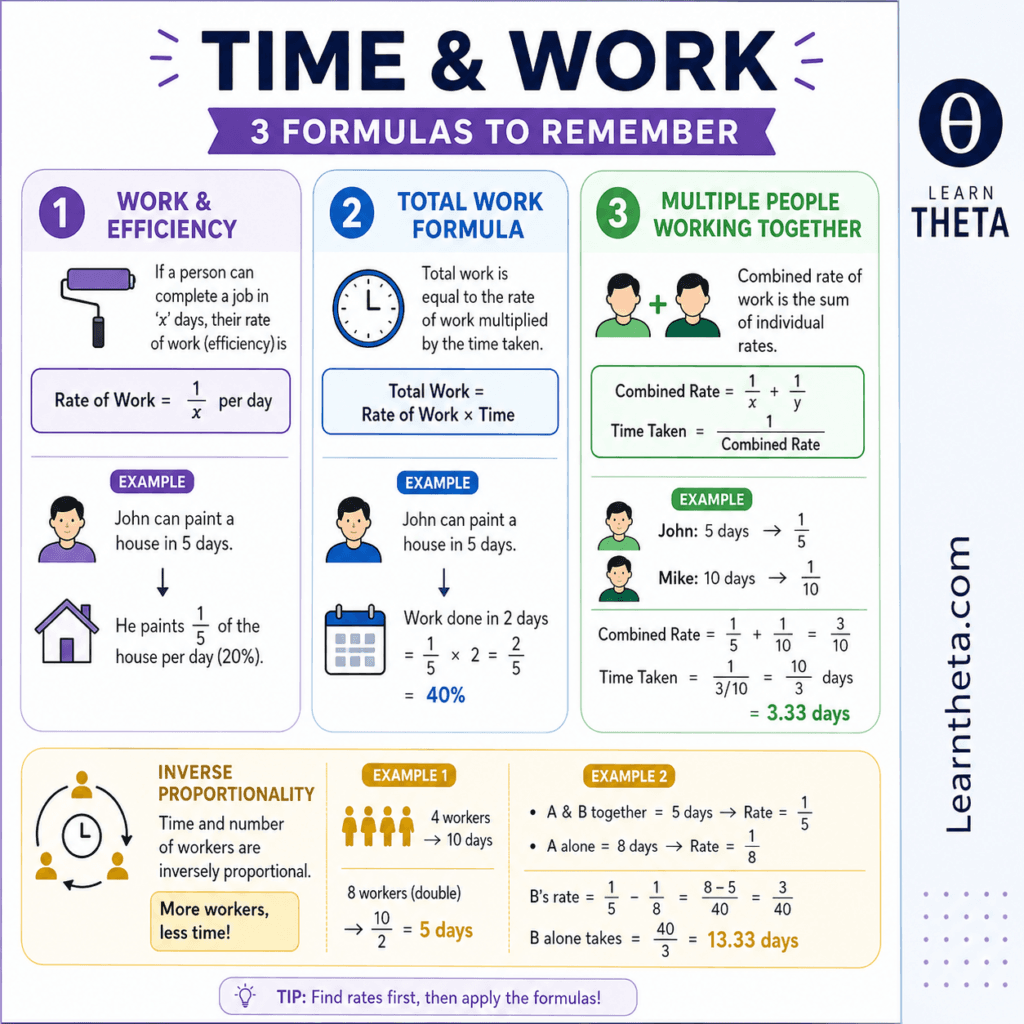
The work done is often considered as a whole unit (1 job or task).The efficiency of a worker is the amount of work they can complete in a unit of time (typically a day).If a person can complete a job in ‘x’ days, then their rate of work (efficiency) is $\frac{1}{x}$ per day.
Q: If John can paint a house in 5 days, then what portion of the house can he paint in 1 day?
Sol: His efficiency is $\frac{1}{5}$ of the house per day. This means John paints 20% of the house each day.
Formula 2: Total Work Formula
The total work is calculated as: Total Work = Rate of Work × Time Taken
Q: If John can paint a house in 5 days, then what portion of the house can he paint in 2 days?
Work Done=$\frac{1}{5} \times 2 = \frac{2}{5}$ = 40%
Formula 3: Multiple People Working Together
When more than one person works together, their combined work rate is the sum of their individual rates.
Combined Rate of Work=$ \frac{1}{x} + \frac{1}{y} $ , where ‘x’ and ‘y’ are the individual times taken by two workers.
Also, the time taken by two workers to complete a task together can be found by:
Time Taken= $\frac{1}{\text{Combined Rate of Work}}$
Q: If John can paint the house in 5 days and Mike can paint it in 10 days, then what is their combined rate of work? In how many days can they paint a house together?
Sol: Their combined rate of work is $= \frac{1}{5} + \frac{1}{10} = \frac{2}{10} + \frac{1}{10} = \frac{3}{10}$
So they can complete $\frac{3}{10}$ of the house in one day, or say they can complete entire house in $\frac{10}{3}$ days
Inverse Proportionality
Time and number of workers are inversely proportional. If the number of workers doubles, the time to complete the work is halved.
Q: If 4 workers can complete a task in 10 days, 8 workers will take______________ ?
Sol: 10/2 = 5days
Q: A and B can complete a task together in 5 days. A alone can complete the task in 8 days. How long will B take to complete the task alone?
Sol: A’s rate = $\frac{1}{8}$
Combined rate = $\frac{1}{5}$
B’s rate = $\frac{1}{5} – \frac{1}{8} = \frac{8 – 5}{40} = \frac{3}{40}$
So, B takes $\frac{40}{3} = 13.33$ days.
Formula 4: Pipes and Cisterns
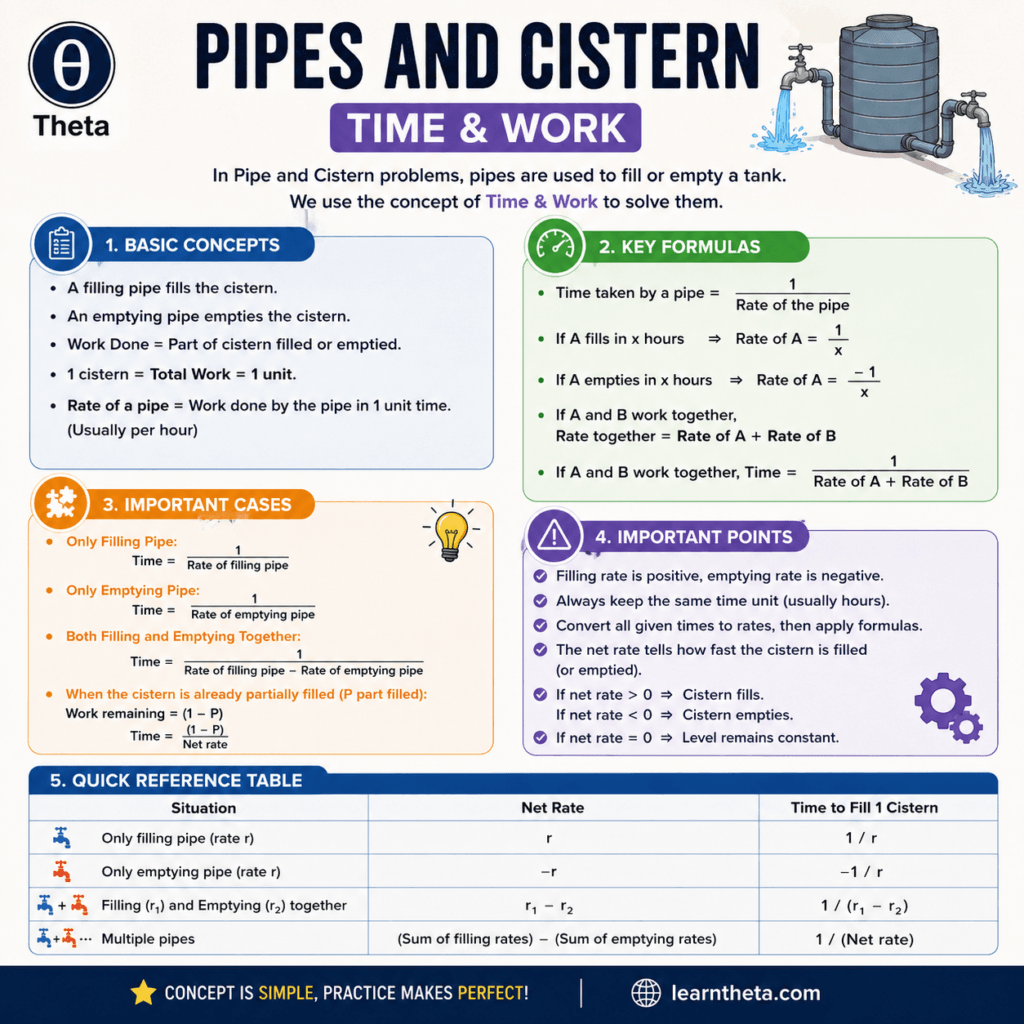
The Pipes and Cisterns problems are a variation of Time and Work problems, where instead of workers or machines, we deal with pipes filling or emptying tanks (cisterns). The key idea is to calculate the rate at which water (or any liquid) is added to or removed from a tank, based on how long it takes for a pipe to fill or empty the tank.
Filling the Tank:
- If a pipe can fill a tank in x hours, the rate of filling the tank is $\frac{1}{x}$ of the tank per hour.
- If multiple pipes are working together, their combined rate of filling the tank is the sum of their individual rates.
Emptying the Tank:
- If a pipe or tap can empty a tank in y hours, the rate of emptying the tank is $\frac{1}{y}$ of the tank per hour.
- If there is a pipe filling the tank and another pipe or tap emptying it, the net effect (combined rate) is the difference between the filling rate and the emptying rate.
Combined Rate (Filling and Emptying Together):
- If one pipe fills the tank at a rate of $\frac{1}{x}$ per hour and another pipe empties it at a rate of $\frac{1}{y}$ per hour, the net rate is:
- Net Rate $= \frac{1}{x} – \frac{1}{y}$
- If the rate is positive, the tank is being filled. If the rate is negative, the tank is being emptied
Q: A pipe can fill a tank in 6 hours. Another pipe can fill the same tank in 8 hours. If both pipes are opened together, how long will it take to fill the tank?
Sol: Rate of the first pipe (A) = $\frac{1}{6}$ (portion of the tank filled per hour).
Rate of the second pipe (B) = $\frac{1}{8}$
Combined Rate: Total Rate= $\frac{1}{6} + \frac{1}{8} = \frac{4 + 3}{24} = \frac{7}{24}$
So two pipes together fill $\frac{7}{24}$ of the tank per hour.
To fill the whole tank, time taken = 24/7≈3.43 hours
Q: Two pipes, A and B, can fill a tank in 4 hours and 6 hours, respectively. However, there is also a tap (C) that can empty the tank in 8 hours. If all three are working together (both filling pipes and the emptying tap), how long will it take to fill the tank?
Solution: Rate of Pipe A (Filling) = $\frac{1}{4}$ (portion of the tank filled per hour)
Rate of Pipe B (Filling) = $\frac{1}{6}$
Rate of Tap C (Emptying) = $\frac{1}{8}$ (portion of the tank emptied per hour)
The net rate is the sum of the rates of the filling pipes minus the rate of the emptying tap:
Net Rate= $\frac{1}{4} + \frac{1}{6} – \frac{1}{8}$
To simplify, we find a common denominator for 4, 6, and 8, which is 24
Net Rate$ = \frac{6}{24} + \frac{4}{24} – \frac{3}{24} = \frac{6 + 4 – 3}{24} = \frac{7}{24}$
Thus, the time taken to fill the tank is approximately = 24/7 = 3.43 hours.
Understand Time & Work with thse Videos
Time and Work Mini Test
1. A can complete a work in 10 days. In how many days can A complete half of the work?
2. A can do a piece of work in 12 days and B in 6 days. Working together they will finish in:
3. A can complete a work in 8 days and B in 12 days. If they work together, the work will be finished in:
4. A can finish a work in 15 days and B in 10 days. Working together they will complete the work in:
5. A can complete a work in 20 days and B in 30 days. Working together they will take:
Time and Work Problem Calculators
1. Two Persons Working Together
Days taken by Person A
Days taken by Person B
2. A Works Alone For Some Days Then B Joins
Days A alone worked
Total days A takes alone
Total days B takes alone
3. Work Efficiency Comparison
Days taken by A
Days taken by B
4. Work Completed In Given Days
Total days required to complete work
Number of days worked
Refer Topic: Distance, Time and Speed
Practice Time and Work Questions
Crack Exams with Adaptive Practice
Placement Tests | Bank Exams | SSC CGL | CAT Quant