
Class 9 Maths: Data | Practice Extra Questions
Q. 1 The populations of five cities were recorded as 74, 64, 15, 21, and 70. What was the average population of the cities?
Check Solution
Ans: C
Explanation: To find the average, sum the populations and divide by the number of cities (5). 74 + 64 + 15 + 21 + 70 = 244. 244 / 5 = 48.8
Q. 2 The average age of a class , including the teacher is 1.5 years more than the average age of the class when the teacher is not considered . If the teacher is 30 years older than the average age of the students , find the number of students in the class .
Check Solution
Ans: D
We can let n = the number of students and x = the average age of the students. So we have:
(30 + x + nx)/(n + 1) = x + 1.5
30 + x + nx = (x + 1.5)(n + 1)
30 + x + nx = nx + x + 1.5n + 1.5
30 = 1.5n + 1.5
1.5n = 28.5
n = 19
Q. 3 Two different alloys, labeled A and B, contain copper and zinc. Alloy A has a copper to zinc weight ratio of 8:1, while alloy B has a ratio of 2:7. It is determined that mixing alloy A and alloy B in a specific proportion results in a new alloy where the weight ratio of copper to zinc matches the mixing ratio. What is this mixing ratio?
Check Solution
Ans: D
Let, the ratio is K:1
SO, Copper : Zinc = 8k+2 : k+7
Now,
8k+2/k+7= k/1
solve for k, k=2
so the ratio is k:1=2:1
Q. 4 A class of 30 students has an average score of 75. If a new student joins and the average becomes 76, what did the new student score?
Check Solution
Ans: D
The total score of the original 30 students is 30×75 = 2250.
Let the score of the new student be y.
The new average for 31 students is:
(2250+y)/31 = 76
Multiplying both sides by 31 gives:
2250+y = 2356
y = 106.
Q. 5 6 tables and 12 chairs cost Rs. 7800. The average price of a table is Rs. 750. What is the average price of a chair?
Check Solution
Ans: B
According to the question,
6T + 12C = 7800
Average price of table = Rs. 750
Total price of tables= 750 × 6 = Rs. 4500
Total price of chairs= 7800 – 4500 = Rs. 3300
Average price of chairs= $\frac{3300}{12}$ = Rs. 275
Q. 6 What ratio of Rs. 15 per kg wheat needs to be mixed with Rs. 18 per kg wheat so that the resulting mixture is worth Rs. 17 per kg?
Check Solution
Ans: B
1. Let ‘x’ kg of Rs. 15 per kg wheat be mixed with ‘y’ kg of Rs. 18 per kg wheat.
2. The total cost of ‘x’ kg of Rs. 15 wheat = 15x
3. The total cost of ‘y’ kg of Rs. 18 wheat = 18y
4. The total cost of the mixture = 15x + 18y
5. The total weight of the mixture = x + y
6. The cost of the mixture per kg = (15x + 18y) / (x + y)
7. Given the mixture is worth Rs. 17 per kg: (15x + 18y) / (x + y) = 17
8. Solve for the ratio x/y:
15x + 18y = 17x + 17y
y = 2x
9. Therefore, x/y = 1/2
10. The ratio of the Rs. 15 per kg wheat to Rs. 18 per kg wheat is 1:2
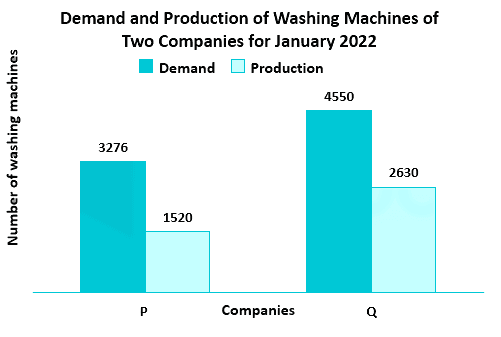
Q. 7 Study the given bar graph carefully and answer the following question. The demand of Company P is what percentage of the demand of Company Q?
Check Solution
Ans: D
Calculation
= 3276 divided by 4550, multiplied by 100
= 18 divided by 25, multiplied by 100
= 72 percent
The result is 72%
Q. 8 You mix petrol and kerosene from three identical containers. The mixtures are 4:1, 5:2, and 6:1. What’s the final petrol to kerosene ratio?
Check Solution
Ans: B
Three identical vessels in the ratio 4:1, 5:2 and 6 :1 respectively.
Petrol : kerosene
(4 : 1 = 5)7
(5 : 2 = 7)5
(6 : 1 = 7)5
28 : 7 = 35
25 : 10 = 35
30 : 5 = 35
83 : 22
Q. 9 Mix inferior wheat (Rs.14/kg) with superior wheat (Rs.28/kg) to make a mix that sells for Rs.20/kg, earning the shopkeeper Rs.2 profit/kg. What is the ratio of the wheat qualities?
Check Solution
Ans: B
1. Calculate the cost price of the mixture: Selling price – Profit = 20 – 2 = 18 Rs/kg
2. Apply the alligation rule: (Superior wheat price – Mixture price) : (Mixture price – Inferior wheat price) = Ratio of quantities
3. Substitute the values: (28 – 18) : (18 – 14)
4. Simplify: 10 : 4
5. Reduce the ratio: 5 : 2
Q. 10 A container holds a mixture of Orange, Apple, and Guava juices in the ratio of 5:7:4 respectively. 24 litres of this mixture is taken out, and then 10 litres of orange juice and 6 litres of guava juice are added to the vessel. If the resultant quantity of apple juice is 14 litres more than the resultant quantity of orange juice, what was the initial quantity of mixture in the vessel (in litres)?
Check Solution
Ans: A
Efficient Approach
Let the initial total volume of the mixture be represented by 16x.
The initial proportions are: Orange = 5x, Apple = 7x.
When 24 litres of the mixture are removed, the quantities of each component taken out are:
Orange removed = (5 / 16) * 24 = 7.5 litres
Apple removed = (7 / 16) * 24 = 10.5 litres
The difference between the resultant Apple and Orange volumes is given as 14 litres.
Resultant Apple volume = Initial Apple volume – Apple removed
Resultant Orange volume = Initial Orange volume – Orange removed + Orange added (which is 10L in the alternate method but the first method implies a net addition/removal)
The provided equation from the original explanation is:
(7x − 10.5) − (5x − 7.5 + 10) = 14
This simplifies to:
2x − 13 = 14
2x = 27
The initial total quantity is 16x.
Initial quantity = 16 * (27/2) = 216 litres.
Therefore, the correct answer is 216 litres.
Alternative Approach
Given information:
Ratio of Orange : Apple : Guava = 5 : 7 : 4
Volume of mixture extracted = 24 litres
Volume of juices added = 10 litres Orange, 6 litres Guava
Final difference between Apple and Orange juice = 14 litres
Calculations:
Total ratio parts initially = 5 + 7 + 4 = 16 parts
Let the initial total quantity of the mixture be 16x litres.
The initial volumes are: Orange = 5x, Apple = 7x, Guava = 4x.
Volume of Orange juice extracted = (5 / 16) * 24 = 7.5 litres
Volume of Apple juice extracted = (7 / 16) * 24 = 10.5 litres
After removing 24 litres and adding the specified juices, the new volumes are:
Resultant Orange juice = 5x – 7.5 + 10 = 5x + 2.5 litres
Resultant Apple juice = 7x – 10.5 litres
According to the problem statement, the difference is 14 litres:
(7x – 10.5) – (5x + 2.5) = 14
7x – 10.5 – 5x – 2.5 = 14
2x – 13 = 14
2x = 27
x = 13.5
The initial quantity of the mixture = 16x = 16 * 13.5 = 216 litres.
Thus, the correct answer is 216 litres.
Supplementary Concepts
Constant Ratio Principle
When a portion of a mixture is removed, the remaining mixture maintains the original proportions of its components. Altering these proportions solely occurs when individual components are selectively added or removed.
Replacement Method
When a specific volume of a mixture is entirely substituted with one of its pure constituents, the remaining quantity of that pure constituent can be determined using the formula:
Final Quantity = Initial Quantity * (1 – (Volume Removed / Total Volume))^n
where ‘n’ is the number of replacement cycles.
Alligation Rule
This method is utilized to determine the required ratio when two ingredients with differing values or concentrations are combined. The ratio is calculated as:
Ratio = (Higher Value – Mean Value) : (Mean Value – Lower Value)
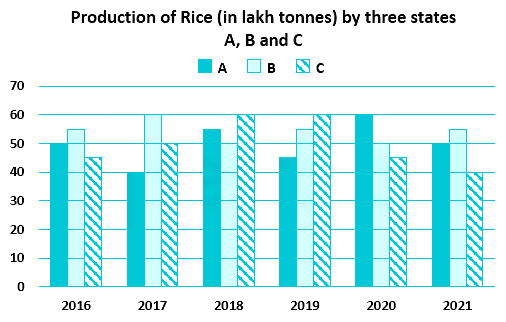
Q. 11 Select the correct statement with respect to the below bar graph.
Check Solution
Ans: D
Calculation:
Observation 1:
Amount of rice cultivated by Entity A during 2016 = 50 lakh metric tons
Amount of rice cultivated by Entity C during 2020 = 45 lakh metric tons
Observation 1 is not accurate.
Observation 2:
Amount of rice cultivated by Entity B during 2018 = 50 lakh metric tons
Amount of rice cultivated by Entity A during 2018 = 55 lakh metric tons
Amount of rice cultivated by Entity C during 2018 = 60 lakh metric tons
Observation 2 is not accurate.
Observation 3:
Total rice cultivation in 2017 = 40 + 60 + 50 = 150 lakh metric tons
Total rice cultivation in 2018 = 55 + 50 + 60 = 165 lakh metric tons
Observation 3 is not accurate.
Observation 4:
Amount of rice cultivated by Entity B during 2017 = 60 lakh metric tons
Amount of rice cultivated by Entity A during 2020 = 60 lakh metric tons
Observation 4 is accurate.
Therefore, the correct choice is 4.
Q. 12 Olivia combines 4 liters of a solution that is 40% sulfuric acid with 5 liters of another sulfuric acid solution of higher concentration. The final mixture totals 9 liters and has a sulfuric acid concentration of 50%. What is the percentage concentration of the sulfuric acid in the second solution?
Check Solution
Ans: C
Going by relation of mixtures
We know that
4(0.40) + 5 (x%) = 9 (0.50)
or, 5(x%) = 9(0.50)-4(0.40)
or, x% =2.9/ 5 = 0.58
ie x= 58 %
Q. 13 There is a 24-liter mixture of water and milk in a 3:5 ratio. How much more water needs to be added to change the ratio to 5:3?
Check Solution
Ans: D
Now, w:m :: 9:15 L
Lt x L water be added
5:3 :: (9+x):15
x=16 L
Q. 14 Mukesh has twice as much money as Soham. Soham has 50% more money than Pankaj. If the average money with them is Rs. 110, then Mukesh has
Check Solution
Ans: C
Explanation: Let the money Pankaj has be x. Soham has 50% more than Pankaj, so Soham has 1.5x. Mukesh has twice as much as Soham, so Mukesh has 2 * 1.5x = 3x. The average money they have is Rs. 110, so (x + 1.5x + 3x) / 3 = 110. This simplifies to 5.5x / 3 = 110. Therefore, 5.5x = 330, and x = 60. Mukesh has 3x, so Mukesh has 3 * 60 = 180.
Q. 15 The average weight of 3 children is 20 kg. The weight of Chinu is three times the weight of Bhavya and weight of Arshi is twice that of Bhavya, Find the weight of Chinu.
Check Solution
Ans: B
Explanation: Let the weight of Bhavya be x kg. Then the weight of Chinu is 3x kg and the weight of Arshi is 2x kg. The average weight of the 3 children is 20 kg, so their total weight is 3 * 20 = 60 kg. Therefore, x + 3x + 2x = 60. Simplifying gives 6x = 60, so x = 10 kg. The weight of Chinu is 3x = 3 * 10 = 30 kg.
Q. 16 A store combines 3/4 pint of red paint with 2/3 pint of white paint to create a color known as Perfect Pink. To produce 34 pints of Perfect Pink, how many pints of red paint are required?
Check Solution
Ans: C
To solve this problem, we first need to figure out the proportion of red paint in the original Perfect Pink mixture and then use that to scale up to the desired 34 pints.
From the problem, we know:
– 3/4 pint of red paint is used
– 2/3 pint of white paint is used
Total pints of Perfect Pink paint in the original mix are:
$ \frac{3}{4} + \frac{2}{3} $
We need a common denominator to add these fractions, which would be 12:
$ \frac{3 \times 3}{4 \times 3} + \frac{2 \times 4}{3 \times 4} = \frac{9}{12} + \frac{8}{12} = \frac{17}{12} \text{ pints of Perfect Pink} $
Now, we calculate the proportion of red paint in the mix:
$ \text{Proportion of red paint} = \frac{\text{Quantity of red paint}}{\text{Total quantity of paint mix}} = \frac{3/4}{17/12} $
To simplify:
$ \frac{3/4}{17/12} = \frac{3/4 \times 12/17} = \frac{3 \times 12}{4 \times 17} = \frac{36}{68} = \frac{18}{34} = \frac{9}{17} $
Thus, 9/17 of the Perfect Pink mix is red paint.
Now, we are asked to find the amount of red paint needed for 34 pints of Perfect Pink paint. We calculate:
$ \frac{9}{17} \times 34 \text{ pints} = 9 \times 2 = 18 \text{ pints of red paint} $
Therefore, 18 pints of red paint are needed to make 34 pints of Perfect Pink paint.
Q. 17 Two containers hold a mixture of petrol, diesel, and kerosene in the proportions 1:2:4 and 3:5:6 respectively. If equal amounts from each container are combined, what is the new ratio of petrol, diesel, and kerosene in the resulting mixture?
Check Solution
Ans: A
In order to find equal quantities to be mixed, we’ll need to find equivalent ratios such that the SUMS of the terms are equal.
Take the ratio
and multiply all terms by
to get the equivalent ratio:
Notice that
So, in
units of the first mixture, there are
units of petrol,
units of diesel and
units of kerosene.
Similarly,
units of the second mixture, there are
units of petrol,
units of diesel and
units of kerosene.
When we combine
units of each mixture, we get 28 units in the ratio: (
+
) : (
+
) : (
+
), which simplifies to be
Practice Extra Questions for Class 9 Maths