
Class 9 Maths: Circles | Practice Extra Questions
Q. 1 Angle in the same segment of a circle are ____.
Check Solution
Ans: A
Explanation: Angles in the same segment of a circle subtended by the same chord (or arc) are equal.
Correct Option: A
Q. 2 State T for true and F for false.
(i) A segment of a circle is the region between an arc and its chord.
(ii) The perpendicular bisector of a chord of a circle passes through the center.
(iii) The angle subtended by the diameter at any point on the circumference is a right angle.
Check Solution
Ans: A
Solution:
(i) T
(ii) T
(iii) T
Answer: T, T, T
Q. 3 Find the measure of arc PAQ.
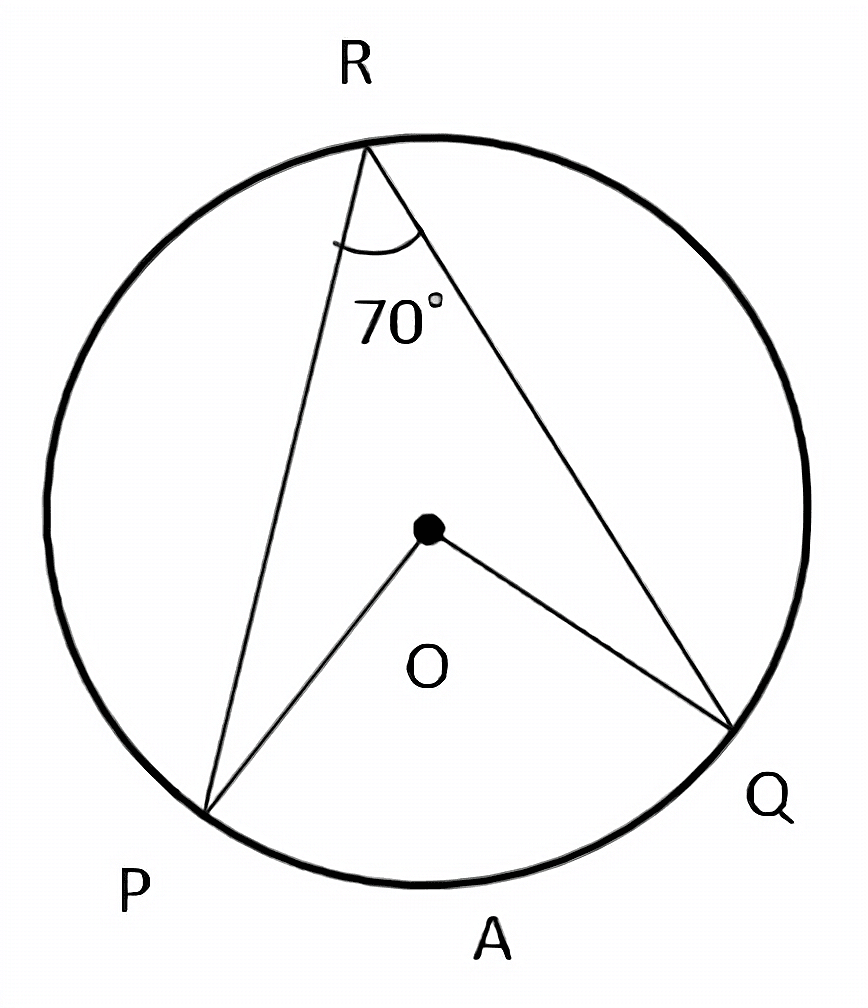
Check Solution
Ans: D
Answer: d
Explanation: The measure of an arc is equal to the angle it subtends at the center of the circle.
Therefore, m(arc PAQ) = ∠POQ.
Also, ∠POQ = 2∠PRQ because the angle subtended by an arc at the center of the circle is twice the angle subtended by the same arc on the circumference.
Hence, m(arc PAQ) = ∠POQ = 2∠PRQ = 140°.
Q. 4 The equation of a circle centered at $(3, -2)$ with a radius of 5 is $(x-3)^2 + (y+2)^2 = r^2$. What is the value of $r$?
Check Solution
Ans: D
Solution:
The equation of a circle with center $(h, k)$ and radius $r$ is given by $(x-h)^2 + (y-k)^2 = r^2$.
In the given equation, the center is $(3, -2)$ and the radius is 5.
Therefore, the equation is $(x-3)^2 + (y-(-2))^2 = 5^2$, which is $(x-3)^2 + (y+2)^2 = 25$.
Since the equation given is $(x-3)^2 + (y+2)^2 = r^2$, we have $r^2 = 5^2 = 25$.
Taking the square root of both sides, we get $r = 5$.
Answer: 5
Q. 5 Find the value of x if ABCD is a cyclic quadrilateral if ∠1 : ∠2 = 3 : 6.
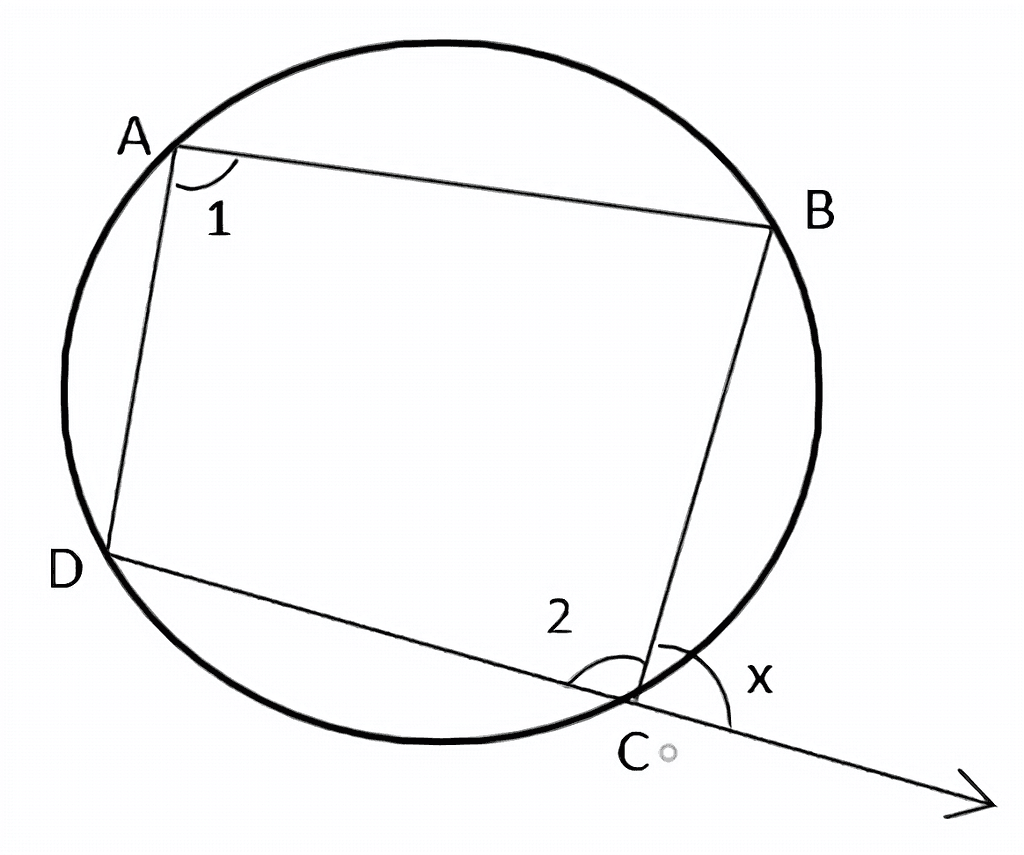
Check Solution
Ans: D
Answer: d
Explanation: Since ABCD is a cyclic quadrilateral, the sum of opposite angles is 180°.
Therefore, $\angle 1 + \angle 2 = 180°$.
Given the ratio $\angle 1 : \angle 2 = 3 : 6$, we can write $\angle 1 = 3k$ and $\angle 2 = 6k$.
Substituting, we get $3k + 6k = 180°$, which simplifies to $9k = 180°$. Thus, $k = 20°$.
Now, $x$ is an exterior angle, which is equal to the interior opposite angle, i.e., $x = \angle 1$.
Hence, $x = 3k = 3(20°) = 60°$.
Q. 6 The region between an arc and the two radii, joining the centre to the end points of the arc is called __________
Check Solution
Ans: C
Explanation: A sector of a circle is the region enclosed by two radii and the arc intercepted by those radii. An arc is a portion of the circumference of a circle. A chord is a line segment connecting two points on a circle. The area of a circle refers to the entire space enclosed within the circle.
Correct Option: C
Q. 7 A chord of length 12 cm is drawn in a circle of radius 10 cm. What is the distance from the center of the circle to the chord?
Check Solution
Ans: B
Solution:
Draw a radius to each end of the chord, forming an isosceles triangle. Draw a perpendicular from the center of the circle to the chord, bisecting the chord. This forms two right triangles. The hypotenuse of each right triangle is the radius (10 cm), and one leg is half the chord length (6 cm). Use the Pythagorean theorem: distance² + 6² = 10². Distance² = 100 – 36 = 64. Distance = 8 cm.
Answer: 8 cm
Q. 8 Two distinct circles can intersect at a maximum of how many points?
Check Solution
Ans: B
Solution: Two distinct circles can intersect at 0, 1, or 2 points. The maximum is 2.
Answer: 2
Q. 9 If PQRS is a cyclic quadrilateral and PQ is diameter, find the value of ∠PQS.
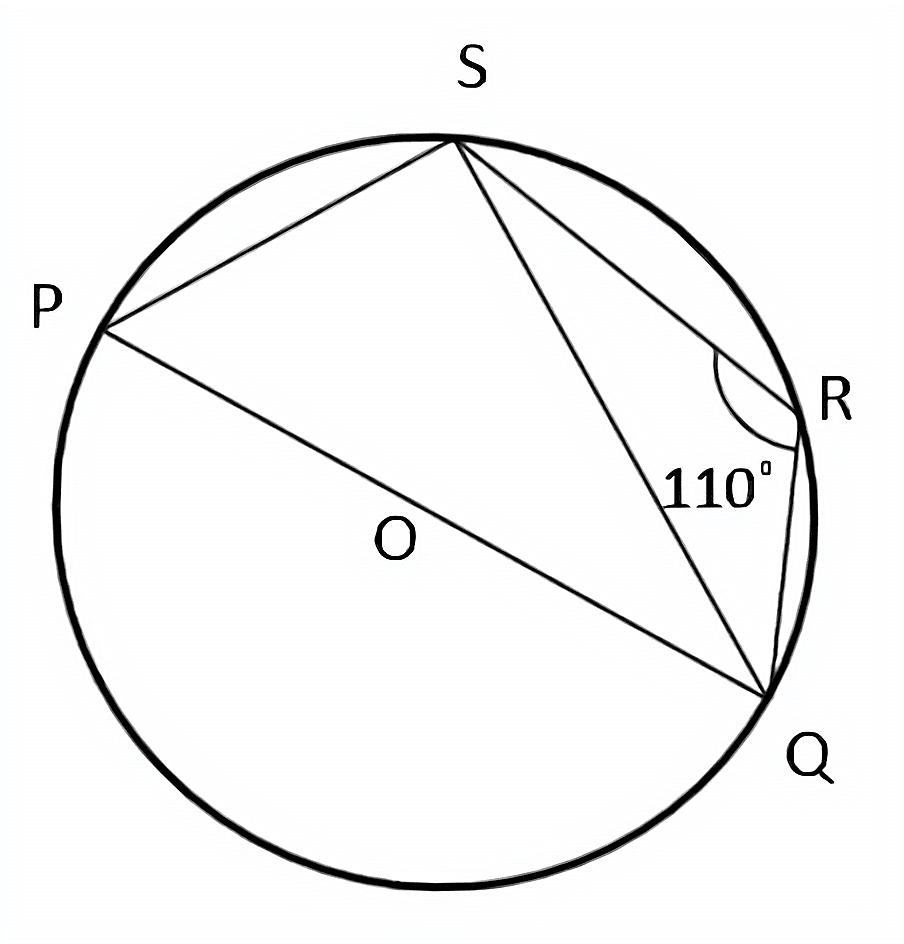
Check Solution
Ans: C
Answer: 20°
Explanation:
Since PQRS is a cyclic quadrilateral and PQ is a diameter, we know that angle $\angle PSQ$ is $90^\circ$ (angle in a semicircle).
We are not provided with the information about the value of $\angle QPS$ in the problem. The provided solution calculates $\angle QPS = 70^\circ$, which is needed to solve the problem. Let’s suppose that $\angle QPS = 70^\circ$.
In $\triangle PSQ$, the sum of the interior angles is $180^\circ$. Therefore:
$\angle PSQ + \angle SPQ + \angle PQS = 180^\circ$
Substituting the known values:
$90^\circ + 70^\circ + \angle PQS = 180^\circ$
$160^\circ + \angle PQS = 180^\circ$
$\angle PQS = 180^\circ – 160^\circ$
$\angle PQS = 20^\circ$
Q. 10 What is the length of AD if distance between centres of the two circles is 9cm?
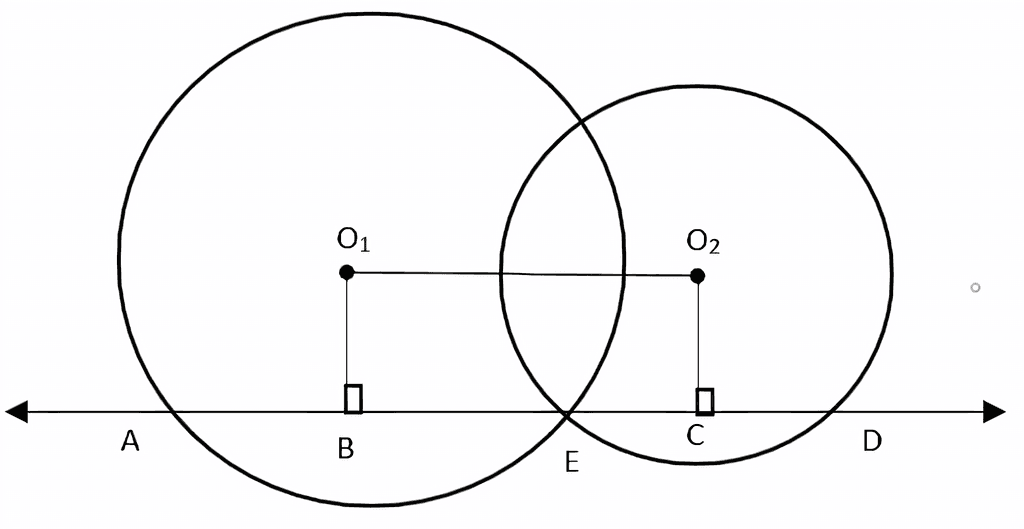
Check Solution
Ans: D
Answer: 18 cm
Explanation: Since $O_1B$ and $O_2B$ are perpendicular to the chord from the centers of the circles, the figure $O_1O_2CB$ forms a rectangle.
Therefore, $O_1O_2 = BC = 9$ cm (Equation i)
Also, a perpendicular from the center of a circle to a chord bisects the chord.
So, $AB = BE$ (Equation ii)
and $CE = CD$ (Equation iii)
Now, $AD = AB + BE + CE + CD$
$AD = 2BE + 2CE$ (From equations ii and iii)
$AD = 2(BE + CE)$
$AD = 2(BC)$
$AD = 2 \times 9 = 18$ cm (From equation i)
Q. 11 Find the equation of the circle with center (-1, 3) and a radius of 5.
Check Solution
Ans: D
Solution:
The standard equation of a circle with center (h, k) and radius r is (x – h)^2 + (y – k)^2 = r^2. In this case, (h, k) = (-1, 3) and r = 5. Substituting these values into the equation, we get (x – (-1))^2 + (y – 3)^2 = 5^2, which simplifies to (x + 1)^2 + (y – 3)^2 = 25.
Answer: (x + 1)^2 + (y – 3)^2 = 25
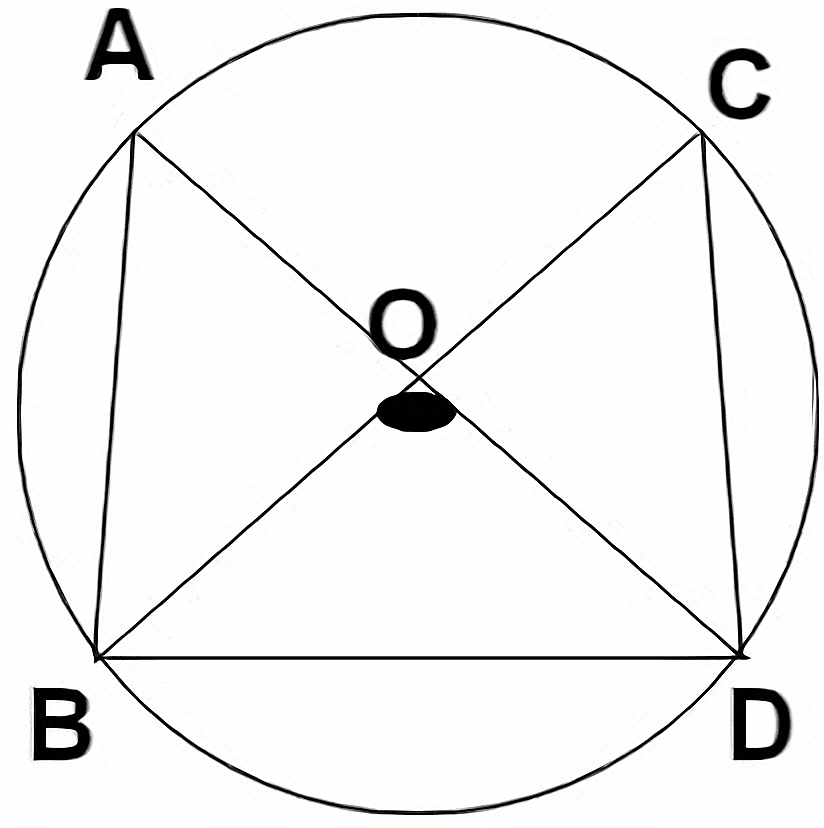
Q. 12 From the diagram given below, what is the relation between ∠BAC and ∠BCD?
Check Solution
Ans: A
Answer: a
Explanation:
Angles subtended by the same chord on the circumference of a circle are equal (Theorem 10.9). Angles $\angle BAC$ and $\angle BDC$ both subtend the same chord, $BC$. Therefore, $\angle BAC = \angle BDC$.
(Note: The original solution stated $\angle BAD = \angle BCD$, which is incorrect. The angles are $\angle BAC$ and $\angle BDC$. Also, the question in the prompt asked about $\angle BAC$ and $\angle BCD$, not $\angle BAD$. Thus I fixed the explanation.)
Q. 13 A right triangle has legs of length 12 cm and 16 cm. What is the radius of the circumcircle of this triangle?
Check Solution
Ans: C
Explanation: In a right triangle, the circumcenter (the center of the circumcircle) is located at the midpoint of the hypotenuse. The hypotenuse can be calculated using the Pythagorean theorem: a^2 + b^2 = c^2, where a and b are the lengths of the legs, and c is the length of the hypotenuse. In this case, 12^2 + 16^2 = c^2, which simplifies to 144 + 256 = c^2, and then to 400 = c^2. Therefore, c = 20 cm. The radius of the circumcircle is half the length of the hypotenuse, which is 20 cm / 2 = 10 cm.
Correct Option: C
Q. 14 A circular garden has a radius of 15 meters. Three friends, Emily, Jack, and Olivia, are positioned at equal distances from each other along the garden’s circumference. They use a long string to connect their positions. What is the length of the string connecting any two of the friends?
Check Solution
Ans: A
Solution: The friends form an equilateral triangle inscribed in the circle. The central angle subtended by each side is 360/3 = 120 degrees. The length of the string (side of the triangle) can be found using the law of cosines. Let s be the length of the string, and r = 15m be the radius. Then s^2 = r^2 + r^2 – 2*r*r*cos(120) = 2*15^2 – 2*15^2*(-0.5) = 3*15^2. So s = 15*sqrt(3).
Answer: 15√3
Q. 15 In a circle with a radius of 10 cm, two parallel chords, EF and GH, have lengths of 16 cm and 12 cm, respectively. Determine the distance between the chords if they lie on opposite sides of the circle’s center.
Check Solution
Ans: B
Solution:
Let O be the center of the circle. Let M and N be the midpoints of EF and GH, respectively. Then OM and ON are perpendicular to EF and GH, respectively. Also, EM = EF/2 = 8 cm, and GN = GH/2 = 6 cm.
In right triangle OME, $OM = \sqrt{OE^2 – EM^2} = \sqrt{10^2 – 8^2} = \sqrt{100-64} = \sqrt{36} = 6$ cm.
In right triangle ONG, $ON = \sqrt{OG^2 – GN^2} = \sqrt{10^2 – 6^2} = \sqrt{100-36} = \sqrt{64} = 8$ cm.
Since the chords are on opposite sides of the center, the distance between the chords is $OM + ON = 6 + 8 = 14$ cm.
Answer: 14 cm
Q. 16 Two parallel chords of lengths 24 cm and 10 cm are drawn on the same side of the center of a circle with a radius of 13 cm. Find the distance between the chords.
Check Solution
Ans: A
Solution:
Let the circle have center O and radius r = 13 cm. Let the chords be AB = 24 cm and CD = 10 cm. Let M and N be the midpoints of AB and CD, respectively. Then AM = AB/2 = 12 cm and CN = CD/2 = 5 cm. OM is perpendicular to AB and ON is perpendicular to CD. In right triangle OAM, $OM = \sqrt{OA^2 – AM^2} = \sqrt{13^2 – 12^2} = \sqrt{169 – 144} = \sqrt{25} = 5$ cm. In right triangle OCN, $ON = \sqrt{OC^2 – CN^2} = \sqrt{13^2 – 5^2} = \sqrt{169 – 25} = \sqrt{144} = 12$ cm. Since the chords are on the same side of the center, the distance between them is $|ON – OM| = |12 – 5| = 7$ cm.
Answer: 7 cm
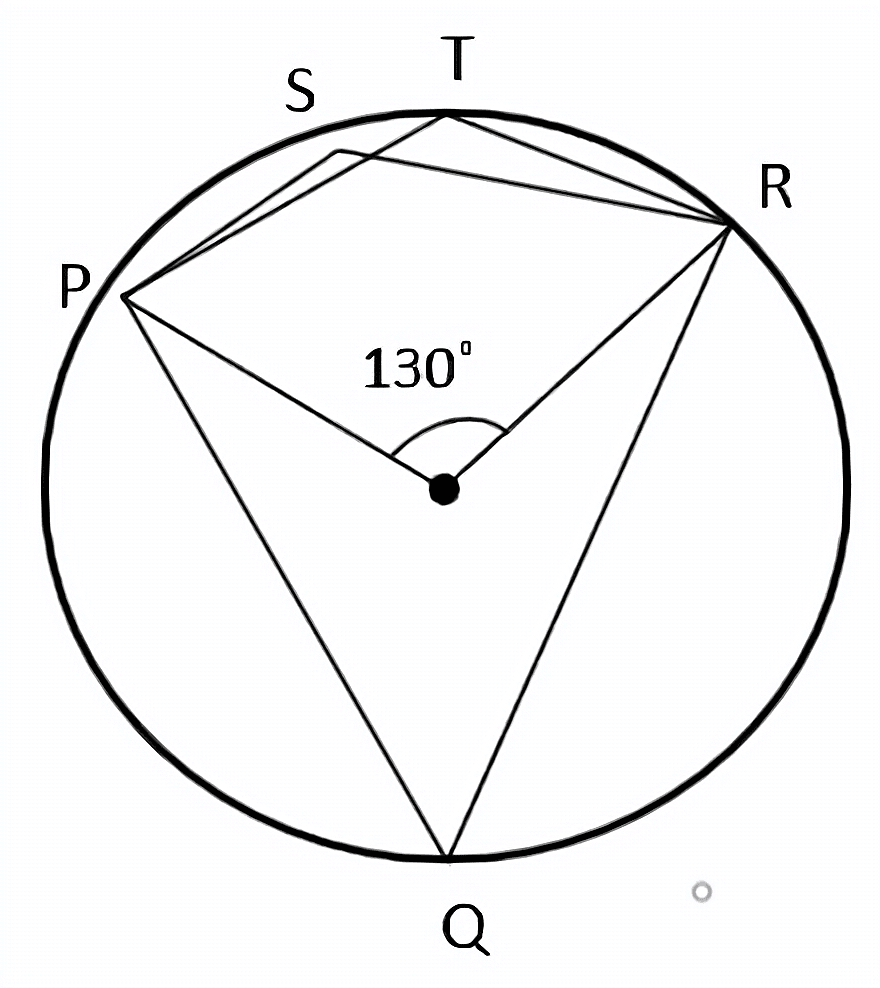
Q. 17 Find the value of ∠PTR if PQRS is a cyclic quadrilateral.
Check Solution
Ans: D
Answer: d
Explanation:
From the figure, $\angle POQ = 2\angle PQR$ (The angle subtended by an arc at the center is twice the angle subtended by the arc on the circumference).
Therefore, $\angle PQR = 65^\circ$.
Since PQRS is a cyclic quadrilateral, the sum of opposite angles is $180^\circ$. Thus, $\angle PQR + \angle PSR = 180^\circ$, which means $\angle PSR = 180^\circ – \angle PQR = 180^\circ – 65^\circ = 115^\circ$.
Angles subtended by an arc in the same segment are equal. Therefore, $\angle PTR = \angle PSR = 115^\circ$.
Q. 18 Four points A, B, C, and D lie on a circle. Lines AC and BD cross at point E. The angle BEC is 130 degrees, and angle ECD is 20 degrees. What is the measure of angle BAC?
Check Solution
Ans: A
Explanation:
1. Find angle CED: Angles BEC and CED are supplementary, so angle CED = 180 – 130 = 50 degrees.
2. Find angle EDC: In triangle ECD, the sum of angles is 180 degrees. So, angle EDC = 180 – angle CED – angle ECD = 180 – 50 – 20 = 110 degrees.
3. Find angle BAC: Angle BAC and angle BDC subtend the same arc (BC) in the circle. Therefore, angle BAC = angle BDC. Angle BDC = angle EDC = 110 degrees.
Correct Option: A
Q. 19 A circle has two parallel chords. One chord is 6 cm long, and the other is 8 cm long. The 6 cm chord is 4 cm away from the circle’s center. How far from the center is the 8 cm chord?
Check Solution
Ans: B
Explanation: Let the radius of the circle be $r$. Let the distance of the 6 cm chord from the center be $d_1 = 4$ cm and the distance of the 8 cm chord from the center be $d_2$. We consider two cases:
Case 1: The chords are on the same side of the center.
Draw a radius to the endpoints of the chords. Using the Pythagorean theorem: $(\frac{6}{2})^2 + d_1^2 = r^2$ and $(\frac{8}{2})^2 + d_2^2 = r^2$. Thus, $3^2 + 4^2 = 9 + 16 = 25 = r^2$. Also, $4^2 + d_2^2 = 16 + d_2^2 = r^2 = 25$. So, $d_2^2 = 25 – 16 = 9$, which means $d_2 = 3$.
Case 2: The chords are on opposite sides of the center.
In this case, the distance between the chords is $d_1 + d_2$.
$(\frac{6}{2})^2 + d_1^2 = r^2$ and $(\frac{8}{2})^2 + d_2^2 = r^2$.
$3^2 + 4^2 = r^2 \Rightarrow 25 = r^2$
$4^2 + d_2^2 = r^2 \Rightarrow 16 + d_2^2 = 25$
$d_2^2 = 9$ so $d_2 = 3$. However, $d_1 = 4$, if they are on opposite sides, $d_1 + d_2$ will equal the distance between the two chords.
Now let’s consider which case is valid from the given options.
We can have the distances from the center as 3cm. If so, since we know $d_1 = 4cm$, the 8cm chord must be 3cm from the center.
Consider a case where the chords are on opposite sides. Then the distance between the chords is the sum of the distances from the center.
In this case, the distance of the 6cm chord to the center is 4cm. $r = \sqrt{3^2 + 4^2} = 5$.
For the 8cm chord, $r = 5$, and $4^2 + d_2^2 = 5^2$.
Then $16 + d_2^2 = 25$, so $d_2 = 3$.
Then, distance between chords = 4 + 3 = 7.
So distance from the center is 3 cm.
Correct Option: B
Q. 20 Two circles have radii of 10 cm and 8 cm. They cross, and the shared line segment (chord) is 12 cm long. What’s the space between the centers of these circles?
Check Solution
Ans: D
Explanation:
Let the two circles have centers A and B and radii 10 cm and 8 cm respectively. Let the chord be CD, where CD = 12 cm. Let M be the midpoint of CD. Then AM is perpendicular to CD and BM is perpendicular to CD. Since M is the midpoint, CM = MD = 12/2 = 6 cm.
In triangle AMC, we have AC = 10 cm and CM = 6 cm. Using the Pythagorean theorem: AM^2 + CM^2 = AC^2, so AM^2 + 6^2 = 10^2, which gives AM^2 = 100 – 36 = 64. Thus, AM = 8 cm.
In triangle BMC, we have BC = 8 cm and CM = 6 cm. Using the Pythagorean theorem: BM^2 + CM^2 = BC^2, so BM^2 + 6^2 = 8^2, which gives BM^2 = 64 – 36 = 28. Thus, BM = sqrt(28) = 2*sqrt(7) cm.
Since AM and BM are both perpendicular to CD, A, M, and B are collinear. Therefore, the distance between the centers A and B is either AM + BM or |AM – BM|. Since the distance between the centers is on opposite sides of the chord, the distance between A and B is AM + BM. Hence, AB = AM + BM = 8 + 2*sqrt(7)
Alternatively, since the centers can be on the same side or opposite sides of the chord, there are two possibilities.
Case 1: Centers are on the same side. The distance is |AM – BM| = |8 – 2*sqrt(7)|.
Case 2: Centers are on the opposite sides. The distance is AM + BM = 8 + 2*sqrt(7).
Since the given problem does not specify the position of the centers, let’s assume they are on the opposite sides.
We know AM = 8 cm and BM = 2*sqrt(7) cm. Then distance AB = AM + BM = 8 + 2*sqrt(7) is wrong.
However if the centers are on the same side, then we have the distance |8-2sqrt(7)|.
The problem could mean that the centers lie on opposite sides of the chord.
If we consider that AM=8, CM=6, and radius of the second circle is 8, so BM = sqrt(8^2 – 6^2) = sqrt(64-36) = sqrt(28) = 2*sqrt(7). The distance between the centers is AM + BM = 8+2sqrt(7).
Correct Answer: 8 + 2*sqrt(7)