
CBSE Class 10 Maths Notes: Probability
Definitions: Probability Unveiled
Probability is a measure of the likelihood that an event will occur. It’s a fundamental concept in mathematics and statistics, helping us quantify uncertainty. Essentially, it tells us “how likely” something is to happen. Probability values range from 0 to 1, where 0 indicates impossibility and 1 indicates certainty.
Key Terms:
- Experiment: An action or process that leads to well-defined outcomes.
- Outcome: A possible result of an experiment.
- Event: A specific set of outcomes of an experiment.
- Sample Space: The set of all possible outcomes of an experiment.
Core Principles: Classical Probability
The classical (or theoretical) definition of probability assumes all outcomes in the sample space are equally likely.
Formula:
The probability of an event, $P(E)$, is calculated as:
$P(E) = \frac{\text{Number of favorable outcomes}}{\text{Total number of possible outcomes}}$
Where:
- Favorable outcomes are those that constitute the event E.
- The total number of possible outcomes is the size of the sample space.
Formulae & Calculations
Let’s break down some common probability scenarios with formulas:
Probability of an event not happening (complement):
$P(\text{not } E) = 1 – P(E)$
Probability of certain events:
$P(\text{certain event}) = 1$
Probability of impossible events:
$P(\text{impossible event}) = 0$
Examples: Rolling Dice, Flipping Coins & Drawing Cards
1. Flipping a Coin:
What is the probability of getting heads when flipping a fair coin?
Solution:
- Sample space: {Heads, Tails} (2 outcomes)
- Favorable outcome: Heads (1 outcome)
- $P(\text{Heads}) = \frac{1}{2} = 0.5$ or 50%
2. Rolling a Die:
What is the probability of rolling a 4 on a fair six-sided die?
Solution:
- Sample space: {1, 2, 3, 4, 5, 6} (6 outcomes)
- Favorable outcome: 4 (1 outcome)
- $P(\text{Rolling a 4}) = \frac{1}{6}$
3. Drawing a Card (Basic Case):
What is the probability of drawing an Ace from a standard deck of 52 playing cards?
Solution:
- Sample space: 52 cards (52 outcomes)
- Favorable outcome: 4 Aces (4 outcomes)
- $P(\text{Drawing an Ace}) = \frac{4}{52} = \frac{1}{13}$
Real-Life Examples: Probability in Action
Let’s see how probability pops up in everyday scenarios:
Example 1: Weather Forecasting
If a weather forecast predicts a 70% chance of rain, it’s expressing the probability of rain occurring.
Example 2: Insurance
Insurance companies use probability to estimate the likelihood of events (e.g., accidents, illnesses) to set premiums.
Example 3: Games of Chance
Games like lottery and other casino games are built upon probability. Players use it to understand their odds of winning.
Further Reading
- Classical (Theoretical) Probability: Definition
- Elementary Events & Probability Sum
- Sure & Impossible Events: Probability Values
- Range of Probability
- Complementary Events: Probability Relationship
- Probability Problems: Single Events
Practice Probability Extra Questions
Refer Probability NCERT Solutions
Refer Class 10 Math Notes & CBSE Syllabus
Conquer Maths & Science – with LearnTheta’s AI-Practice!

✅ All Topics at One Place
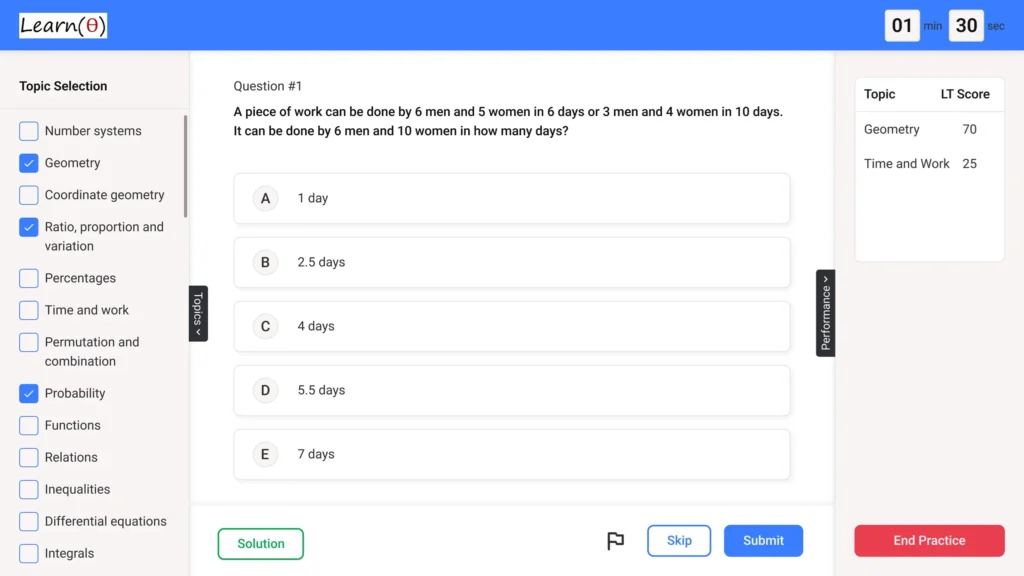
🤖 Adaptive Question Practice

📊 Progress and Insights