
Matching Puzzle: CAT Previous Year Questions
Q. 1 Instructions
Three reviewers Amal, Bimal, and Komal are tasked with selecting questions from a pool of 13 questions (Q01 to Q13). Questions can be created by external “subject matter experts” (SMEs) or by one of the three reviewers. Each of the reviewers either approves or disapproves a question that is shown to them. Their decisions lead to eventual acceptance or rejection of the question in the manner described below.
If a question is created by an SME, it is reviewed first by Amal, and then by Bimal. If both of them approve the question, then the question is accepted and is not reviewed by Komal. If both disapprove the question, it is rejected and is not reviewed by Komal. If one of them approves the question and the other disapproves it, then the question is reviewed by Komal. Then the question is accepted only if she approves it.
A question created by one of the reviewers is decided upon by the other two. If a question is created by Amal, then it is first reviewed by Bimal. If Bimal approves the question, then it is accepted. Otherwise, it is reviewed by Komal. The question is then accepted only if Komal approves it. A similar process is followed for questions created by Bimal, whose questions are first reviewed by Komal, and then by Amal only if Komal disapproves it. Questions created by Komal are first reviewed by Amal, and then, if required, by Bimal.
The following facts are known about the review process after its completion.
1. Q02, Q06, Q09, Q11, and Q12 were rejected and the other questions were accepted.
2. Amal reviewed only Q02, Q03, Q04, Q06, Q08, Q10, Q11, and Q13.
3. Bimal reviewed only Q02, Q04, Q06 through Q09, Q12, and Q13.
4. Komal reviewed only Q01 through Q05, Q07, Q08, Q09, Q11, and Q12.
How many questions were DEFINITELY created by Amal?
Check Solution
Ans: 3
For questions originated by external subject matter experts (SMEs), a minimum of two and a maximum of three reviews are necessary to determine their acceptance or rejection.
Questions developed by any of the individuals Amal, Bimal, or Komal can be accepted or rejected after either one or two reviews.
The provided data indicates:
Rejected questions: Q02, Q06, Q09, Q11, and Q12.
Accepted questions: Q01, Q03, Q04, Q05, Q07, Q08, Q10, Q13.
Reviewers for each question:
Amal: Q02, Q03, Q04, Q06, Q08, Q10, Q11, Q13.
Bimal: Q02, Q04, Q06, Q07, Q08, Q09, Q12, Q13.
Komal: Q01, Q02, Q03, Q04, Q05, Q07, Q08, Q09, Q11, Q12.
Analyzing each question:
Q01 was reviewed solely by Komal and was accepted. This implies it was likely prepared by Bimal, as it was accepted after a single review. (Bimal)
Q02 was reviewed by Amal, Bimal, and Komal and was rejected. This suggests it could have been prepared by an external expert and subsequently rejected by at least one of Amal, Bimal, or Komal. (SME)
Q03 was accepted and reviewed by Amal and Komal. Therefore, it must have been prepared by Bimal. (Bimal)
Q04 was accepted and reviewed by all three individuals (Amal, Bimal, and Komal). This indicates it was likely prepared by an external expert. (SME)
Q05 was reviewed only by Komal and was accepted. This means it must have been prepared by Bimal. (Bimal)
Q06 was rejected and reviewed by Amal and Bimal. It could have been prepared by Komal or an external expert, and then rejected by both Amal and Bimal. (Komal/SME)
Q07 was accepted and reviewed by Bimal and Komal. This implies it was prepared by Amal. (Amal)
Q08 was reviewed by Amal, Bimal, and Komal and was accepted. This suggests it was prepared by an external expert. (SME)
Q09 was reviewed by Bimal and Komal and was rejected. It must have been prepared by Amal and rejected by both reviewers. (Amal)
Q10 was reviewed by Amal and was accepted. It must have been prepared by Komal. (Komal)
Q11 was reviewed by Amal and Komal and was rejected. It must have been prepared by Bimal and rejected by both Amal and Komal. (Bimal)
Q12 was reviewed by Bimal and Komal and was rejected. It must have been prepared by Amal and rejected by both Bimal and Komal. (Amal)
Q13 was reviewed by Amal and Bimal and was accepted. The question could have been prepared by either Komal or an external expert. (Komal/SME)
Based on the analysis, Amal definitively prepared questions Q07, Q09, and Q12.
Q. 2 How many questions were DEFINITELY created by Komal?
Check Solution
Ans: 1
For questions originating from external subject matter experts (SMEs), a minimum of two reviews and a maximum of three reviews are required to determine acceptance or rejection.
Questions created by any of Amal, Bimal, or Komal can be finalized after one or two reviews.
The provided data indicates:
Rejected Questions: Q02, Q06, Q09, Q11, Q12.
Accepted Questions: Q01, Q03, Q04, Q05, Q07, Q08, Q10, Q13.
Reviewer participation:
Amal: Q02, Q03, Q04, Q06, Q08, Q10, Q11, Q13.
Bimal: Q02, Q04, Q06, Q07, Q08, Q09, Q12, Q13.
Komal: Q01, Q02, Q03, Q04, Q05, Q07, Q08, Q09, Q11, Q12.
Analysis:
Q01: Reviewed solely by Komal and accepted. This implies Bimal was the preparer, as acceptance occurred in a single review. (Bimal)
Q02: Reviewed by Amal, Bimal, and Komal, and rejected. This could indicate preparation by an external expert, facing rejection from one of the other reviewers. (SME)
Q03: Accepted and reviewed by Amal and Komal. This points to preparation by Bimal. (Bimal)
Q04: Accepted and reviewed by all three. This suggests preparation by an external expert. (SME)
Q05: Reviewed only by Komal and accepted. This indicates preparation by Bimal. (Bimal)
Q06: Rejected and reviewed by Amal and Bimal. This question could have been prepared by Komal or an external expert, and subsequently rejected by Bimal and Amal. (Komal/SME)
Q07: Accepted and reviewed by Bimal and Komal. This implies preparation by Amal. (Amal)
Q08: Reviewed by Amal, Bimal, and Komal, and accepted. This indicates preparation by an SME. (SME)
Q09: Reviewed by Bimal and Komal, and rejected. This question must have been prepared by Amal and was rejected by both reviewers. (Amal)
Q10: Reviewed by Amal and accepted. This indicates preparation by Komal. (Komal)
Q11: Reviewed by Amal and Komal, and rejected. This implies preparation by Bimal, facing rejection from both Amal and Komal. (Bimal)
Q12: Reviewed by Bimal and Komal, and rejected. This implies preparation by Amal, facing rejection from both Bimal and Komal. (Amal)
Q13: Reviewed by Amal and Bimal, and accepted. The preparer could be Komal or an SME. (Komal/SME)
Conclusion: Q10 was definitively prepared by Komal.
Q. 3 How many questions were DEFINITELY created by the SMEs?
Check Solution
Ans: 3
For questions authored by an external subject matter expert (SME), a minimum of two and a maximum of three reviews are necessary to determine acceptance or rejection.
If a question is authored by Amal, Bimal, or Komal, it can be accepted or rejected after one or two reviews.
The provided data indicates:
Rejected questions: Q02, Q06, Q09, Q11, Q12.
Accepted questions: Q01, Q03, Q04, Q05, Q07, Q08, Q10, Q13.
Authorship breakdown:
Amal: Q02, Q03, Q04, Q06, Q08, Q10, Q11, Q13.
Bimal: Q02, Q04, Q06, Q07, Q08, Q09, Q12, Q13.
Komal: Q01, Q02, Q03, Q04, Q05, Q07, Q08, Q09, Q11, Q12.
Analysis of each question:
Q01: Reviewed solely by Komal and accepted. This implies Bimal authored the question, as it was accepted after a single review. (Bimal)
Q02: Reviewed by Amal, Bimal, and Komal, and was rejected. This question could have been authored by an external expert and subsequently rejected by at least one of Amal, Bimal, or Komal. (SME)
Q03: Accepted and reviewed by Amal and Komal. This points to Bimal as the author. (Bimal)
Q04: Accepted and reviewed by all three (Amal, Bimal, Komal). This indicates authorship by an external expert. (SME)
Q05: Reviewed only by Komal and accepted. This means Bimal must have authored it. (Bimal)
Q06: Rejected and reviewed by Amal and Bimal. The author could be Komal or an external expert, with rejection occurring due to reviews from Bimal and Amal. (Komal/SME)
Q07: Accepted and reviewed by Bimal and Komal. The author must be Amal. (Amal)
Q08: Reviewed by Amal, Bimal, and Komal, and accepted. This question must have been authored by an SME. (SME)
Q09: Reviewed by Bimal and Komal, and rejected. This question must have been authored by Amal and rejected by both reviewers. (Amal)
Q10: Reviewed by Amal and accepted. This question must have been authored by Komal. (Komal)
Q11: Reviewed by Amal and Komal, and rejected. This question must have been authored by Bimal and rejected by both Amal and Komal. (Bimal)
Q12: Reviewed by Bimal and Komal, and rejected. This question must have been authored by Amal and rejected by both Bimal and Komal. (Amal)
Q13: Reviewed by Amal and Bimal, and accepted. The author could be Komal or an SME. (Komal/SME)
Questions Q02, Q04, and Q08 were prepared by SME.
Q. 4 How many questions were DEFINITELY disapproved by Bimal?
Check Solution
Ans: B
For questions authored by an external subject matter expert (SME), a minimum of two reviews and a maximum of three are required to determine acceptance or rejection.
Questions authored by Amal, Bimal, or Komal can be approved or rejected after either one or two reviews.
The provided data indicates:
* **Rejected questions:** Q02, Q06, Q09, Q11, Q12
* **Accepted questions:** Q01, Q03, Q04, Q05, Q07, Q08, Q10, Q13
Reviewer assignments are as follows:
* **Amal’s questions:** Q02, Q03, Q04, Q06, Q08, Q10, Q11, Q13
* **Bimal’s questions:** Q02, Q04, Q06, Q07, Q08, Q09, Q12, Q13
* **Komal’s questions:** Q01, Q02, Q03, Q04, Q05, Q07, Q08, Q09, Q11, Q12
**Analysis of each question:**
* **Q01:** Reviewed solely by Komal and accepted. This implies Bimal must have authored it, as it was accepted after a single review. (Authored by Bimal)
* **Q02:** Reviewed by Amal, Bimal, and Komal, and was rejected. This question could have been authored by an external expert (SME) and subsequently rejected by one of Amal, Bimal, or Komal. (Authored by SME)
* **Q03:** Accepted and reviewed by Amal and Komal. This indicates it was authored by Bimal. (Authored by Bimal)
* **Q04:** Accepted and reviewed by all three individuals. This suggests it was authored by an external expert (SME). (Authored by SME)
* **Q05:** Reviewed only by Komal and accepted. Therefore, Bimal must have authored it. (Authored by Bimal)
* **Q06:** Rejected and reviewed by Amal and Bimal. This question could have been authored by Komal or an external expert (SME) and rejected by Bimal and Amal. (Authored by Komal/SME)
* **Q07:** Accepted and reviewed by Bimal and Komal. This means Amal must have authored it. (Authored by Amal)
* **Q08:** Reviewed by Amal, Bimal, and Komal, and accepted. This indicates it was authored by an SME. (Authored by SME)
* **Q09:** Reviewed by Bimal and Komal and rejected. This question must have been authored by Amal and was rejected by both reviewers. (Authored by Amal)
* **Q10:** Reviewed by Amal and accepted. This question must have been authored by Komal. (Authored by Komal)
* **Q11:** Reviewed by Amal and Komal and rejected. This implies Bimal authored it and it was rejected by both Amal and Komal. (Authored by Bimal)
* **Q12:** Reviewed by Bimal and Komal and rejected. This question must have been authored by Amal and was rejected by both Bimal and Komal. (Authored by Amal)
* **Q13:** Reviewed by Amal and Bimal and accepted. The question could have been authored by Komal or an SME. (Authored by Komal/SME)
Considering the scenarios:
* For Q06, regardless of whether it was authored by Komal or an SME, Bimal must have rejected it.
* For Q07, Q09, and Q12, which were authored by Amal, they were reviewed by Bimal first, followed by Komal. For this sequence to occur, Bimal must have rejected these questions.
Therefore, Bimal rejected a total of four questions.
Q. 5 The approval ratio of a reviewer is the ratio of the number of questions (s)he approved to the number of questions (s)he reviewed. Which option best describes Amal’s approval ratio?
Check Solution
Ans: D
For a question originated by an external subject matter expert (SME), a minimum of two and a maximum of three reviews are required to determine its acceptance or rejection.
Questions composed by any of the individuals Amal, Bimal, or Komal can be approved or rejected after one or two reviews.
The provided data indicates:
Rejected questions: Q02, Q06, Q09, Q11, Q12.
Accepted questions: Q01, Q03, Q04, Q05, Q07, Q08, Q10, Q13.
Reviewer assignments:
Amal: Q02, Q03, Q04, Q06, Q08, Q10, Q11, Q13.
Bimal: Q02, Q04, Q06, Q07, Q08, Q09, Q12, Q13.
Komal: Q01, Q02, Q03, Q04, Q05, Q07, Q08, Q09, Q11, Q12.
Deductions:
Q01: Reviewed solely by Komal and accepted. This implies Bimal must have prepared it, as it was accepted in a single review. (Prepared by Bimal)
Q02: Reviewed by Amal, Bimal, and Komal, and was rejected. This suggests it might have been prepared by an external expert, who then faced rejection from at least one of Amal, Bimal, or Komal. (Prepared by SME)
Q03: Accepted and reviewed by Amal and Komal. This indicates it was prepared by Bimal. (Prepared by Bimal)
Q04: Accepted and reviewed by all three (Amal, Bimal, and Komal). This means it must have been prepared by an external expert. (Prepared by SME)
Q05: Reviewed only by Komal and accepted. This implies it was prepared by Bimal. (Prepared by Bimal)
Q06: Rejected and reviewed by Amal and Bimal. It could have been prepared by Komal or an external expert, and subsequently rejected by Bimal and Amal. (Prepared by Komal/SME)
Q07: Accepted and reviewed by Bimal and Komal. This suggests it was prepared by Amal. (Prepared by Amal)
Q08: Reviewed by Amal, Bimal, and Komal, and accepted. This indicates it was prepared by an SME. (Prepared by SME)
Q09: Reviewed by Bimal and Komal, and rejected. This implies it was prepared by Amal and rejected by both reviewers. (Prepared by Amal)
Q10: Reviewed by Amal and accepted. This means it must have been prepared by Komal. (Prepared by Komal)
Q11: Reviewed by Amal and Komal, and rejected. This indicates it was prepared by Bimal and rejected by both Amal and Komal. (Prepared by Bimal)
Q12: Reviewed by Bimal and Komal, and rejected. This implies it was prepared by Amal and rejected by both Bimal and Komal. (Prepared by Amal)
Q13: Reviewed by Amal and Bimal, and accepted. The question could have been prepared by either Komal or an SME. (Prepared by Komal/SME)
Amal’s review actions on specific questions:
Amal reviewed: Q02, Q03, Q04, Q06, Q08, Q10, Q11, Q13.
For Q02: Amal could have approved or rejected.
For Q03: Amal must have approved.
For Q04: Amal could have approved or rejected.
For Q06: Amal must have rejected.
For Q08: Amal could have approved or rejected.
For Q10: Amal must have approved.
For Q11: Amal must have rejected.
For Q13: Amal could have approved or rejected.
The approval ratio is between a minimum of 2 questions (specifically Q03 and Q10) and a maximum of 6 questions (Q02, Q03, Q04, Q08, Q10, Q13).
Thus, the approval ratio ranges from 2/8 = 0.25 to 6/8 = 0.75.
Q. 6 How many questions created by Amal or Bimal were disapproved by at least one of the other reviewers?
Check Solution
Ans: C
For questions developed by outside subject matter experts (SMEs), a minimum of two and a maximum of three reviews are necessary to determine their acceptance or rejection.
Questions developed by Amal, Bimal, or Komal can be reviewed after a single review or two reviews.
The provided information indicates the following outcomes:
Rejected: Q02, Q06, Q09, Q11, and Q12.
Accepted: Q01, Q03, Q04, Q05, Q07, Q08, Q10, Q13.
The reviewers for each question are as follows:
Amal: Q02, Q03, Q04, Q06, Q08, Q10, Q11, Q13.
Bimal: Q02, Q04, Q06, Q07, Q08, Q09, Q12, Q13.
Komal: Q01, Q02, Q03, Q04, Q05, Q07, Q08, Q09, Q11, Q12.
Analysis of each question:
Q01: Reviewed only by Komal and accepted. This implies Bimal prepared the question, as it was accepted in a single review. (Prepared by Bimal)
Q02: Reviewed by Amal, Bimal, and Komal and was rejected. This question could have been prepared by an external expert and rejected by one of the other reviewers. (Prepared by SME)
Q03: Accepted and reviewed by Amal and Komal. This indicates it was prepared by Bimal. (Prepared by Bimal)
Q04: Accepted and reviewed by all three. This suggests it was prepared by an external expert. (Prepared by SME)
Q05: Reviewed only by Komal and accepted. This implies it was prepared by Bimal. (Prepared by Bimal)
Q06: Rejected and reviewed by Amal and Bimal. This question could have been prepared by Komal or an external expert and rejected by both Amal and Bimal. (Prepared by Komal/SME)
Q07: Accepted and reviewed by Bimal and Komal. This means it must have been prepared by Amal. (Prepared by Amal)
Q08: Reviewed by Amal, Bimal, and Komal and accepted. This indicates it was prepared by an external expert. (Prepared by SME)
Q09: Reviewed by Bimal and Komal and rejected. This implies it was prepared by Amal and rejected by both Bimal and Komal. (Prepared by Amal)
Q10: Reviewed by Amal and accepted. This indicates it was prepared by Komal. (Prepared by Komal)
Q11: Reviewed by Amal and Komal and rejected. This implies it was prepared by Bimal and rejected by both Amal and Komal. (Prepared by Bimal)
Q12: Reviewed by Bimal and Komal and rejected. This implies it was prepared by Amal and rejected by both Bimal and Komal. (Prepared by Amal)
Q13: Reviewed by Amal and Bimal and accepted. The question could have been prepared by Komal or an external expert. (Prepared by Komal/SME)
Amal could have possibly created questions Q07, Q09, and Q12. All three of these were reviewed by two individuals each, suggesting they were rejected by the first reviewer.
Bimal could have created the questions: Q01, Q03, Q05, and Q11.
Q01 and Q05 were reviewed only by Komal and did not experience any rejection.
Q03 and Q11 faced at least one rejection.
Therefore, a total of five questions.
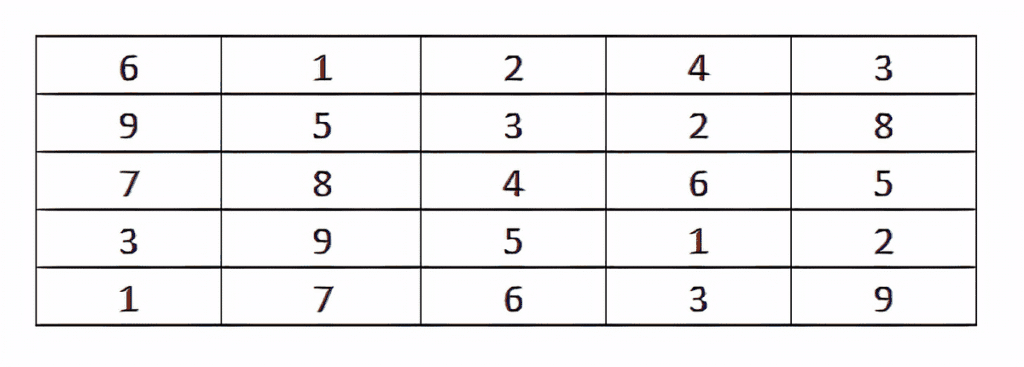
Q. 7 Instructions
In a square layout of site 5m ~ 5m 25 equal-sized square platforms of different heights are built. The heights (in metre) of individual platforms are as shown below:
Individuals (all of same height) are seated on these platforms. We say an individual A can reach individual B, if all the three following conditions are met;
(i) A and B are In the same row or column
(ii) A is at a lower height than B
(iii) If there is/are any individuals (s) between A and B, such individual(s) must be at a height lower than that of A.
Thus in the table given above, consider the Individual seated at height 8 on 3rd row and 2nd column. He can be reached by four individuals. He can be reached by the individual on his left at height 7, by the two individuals on his right at heights of 4 and 6 and by the individual above at height 5.
Rows in the layout are numbered from top to bottom and columns are numbered from left to right.
Which of the following is true for any individual at a platform of height 1 m in this layout?
Check Solution
Ans: D
As it’s established that an individual is only accessible to those numerically smaller than them, consequently, the number 1 is not reachable by any other number. Therefore, option D represents the correct choice.
Q. 8 We can find two individuals who cannot be reached by anyone in
Check Solution
Ans: C
Consider the provided choices.
In the final row, a single entity lacks inbound connections from any other entity.
In the fourth row from the top, a solitary entity cannot be accessed by any other entity.
Within the central column, every entity receives connections from at least one other entity.
In the fourth column, entities labeled ‘1’ and ‘2’ are not reachable by any other entity. Therefore, the fourth column represents the correct selection.
Q. 9 Which of the following statements is true about this layout?
Check Solution
Ans: C
Let us evaluate each choice.
Choice A: In the initial row, the number 6 is associated with 3, while 1, 2, and 3 are not connected to any other numbers. Additionally, 4 is connected to 3. Therefore, this choice is invalid.
Choice B: Observing the third row, each element receives input from other elements.
Choice D: In the initial row, the number 6 is linked to 3, while 1, 2, and 3 are not linked to any other numbers. Furthermore, 4 is linked to 3. Consequently, this choice is invalid.
Based on this analysis, Choice C is the correct answer.
Q. 10 Instructions
In an 8 X 8 chess board a queen placed any where can attack another piece if the piece is present in the same row, or in the same column or in any diagonal position in any possible 4 directions, provided there is no other piece in between in the path from the queen to that piece.
The columns are labelled a to h (left to right) and the rows are numbered 1 to 8 (bottom to top). The position of a piece is given by the combination of column and row labels. For example, position c5 means that the piece is in $c^{th}$ column and $5^{th}$ row.
If the queen is at c5, and the other pieces at positions c2, g1, g3, g5 and a3, how many are under attack by the queen? There are no other pieces on the board.
Check Solution
Ans: C
Explanation:The queen is at position c5. The other pieces are at c2, g1, g3, g5, and a3.
A queen attacks pieces in the same row, same column, or along any diagonal.
1. **Same Row:** The queen is in row 5. Is there any piece in row 5? Yes, there is a piece at g5. This piece is under attack.
2. **Same Column:** The queen is in column ‘c’. Is there any piece in column ‘c’? Yes, there is a piece at c2. This piece is under attack.
3. **Diagonals:**
* **Diagonal 1 (Top-Left to Bottom-Right):** The queen is at c5. Pieces on this diagonal have a constant difference between their column index (a=1, b=2, c=3, …) and their row number.
* c5 -> column 3, row 5. Difference = 3 – 5 = -2.
* Let’s check the other pieces:
* c2 -> column 3, row 2. Difference = 3 – 2 = 1. Not on this diagonal.
* g1 -> column 7, row 1. Difference = 7 – 1 = 6. Not on this diagonal.
* g3 -> column 7, row 3. Difference = 7 – 3 = 4. Not on this diagonal.
* a3 -> column 1, row 3. Difference = 1 – 3 = -2. This piece is on the same diagonal as the queen. However, the queen is at c5 (column 3, row 5) and the piece is at a3 (column 1, row 3). To go from c5 to a3, we move left 2 columns and down 2 rows. This is a diagonal attack. Is there any piece between c5 and a3? No, because the intermediate squares would be b4. There is no piece at b4. So, a3 is under attack.
* **Diagonal 2 (Top-Right to Bottom-Left):** The queen is at c5. Pieces on this diagonal have a constant sum of their column index and their row number.
* c5 -> column 3, row 5. Sum = 3 + 5 = 8.
* Let’s check the other pieces:
* c2 -> column 3, row 2. Sum = 3 + 2 = 5. Not on this diagonal.
* g1 -> column 7, row 1. Sum = 7 + 1 = 8. This piece is on the same diagonal as the queen. The queen is at c5 (column 3, row 5) and the piece is at g1 (column 7, row 1). To go from c5 to g1, we move right 4 columns and down 4 rows. This is a diagonal attack. Is there any piece between c5 and g1? The intermediate squares are d4, e3, f2. There are no pieces at these intermediate squares. So, g1 is under attack.
* g3 -> column 7, row 3. Sum = 7 + 3 = 10. Not on this diagonal.
* a3 -> column 1, row 3. Sum = 1 + 3 = 4. Not on this diagonal.
The pieces under attack are:
* g5 (same row)
* c2 (same column)
* a3 (diagonal)
* g1 (diagonal)
Therefore, 4 pieces are under attack.
Correct_Option:C