
Distribution allocation: CAT Previous Year Questions
Q. 1 Instructions
Two students, Amiya and Ramya are the only candidates in an election for the position of class representative. Students will vote based on the intensity level of Amiya’s and Ramya’s campaigns and the type of campaigns they run. Each campaign is said to have a level of 1 if it is a staid campaign and a level of 2 if it is a vigorous campaign. Campaigns can be of two types, they can either focus on issues, or on attacking the other candidate.
If Amiya and Ramya both run campaigns focusing on issues, then
• The percentage of students voting in the election will be 20 times the sum of the levels of campaigning of the two students. For example, if Amiya and Ramya both run vigorous campaigns, then 20 × (2+2)%, that is, 80% of the students will vote in the election.
• Among voting students, the percentage of votes for each candidate will be proportional to the levels of their campaigns. For example, if Amiya runs a staid (i.e., level 1) campaign while Ramya runs a vigorous (i.e., level 2) campaign, then Amiya will receive 1/3 of the votes cast, and Ramya will receive the other 2/3. The above-mentioned percentages change as follows if at least one of them runs a campaign attacking their opponent.
• If Amiya runs a campaign attacking Ramya and Ramya runs a campaign focusing on issues, then 10% of the students who would have otherwise voted for Amiya will vote for Ramya, and another 10% who would have otherwise voted for Amiya, will not vote at all.
• If Ramya runs a campaign attacking Amiya and Amiya runs a campaign focusing on issues, then 20% of the students who would have otherwise voted for Ramya will vote for Amiya, and another 5% who would have otherwise voted for Ramya, will not vote at all.
• If both run campaigns attacking each other, then 10% of the students who would have otherwise voted for them had they run campaigns focusing on issues, will not vote at all.
If both of them run staid campaigns attacking the other, then what percentage of students will vote in the election?
Check Solution
Ans: D
Explanation:The question states that both Amiya and Ramya run staid campaigns attacking the other. This means both have a campaign level of 1 and both are attacking campaigns.
We need to find the percentage of students who will vote in the election under this specific scenario.
The instructions detail how the percentages change when at least one candidate runs an attacking campaign. The specific condition for “both run campaigns attacking each other” is given as: “If both run campaigns attacking each other, then 10% of the students who would have otherwise voted for them had they run campaigns focusing on issues, will not vote at all.”
First, let’s determine the scenario if they were focusing on issues. If both Amiya and Ramya run staid campaigns (level 1) focusing on issues:
The percentage of students voting in the election will be 20 times the sum of the levels of campaigning of the two students.
Sum of levels = Level of Amiya’s campaign + Level of Ramya’s campaign = 1 + 1 = 2.
Percentage of students voting = 20 * (sum of levels) = 20 * 2 = 40%.
Now, we apply the condition for when both run campaigns attacking each other: “10% of the students who would have otherwise voted for them had they run campaigns focusing on issues, will not vote at all.”
This means 10% of the 40% who would have voted will now not vote.
Percentage of students who will not vote = 10% of 40% = 0.10 * 40% = 4%.
The percentage of students who will vote in the election is the percentage who would have voted minus the percentage who will now not vote due to attacking campaigns.
Percentage of students voting = 40% – 4% = 36%.
Therefore, if both of them run staid campaigns attacking the other, 36% of students will vote in the election.
Correct_Option:D
Q. 2 What is the minimum percentage of students who will vote in the election?
Check Solution
Ans: D
To achieve the minimum vote share, both candidates should conduct subdued campaigns.
Furthermore, both campaigns should be confrontational. This is because when one candidate adopts a confrontational approach and the other focuses on issues, a significant portion of voters shift their allegiance.
This suggests a situation where both campaigns are subdued and confrontational, mirroring the scenario previously discussed.
If both Ramya and Amiya opt for subdued campaigns, the intensity of each subdued campaign is 1.
Consequently, the combined voter share they would secure if they concentrated on issues is 20% * (1 + 1) = 40%.
This implies that if both had campaigned on issues, each would have garnered 20% of the votes.
We are informed that both candidates engage in confrontational campaigns.
The rule for mutual confrontational campaigns dictates that 10% of voters who would have otherwise supported each candidate will refrain from voting.
Therefore, 10% of each candidate’s potential 20% vote share will be lost due to the mutually confrontational nature of their campaigns.
This results in each candidate securing 18% of the votes.
The total votes secured amount to 36%, representing the lowest possible outcome.
Q. 3 If Amiya runs a campaign focusing on issues, then what is the maximum percentage of votes that she can get?
Check Solution
Ans: A
The objective is to determine the highest possible vote percentage for Amiya.
This translates to maximizing the number of voters who cast their ballot for Amiya, implying a strong campaigning effort.
To boost Amiya’s vote share, the goal is to shift as many voters as possible from Ramya’s support base to Amiya’s.
Given that a candidate’s vote count is directly related to their campaign’s intensity, it is advantageous for Ramya to also conduct an aggressive and confrontational campaign, thereby causing voters to switch to Amiya.
In this situation, 20 times the sum of 2 and 2 percent, which equals 80% of the populace, are participating in the election. Of this voting group, if both candidates had focused on issue-based campaigns, each would have secured 40% of the votes.
Now, the scenario shifts to Ramya conducting a negative campaign. This results in 20% of the voters who would have otherwise voted for Ramya now casting their vote for Amiya.
Therefore, 20% of Ramya’s potential 40% share is transferred to Amiya, amounting to an 8% increase in Amiya’s votes. Additionally, it is stated that 5% of those who would have voted for Ramya abstain from voting. This means 5% of Ramya’s 40% potential votes do not materialize, representing 2% of the total voters.
The final vote distribution shows Amiya securing 48% of the votes, while Ramya receives 30%.
Q. 4 If Ramya runs a campaign attacking Amiya, then what is the minimum percentage of votes that she is guaranteed to get?
Check Solution
Ans: B
We aim to determine the lowest possible vote count for Ramya when she conducts an aggressive campaign.
To achieve this minimum, consider Ramya opting for a subdued campaign approach, representing the least impactful strategy. In this scenario, if she were to campaign on issues, she would secure 20% of the total votes.
However, given her decision to run an attacking campaign, this results in a loss of support. Specifically, she will cede 20% of her potential votes to Amiya, and an additional 5% of voters will abstain from participating altogether.
Collectively, this represents a 25% reduction in her potential vote share. Consequently, the votes Ramya will retain are 75% of her initial 20% target, leaving her with a final share of 15% of the total votes.
Q. 5 What is the maximum possible voting margin with which one of the candidates can win?
Check Solution
Ans: B
The objective is to determine the smallest number of votes Ramya can secure while simultaneously maximizing Amiya’s vote count.
We can adapt the context from a prior problem, focusing on minimizing Ramya’s votes. To achieve this minimum, Ramya could conduct a subdued campaign, resulting in a base of 20% of the votes if she had campaigned on issues. However, by running an aggressive campaign, she forfeits 20% of these potential votes to Amiya, and an additional 5% choose not to vote.
This constitutes a 25% reduction. The votes Ramya secures are consequently 75% of her initial 20%, leaving her with 15% of the total votes.
To maximize Amiya’s votes, she could launch a robust campaign focused on issues, attracting double the base 20%, equating to 40% of the votes. Furthermore, due to Ramya’s aggressive tactics, 20% of the votes initially leaning towards Ramya are now diverted to Amiya. This represents 20% of Ramya’s 20%, or 4% of the total votes, shifting to Amiya. This elevates Amiya’s total to 44%, while Ramya’s stands at 15%.
The discrepancy in votes is 44% – 15% = 29%.
This represents the largest possible margin of votes between the two contenders.
Q. 6 Instructions
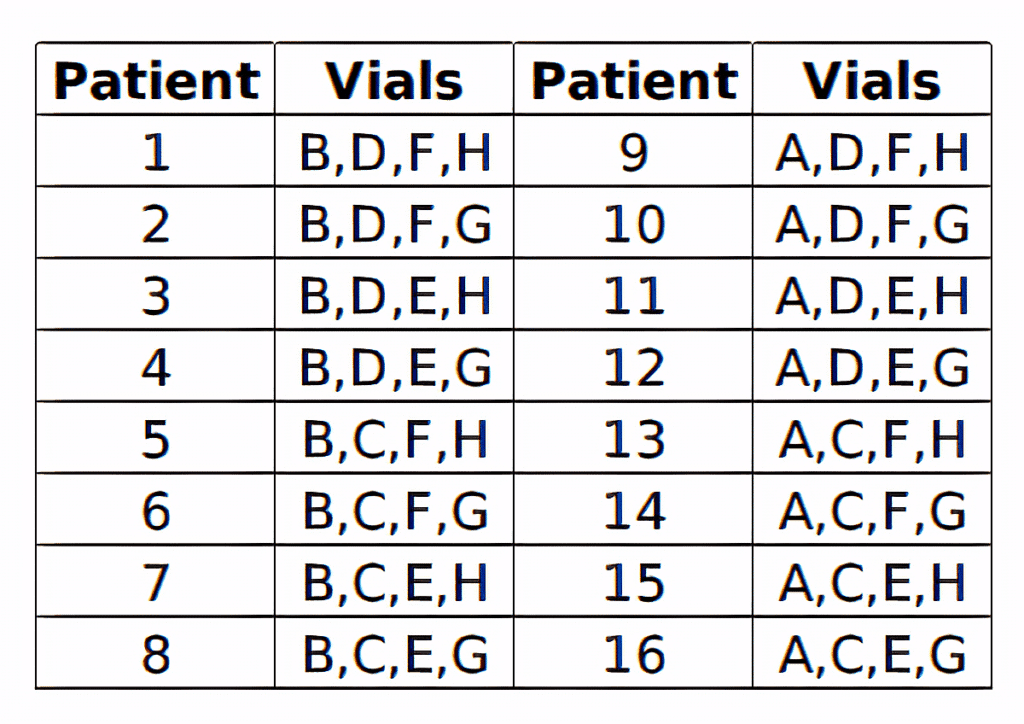
Sixteen patients in a hospital must undergo a blood test for a disease. It is known that exactly one of them has the disease. The hospital has only eight testing kits and has decided to pool blood samples of patients into eight vials for the tests. The patients are numbered 1 through 16, and the vials are labelled A, B, C, D, E, F, G, and H. The following table shows the vials into which each patient’s blood sample is distributed.
If a patient has the disease, then each vial containing his/her blood sample will test positive. If a vial tests positive, one of the patients whose blood samples were mixed in the vial has the disease. If a vial tests negative, then none of the patients whose blood samples were mixed in the vial has the disease.
Suppose vial C tests positive and vials A, E and H test negative. Which patient has the disease?
Check Solution
Ans: C
The individuals within the vials are categorized as follows:
Vial A: 9, 10, 11, 12, 13, 14, 15, 16
Vial B: 1, 2, 3, 4, 5, 6, 7, 8.
Vial C: 5, 6, 7, 8, 13, 14, 15, 16
Vial D: 1, 2, 3, 4, 9, 10, 11, 12
Vial E: 3, 4, 7, 8, 11, 12, 15, 16
Vial F: 1, 2, 5, 6, 9, 10, 13, 14
Vial G: 2, 4, 6, 8, 10, 12, 14, 16
Vial H: 1, 3, 5, 7, 9, 11, 13, 15
Given that Vial C yields a positive result, and Vials A, E, and H yield negative results, it is established that Individual 6 carries the condition. This is because all individuals in Vial C, with the exception of Individual 6, are also accounted for in at least one of the negative Vials (A, E, or H).
Q. 7 Suppose vial A tests positive and vials D and G test negative. Which of the following vials should we test next to identify the patient with the disease?
Check Solution
Ans: B
The patient groups for each vial are as follows:
Vial A: 9, 10, 11, 12, 13, 14, 15, 16
Vial B: 1, 2, 3, 4, 5, 6, 7, 8
Vial C: 5,6,7,8,13,14,15,16
Vial D:1,2,3,4,9,10,11,12
Vial E:3,4,7,8,11,12,15,16
Vial F:1,2,5,6,9,10,13,14
Vial G:2,4,6,8,10,12,14,16
Vial H:1,3,5,7,9,11,13,15
Given that Vial A shows a positive result, and Vials D and G show negative results, the individual with the condition must be either patient 13 or patient 15.
Patient 13 or 15 is absent from Vial B. Therefore, Vial B cannot be the correct answer.
Both patient 13 and patient 15 are included in Vial C. Regardless of whether Vial C tests positive or negative, it’s impossible to definitively identify the affected individual. Thus, Vial C is eliminated.
Similarly, both patient 13 and patient 15 are present in Vial H. As with Vial C, the test results for Vial H will not pinpoint the specific patient with the condition. Therefore, Vial H is also eliminated.
Only patient 15 is present in Vial E. If Vial E tests positive, patient 15 has the condition. If Vial E tests negative, then patient 13 must have the condition.
Consequently, the second option is the correct choice.
Q. 8 Which of the following combinations of test results is NOT possible?
Check Solution
Ans: A
The data presents eight vials, each containing a set of patient identifiers:
* **Vial A:** 9, 10, 11, 12, 13, 14, 15, 16
* **Vial B:** 1, 2, 3, 4, 5, 6, 7, 8
* **Vial C:** 5, 6, 7, 8, 13, 14, 15, 16
* **Vial D:** 1, 2, 3, 4, 9, 10, 11, 12
* **Vial E:** 3, 4, 7, 8, 11, 12, 15, 16
* **Vial F:** 1, 2, 5, 6, 9, 10, 13, 14
* **Vial G:** 2, 4, 6, 8, 10, 12, 14, 16
* **Vial H:** 1, 3, 5, 7, 9, 11, 13, 15
If the results from Vial C and Vial D are both negative, it implies that no patient could have a negative test result. Therefore, Vial A represents the correct answer.
Q. 9 Suppose one of the lab assistants accidentally mixed two patients’ blood samples before they were distributed to the vials. Which of the following correctly represents the set of all possible numbers of positive test results out of the eight vials?
Check Solution
Ans: C
If a single patient, either patient 1 or patient 16, has the disease and their blood is combined with that of all other patients, then all 8 vials will yield a positive test result. This implies that 8 must be one of the possible outcomes.
Consider the scenario where patient 2 and patient 16’s blood are mixed. If one of them has the disease, then 7 out of the 8 vials will test positive. Therefore, 7 must be an included option.
If patient 1 has the disease and their blood is mixed with patients 1 and 7, then 6 out of the 8 vials will test positive.
If patient 1 has the disease and their blood is mixed with patients 1 and 9, then 5 out of the 8 vials will test positive.
Now, let’s assume patient 1 has the disease and their blood is not mixed with any other blood samples. In this case, 4 vials will definitively show a positive result.
Therefore, 3 is the correct answer.
Q. 10 Instructions
There are 21 employees working in a division, out of whom 10 are special-skilled employees (SE) and the remaining are regular-skilled employees (RE). During the next five months, the division has to complete five projects every month. Out of the 25 projects, 5 projects are “challenging”, while the remaining ones are “standard”. Each of the challenging projects has to be completed in different months. Every month, five teams — T1 T2, T3, T4 and T5, work on one project each. T1, T2, T3, T4 and T5 are allotted the challenging project in the first, second, third, fourth and fifth month, respectively. The team assigned the challenging project has one more employee than the rest.
In the first month, T1 has one more SE than T2, T2 has one more SE than T3, T 3 has one more SE than T4, and T4 has one more SE than T5. Between two successive months, the composition of the teams changes as follows:
a. The team allotted the challenging project, gets two SE from the team which was allotted the challenging project in the previous month. In exchange, one RE is shifted from the former team to the latter team.
b. After the above exchange, if T1 has any SE and T5 has any RE, then one SE is shifted from T1 to T5, and one RE is shifted from T5 to T1. Also, if T2 has any SE and T4 has any RE, then one SE is shifted from T2 to T4, and one RE is shifted from T4 to T2.
Each standard project has a total of 100 credit points, while each challenging project has 200 credit points. The credit points are equally shared between the employees included in that team.
Which of the following CANNOT be the total credit points earned by any employee from the projects?
Check Solution
Ans: B
When an employee undertakes a difficult assignment, they are awarded 40 credits.
For a typical assignment, an employee receives 20 credits.
Let’s analyze the point accumulation based on the mix of assignments:
* **Scenario 1:** An employee participates in five typical assignments. Their total credits would be 5 * 20 = 100.
* **Scenario 2:** An employee participates in four typical assignments and one difficult assignment. Their total credits would be (4 * 20) + (1 * 40) = 80 + 40 = 120.
* **Scenario 3:** An employee participates in three typical assignments and two difficult assignments. Their total credits would be (3 * 20) + (2 * 40) = 60 + 80 = 140.
* **Scenario 4:** An employee participates in two typical assignments and three difficult assignments. Their total credits would be (2 * 20) + (3 * 40) = 40 + 120 = 160.
* **Scenario 5:** An employee participates in one typical assignment and four difficult assignments. Their total credits would be (1 * 20) + (4 * 40) = 20 + 160 = 180.
* **Scenario 6:** An employee participates in five difficult assignments. Their total credits would be 5 * 40 = 200.
Based on these calculations, it is evident that an employee cannot achieve a credit total of 150 points.
Q. 11 One of the employees named Aneek scored 185 points. Which of the following CANNOT be true?
Check Solution
Ans: D
Examine Choice A:
A progression from T1 to T2 is feasible after one month in T1. From T2, transitions to either T3 or T4 are permitted. Subsequently, a move to T4 from T3 is possible in the following month due to project demands. Therefore, this choice is a valid scenario.
Examine Choice B:
A move from T1 to T2 is achievable after the initial month in T1. From T2, one can proceed to either T3 or T4. If the individual moves to T4, the subsequent relocation can be to T5. Consequently, this choice is a plausible scenario.
Examine Choice C:
A sequence of T2, T3, T4, T5 represents a permissible series of movements.
Examine Choice D:
If Aneek spends the first month in T1, the subsequent month offers options of moving to T2, T5, or remaining in T1.
If Aneek remains in T1, the next month’s possibilities are either moving to T5 or staying in T1. In this case, the sequence presented in the option cannot occur.
If Aneek moves to T2, T2 is not part of the given sequence, so this path is invalid.
If Aneek moves to T5 in the next month, Aneek will remain in T5 thereafter.
Thus, Choice D is not a correct option.
Q. 12 Instructions
An old woman had the following assets:
(a) Rs. 70 lakh in bank deposits
(b) 1 house worth Rs. 50 lakh
(c) 3 flats, each worth Rs. 30 lakh
(d) Certain number of gold coins, each worth Rs. 1 lakh
She wanted to distribute her assets among her three children; Neeta, Seeta and Geeta.
The house, any of the flats or any of the coins were not to be split. That is, the house went entirely to one child; a flat went to one child and similarly, a gold coin went to one child.
The value of the assets distributed among Neeta, Seeta and Geeta was in the ratio of 1:2:3, while the gold coins were distributed among them in the ratio of 2:3:4. One child got all three flats and she did not get the house. One child, other than Geeta, got Rs. 30 lakh in bank deposits.
How many gold coins did the old woman have?
Check Solution
Ans: B
Let the total quantity of gold coins held by the elderly woman be represented as ‘9k’.
The aggregate worth of the elderly woman’s possessions amounts to 50 + (3 * 30) + 70 + 9k = 210 + 9k.
It is understood that the assets were apportioned according to a 1:2:3 ratio.
Consequently, Neeta would have acquired assets valued at 35 + 1.5k, Seeta at 70 + 3k, and Geeta at 105 + 4.5k.
Furthermore, the distribution of gold coins is stated to be in the ratio 2:3:4.
This implies that Neeta would possess ‘2k’ gold coins, Seeta ‘3k’, and Geeta ‘4k’.
Seeta possesses ‘3k’ gold coins. Therefore, the total worth of her assets must equate to 70. As Seeta could not have inherited all the apartments, she must have received the dwelling (valued at 50 lakh) and 20 lakh from the bank deposits.
Given that Geeta did not receive Rs. 30 lakh from the bank deposits, it follows that Neeta must have received Rs. 30 lakh.
The remaining 5 lakh must originate from the gold coins, as no other asset is worth 5 lakh.
This leads to the equation: 5 + 1.5k = 2k
Subtracting 1.5k from both sides yields: 0.5k = 5
Solving for k gives: k = 10
The elderly woman must have possessed 10 * 9 = 90 gold coins. Thus, option B is the correct selection.
Q. 13 The value of the assets distributed among Neeta, Seeta and Geeta was in the ratio of 1:2:3, while the gold coins were distributed among them in the ratio of 2:3:4. One child got all three flats and she did not get the house. One child, other than Geeta, got Rs. 30 lakh in. bank deposits.
How much did Geeta get in bank deposits (in lakhs of rupees)?
Check Solution
Ans: 20
Let the total quantity of gold coins held by the elderly woman be represented as ‘9x’.
The aggregate worth of the possessions held by the elderly woman amounts to 50 + (3 * 30) + 70 + 9x = 210 + 9x.
It is understood that these possessions were divided according to a 1:2:3 proportion.
Consequently, Neeta would have obtained assets valued at 35 + 1.5x, Seeta at 70 + 3x, and Geeta at 105 + 4.5x.
Additionally, it is stipulated that the gold coins distributed followed a 2:3:4 ratio.
Therefore, the quantity of gold coins held by Neeta would be ‘2x’, by Seeta ‘3x’, and by Geeta ‘4x’.
Seeta possesses 3x gold coins. Accordingly, the total value of her assets must be 70. Given that Seeta could not have inherited all the apartments, she must have received the dwelling (valued at 50 lakh) and 20 lakh from the bank deposits.
Since we know that Geeta did not receive Rs. 30 lakh from the bank deposits, Neeta must have received Rs. 30 lakh.
The remaining 5 lakh must originate from the gold coins (as no other asset is worth 5 lakh).
This leads to the equation: 5 + 1.5x = 2x
Solving for x: 0.5x = 5, which gives x = 10.
The elderly woman must have possessed 9 * 10 = 90 gold coins.
The total value of the assets amounts to 210 + (90 * 1) = 300 lakh.
Neeta received a total of 50 lakh, Seeta received 100 lakh, and Geeta received 150 lakh.
Geeta must have received 90 lakh from the 3 apartments. Of the remaining 60 lakh, 4 * 10 = 40 lakh was contributed by the gold coins. Geeta must have received 150 – 90 – 40 = 20 lakh from bank deposits. Therefore, 20 is the correct amount.