
CAT 2024 LRDI Slot 1 Paper
Q. 1 Instructions
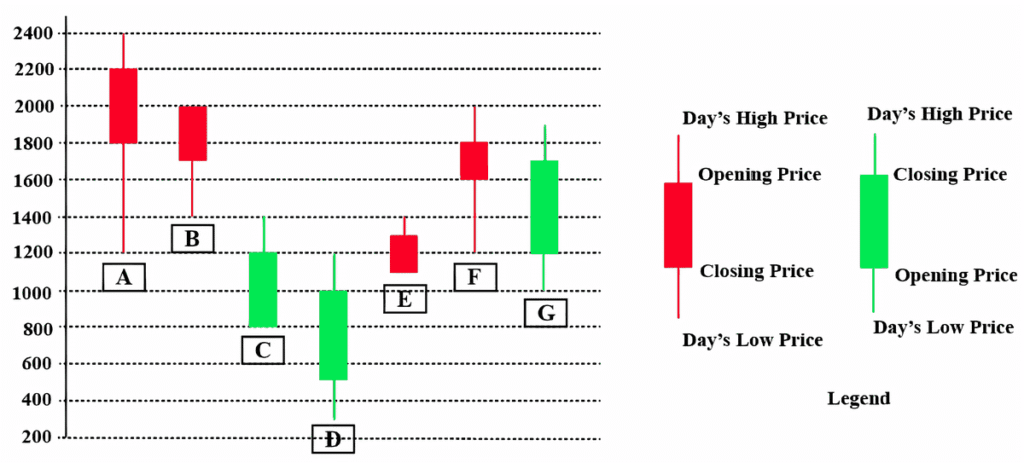
The chart below shows the price data for seven shares – A, B, C, D, E, F, and G as a candlestick plot for a particular day. The vertical axis shows the price of the share in rupees. A share whose closing price (price at the end of the day) is more than its opening price (price at the start of the day) is called a bullish share; otherwise, it is called a bearish share. All bullish and bearish shares are shown in green and red colour respectively.
Daily Share Price Variability (SPV) is defined as (Day’s high price – Day’s low price) / (Average of the opening and closing prices during the day). Which among the shares A, C, D and F had the highest SPV on that day?
Check Solution
Ans: C
To be published
Q. 2 Daily Share Price Variability (SPV) is defined as (Day’s high price – Day’s low price) / (Average of the opening and closing prices during the day). How many shares had an SPV greater than 0.5 on that day?
Check Solution
Ans: 4
To be published
Q. 3 Daily loss for a share is defined as (Opening price – Closing price) / (Opening price). Which among the shares A, B, F and G had the highest daily loss on that day?
Check Solution
Ans: C
To be published
Q. 4 What would have been the percentage wealth gain for a trader, who bought equal numbers of all bullish shares at opening price and sold them at their day’s high?
Check Solution
Ans: A
To be published
Q. 5 Instructions
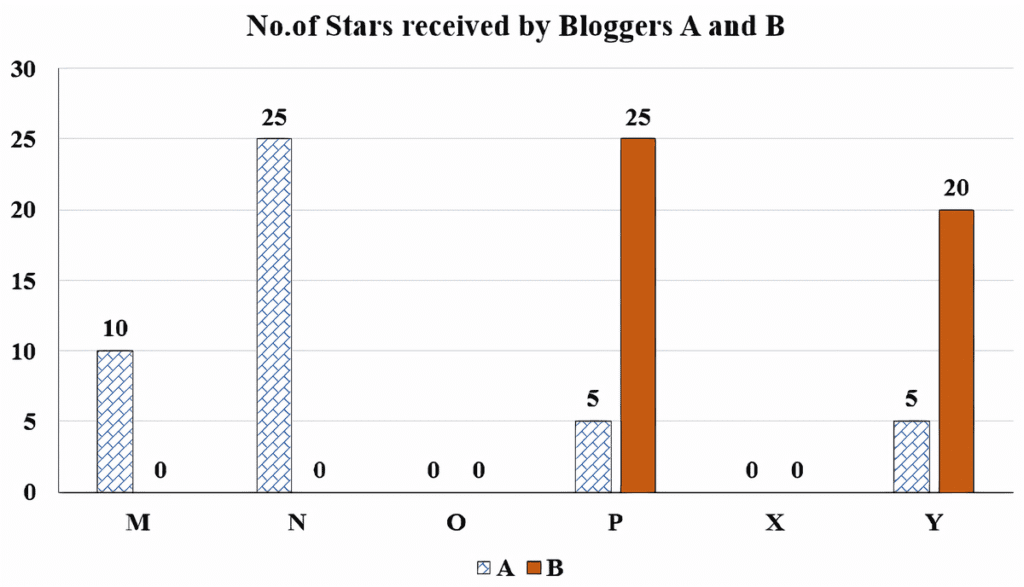
Six web surfers M, N, O, P, X, and Y each had 30 stars which they distributed among four bloggers A, B, C, and D. The number of stars received by A and B from the six web surfers is shown in the figure below.
The following additional facts are known regarding the number of stars received by the bloggers from the surfers.
1. The numbers of stars received by the bloggers from the surfers were all multiples of 5 (including 0).
2. The total numbers of stars received by the bloggers were the same.
3. Each blogger received a different number of stars from M.
4. Two surfers gave all their stars to a single blogger.
5. D received more stars than C from Y.
What was the total number of stars received by D?
Check Solution
Ans: 45
To be published
Q. 6 What was the number of stars received by D from Y?
Check Solution
Ans: A
To be published
Q. 7 How many surfers distributed their stars among exactly 2 bloggers?
Check Solution
Ans: 2
To be published
Q. 8 Which of the following can be determined with certainty?
I. The number of stars received by C from M
II. The number of stars received by D from O
Check Solution
Ans: B
To be published
Q. 9 Instructions
The game of QUIET is played between two teams. Six teams, numbered 1, 2, 3, 4, 5, and 6, play in a QUIET tournament. These teams are divided equally into two groups. In the tournament, each team plays every other team in the same group only once, and each team in the other group exactly twice. The tournament has several rounds, each of which consists of a few games. Every team plays exactly one game in each round.
The following additional facts are known about the schedule of games in the tournament.
1. Each team played against a team from the other group in Round 8.
2. In Round 4 and Round 7, the match-ups, that is the pair of teams playing against each other, were identical. In Round 5 and Round 8, the match-ups were identical.
3. Team 4 played Team 6 in both Round 1 and Round 2.
4. Team 1 played Team 5 ONLY once and that was in Round 2.
5. Team 3 played Team 4 in Round 3. Team 1 played Team 6 in Round 6.
6. In Round 8, Team 3 played Team 6, while Team 2 played Team 5.
How many rounds were there in the tournament?
Check Solution
Ans: 8
To be published
Q. 10 What is the number of the team that played Team 1 in Round 5?
Check Solution
Ans: 4
To be published
Q. 11 Which team among the teams numbered 2, 3, 4, and 5 was not part of the same group?
Check Solution
Ans: A
To be published
Q. 12 What is the number of the team that played Team 1 in Round 7?
Check Solution
Ans: 3
To be published
Q. 13 What is the number of the team that played Team 6 in Round 3?
Check Solution
Ans: 5
To be published
Q. 14 Instructions
Two students, Amiya and Ramya are the only candidates in an election for the position of class representative. Students will vote based on the intensity level of Amiya’s and Ramya’s campaigns and the type of campaigns they run. Each campaign is said to have a level of 1 if it is a staid campaign and a level of 2 if it is a vigorous campaign. Campaigns can be of two types, they can either focus on issues, or on attacking the other candidate.
If Amiya and Ramya both run campaigns focusing on issues, then
• The percentage of students voting in the election will be 20 times the sum of the levels of campaigning of the two students. For example, if Amiya and Ramya both run vigorous campaigns, then 20 × (2+2)%, that is, 80% of the students will vote in the election.
• Among voting students, the percentage of votes for each candidate will be proportional to the levels of their campaigns. For example, if Amiya runs a staid (i.e., level 1) campaign while Ramya runs a vigorous (i.e., level 2) campaign, then Amiya will receive 1/3 of the votes cast, and Ramya will receive the other 2/3. The above-mentioned percentages change as follows if at least one of them runs a campaign attacking their opponent.
• If Amiya runs a campaign attacking Ramya and Ramya runs a campaign focusing on issues, then 10% of the students who would have otherwise voted for Amiya will vote for Ramya, and another 10% who would have otherwise voted for Amiya, will not vote at all.
• If Ramya runs a campaign attacking Amiya and Amiya runs a campaign focusing on issues, then 20% of the students who would have otherwise voted for Ramya will vote for Amiya, and another 5% who would have otherwise voted for Ramya, will not vote at all.
• If both run campaigns attacking each other, then 10% of the students who would have otherwise voted for them had they run campaigns focusing on issues, will not vote at all.
If both of them run staid campaigns attacking the other, then what percentage of students will vote in the election?
Check Solution
Ans: D
Explanation:The question states that both Amiya and Ramya run staid campaigns attacking the other. This means both have a campaign level of 1 and both are attacking campaigns.
We need to find the percentage of students who will vote in the election under this specific scenario.
The instructions detail how the percentages change when at least one candidate runs an attacking campaign. The specific condition for “both run campaigns attacking each other” is given as: “If both run campaigns attacking each other, then 10% of the students who would have otherwise voted for them had they run campaigns focusing on issues, will not vote at all.”
First, let’s determine the scenario if they were focusing on issues. If both Amiya and Ramya run staid campaigns (level 1) focusing on issues:
The percentage of students voting in the election will be 20 times the sum of the levels of campaigning of the two students.
Sum of levels = Level of Amiya’s campaign + Level of Ramya’s campaign = 1 + 1 = 2.
Percentage of students voting = 20 * (sum of levels) = 20 * 2 = 40%.
Now, we apply the condition for when both run campaigns attacking each other: “10% of the students who would have otherwise voted for them had they run campaigns focusing on issues, will not vote at all.”
This means 10% of the 40% who would have voted will now not vote.
Percentage of students who will not vote = 10% of 40% = 0.10 * 40% = 4%.
The percentage of students who will vote in the election is the percentage who would have voted minus the percentage who will now not vote due to attacking campaigns.
Percentage of students voting = 40% – 4% = 36%.
Therefore, if both of them run staid campaigns attacking the other, 36% of students will vote in the election.
Correct_Option:D
Q. 15 What is the minimum percentage of students who will vote in the election?
Check Solution
Ans: D
To achieve the minimum vote share, both candidates should conduct subdued campaigns.
Furthermore, both campaigns should be confrontational. This is because when one candidate adopts a confrontational approach and the other focuses on issues, a significant portion of voters shift their allegiance.
This suggests a situation where both campaigns are subdued and confrontational, mirroring the scenario previously discussed.
If both Ramya and Amiya opt for subdued campaigns, the intensity of each subdued campaign is 1.
Consequently, the combined voter share they would secure if they concentrated on issues is 20% * (1 + 1) = 40%.
This implies that if both had campaigned on issues, each would have garnered 20% of the votes.
We are informed that both candidates engage in confrontational campaigns.
The rule for mutual confrontational campaigns dictates that 10% of voters who would have otherwise supported each candidate will refrain from voting.
Therefore, 10% of each candidate’s potential 20% vote share will be lost due to the mutually confrontational nature of their campaigns.
This results in each candidate securing 18% of the votes.
The total votes secured amount to 36%, representing the lowest possible outcome.
Q. 16 If Amiya runs a campaign focusing on issues, then what is the maximum percentage of votes that she can get?
Check Solution
Ans: A
The objective is to determine the highest possible vote percentage for Amiya.
This translates to maximizing the number of voters who cast their ballot for Amiya, implying a strong campaigning effort.
To boost Amiya’s vote share, the goal is to shift as many voters as possible from Ramya’s support base to Amiya’s.
Given that a candidate’s vote count is directly related to their campaign’s intensity, it is advantageous for Ramya to also conduct an aggressive and confrontational campaign, thereby causing voters to switch to Amiya.
In this situation, 20 times the sum of 2 and 2 percent, which equals 80% of the populace, are participating in the election. Of this voting group, if both candidates had focused on issue-based campaigns, each would have secured 40% of the votes.
Now, the scenario shifts to Ramya conducting a negative campaign. This results in 20% of the voters who would have otherwise voted for Ramya now casting their vote for Amiya.
Therefore, 20% of Ramya’s potential 40% share is transferred to Amiya, amounting to an 8% increase in Amiya’s votes. Additionally, it is stated that 5% of those who would have voted for Ramya abstain from voting. This means 5% of Ramya’s 40% potential votes do not materialize, representing 2% of the total voters.
The final vote distribution shows Amiya securing 48% of the votes, while Ramya receives 30%.
Q. 17 If Ramya runs a campaign attacking Amiya, then what is the minimum percentage of votes that she is guaranteed to get?
Check Solution
Ans: B
We aim to determine the lowest possible vote count for Ramya when she conducts an aggressive campaign.
To achieve this minimum, consider Ramya opting for a subdued campaign approach, representing the least impactful strategy. In this scenario, if she were to campaign on issues, she would secure 20% of the total votes.
However, given her decision to run an attacking campaign, this results in a loss of support. Specifically, she will cede 20% of her potential votes to Amiya, and an additional 5% of voters will abstain from participating altogether.
Collectively, this represents a 25% reduction in her potential vote share. Consequently, the votes Ramya will retain are 75% of her initial 20% target, leaving her with a final share of 15% of the total votes.
Q. 18 What is the maximum possible voting margin with which one of the candidates can win?
Check Solution
Ans: B
The objective is to determine the smallest number of votes Ramya can secure while simultaneously maximizing Amiya’s vote count.
We can adapt the context from a prior problem, focusing on minimizing Ramya’s votes. To achieve this minimum, Ramya could conduct a subdued campaign, resulting in a base of 20% of the votes if she had campaigned on issues. However, by running an aggressive campaign, she forfeits 20% of these potential votes to Amiya, and an additional 5% choose not to vote.
This constitutes a 25% reduction. The votes Ramya secures are consequently 75% of her initial 20%, leaving her with 15% of the total votes.
To maximize Amiya’s votes, she could launch a robust campaign focused on issues, attracting double the base 20%, equating to 40% of the votes. Furthermore, due to Ramya’s aggressive tactics, 20% of the votes initially leaning towards Ramya are now diverted to Amiya. This represents 20% of Ramya’s 20%, or 4% of the total votes, shifting to Amiya. This elevates Amiya’s total to 44%, while Ramya’s stands at 15%.
The discrepancy in votes is 44% – 15% = 29%.
This represents the largest possible margin of votes between the two contenders.
Q. 19 Instructions
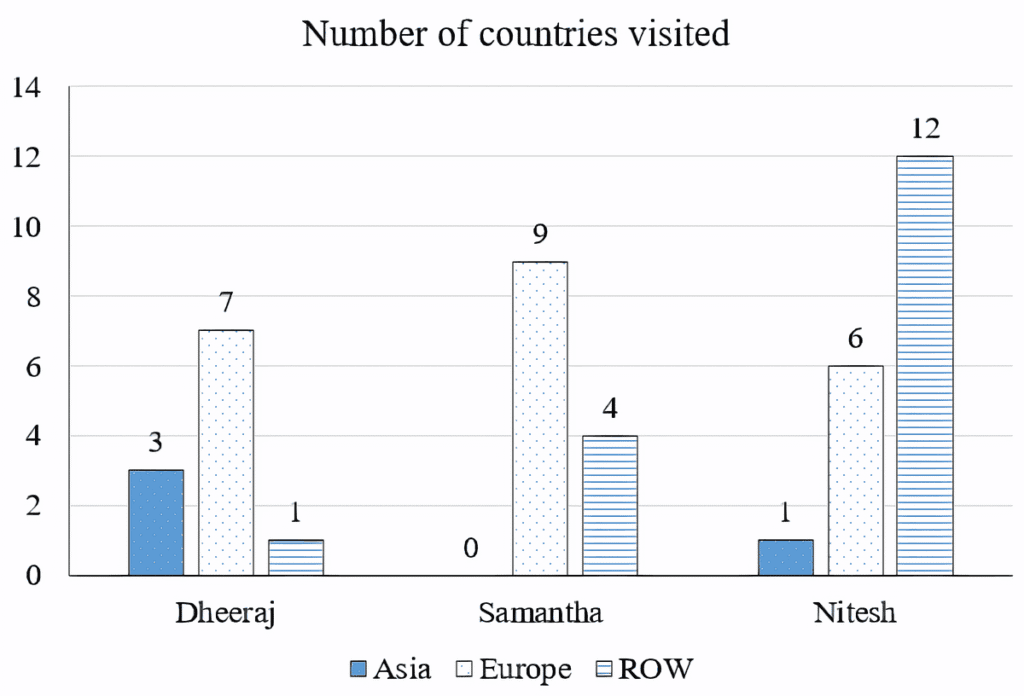
The chart below provides complete information about the number of countries visited by Dheeraj, Samantha and Nitesh, in Asia, Europe and the rest of the world (ROW).
The following additional facts are known about the countries visited by them.
1. 32 countries were visited by at least one of them.
2. USA (in ROW) is the only country that was visited by all three of them.
3. China (in Asia) is the only country that was visited by both Dheeraj and Nitesh, but not by Samantha.
4. France (in Europe) is the only country outside Asia, which was visited by both Dheeraj and Samantha, but not by Nitesh.
5. Half of the countries visited by both Samantha and Nitesh are in Europe.
How many countries in Asia were visited by at least one of Dheeraj, Samantha and Nitesh?
Check Solution
Ans: 3
To be published
Q. 20 How many countries in Europe were visited only by Nitesh?
Check Solution
Ans: 2
To be published
Q. 21 How many countries in the ROW were visited by both Nitesh and Samantha?
Check Solution
Ans: 4
To be published
Q. 22 How many countries in Europe were visited by exactly one of Dheeraj, Samantha and Nitesh?
Check Solution
Ans: D
To be published