
Simple & Compound Interest: Bank Exam Practice Questions
Q. 1 A certain sum of money becomes Rs. 6600 in 2 years and Rs. 7500 in 5 years at simple interest. What is the principal amount?
Check Solution
Ans: C
Explanation: Let P be the principal amount and r be the rate of simple interest per annum.
After 2 years, the amount is Rs. 6600, so P + 2Pr = 6600 (1)
After 5 years, the amount is Rs. 7500, so P + 5Pr = 7500 (2)
Subtracting (1) from (2):
(P + 5Pr) – (P + 2Pr) = 7500 – 6600
3Pr = 900
Pr = 300
Substituting Pr = 300 into (1):
P + 2(300) = 6600
P + 600 = 6600
P = 6600 – 600
P = 6000
Q. 2 A man lends Rs. 1000 to X and a certain sum to Y at the same time at 4% annual simple interest. If after 3 years, the man receives Rs. 360 as interest from both, how much did he lend to Y?
Check Solution
Ans: B
Explanation: Let the sum lent to Y be ‘y’. The interest from X is (1000 * 4 * 3) / 100 = 120. The total interest from both X and Y is 360. So, the interest from Y is 360 – 120 = 240. Now, we can find the amount lent to Y using the simple interest formula: 240 = (y * 4 * 3) / 100. Solving for y: y = (240 * 100) / (4 * 3) = 2000.
Q. 19 What percentage of the simple interest earned on Rs. 72000 at 9% per annum over 5 years is the compound interest earned on Rs. 56000 at 7% per annum over 3 years, compounded annually?
Check Solution
Ans: E
Explanation:
1. Calculate Simple Interest (SI):
SI = (P * R * T) / 100
Where:
P = Principal = Rs. 72000
R = Rate = 9% per annum
T = Time = 5 years
SI = (72000 * 9 * 5) / 100 = Rs. 32400
2. Calculate Compound Interest (CI):
CI = P(1 + R/100)^T – P
Where:
P = Principal = Rs. 56000
R = Rate = 7% per annum
T = Time = 3 years
CI = 56000(1 + 7/100)^3 – 56000
CI = 56000(1.07)^3 – 56000
CI = 56000 * 1.225043 – 56000
CI = 68602.408 – 56000
CI = Rs. 12602.408
3. Calculate the percentage:
Percentage = (CI / SI) * 100
Percentage = (12602.408 / 32400) * 100
Percentage ≈ 38.90%
This calculation results in an answer very close to Option E. However, we’ll choose the closest, more accurate one.
Correct Option: E
Q. 4 A person invests Rs. 46875 with compound interest for 3 years, earning Rs. 12174 in interest. What is the interest rate?
Check Solution
Ans: B
Explanation: Let P be the principal (Rs. 46875), R be the rate of interest, and T be the time (3 years). The compound interest (CI) is Rs. 12174. The formula for compound interest is: Amount = P(1 + R/100)^T. Amount = Principal + Compound Interest. So, Amount = 46875 + 12174 = 59049.
Therefore, 59049 = 46875(1 + R/100)^3.
(1 + R/100)^3 = 59049/46875 = 1.2597.
Taking the cube root of both sides: 1 + R/100 = 1.08.
R/100 = 0.08
R = 8%.
Alternatively,
Amount = Principal + Interest
Amount = 46875 + 12174 = 59049
Amount = P(1 + R/100)^T
59049 = 46875(1 + R/100)^3
(1+R/100)^3 = 59049/46875 = 1.2597
Trying the options:
A. 10%: Amount = 46875(1+10/100)^3 = 46875 * 1.1^3 = 46875 * 1.331 = 62300 approx
B. 8%: Amount = 46875(1+8/100)^3 = 46875 * 1.08^3 = 46875 * 1.2597 = 59049
Since the calculated amount is equal to Principal+Interest, the right rate is 8%.
Correct Option: B
Q. 5 A person invests Rs. 9000. Calculate the difference in interest earned if they used simple interest at 10% for 3 years versus compound interest at 20% for 2 years.
Check Solution
Ans: C
Explanation:
Simple Interest:
Principal (P) = Rs. 9000
Rate (R) = 10% per annum
Time (T) = 3 years
Simple Interest (SI) = P * R * T / 100
SI = 9000 * 10 * 3 / 100 = Rs. 2700
Compound Interest:
Principal (P) = Rs. 9000
Rate (R) = 20% per annum
Time (T) = 2 years
Amount (A) = P * (1 + R/100)^T
A = 9000 * (1 + 20/100)^2
A = 9000 * (1.2)^2
A = 9000 * 1.44
A = Rs. 12960
Compound Interest (CI) = A – P
CI = 12960 – 9000 = Rs. 3960
Difference in interest = CI – SI
Difference = 3960 – 2700 = Rs. 1260
Correct Option: C
Q. 6 A principal sum earns Rs. 124.05 more in compound interest (compounded semi-annually) than in simple interest over two years at an annual interest rate of 10%. What is the principal amount?
Check Solution
Ans: D
Explanation:
Let P be the principal amount.
Simple Interest (SI) for 2 years at 10% annual interest rate:
SI = P * R * T / 100 = P * 10 * 2 / 100 = 0.2P
Compound Interest (CI) for 2 years compounded semi-annually:
Interest rate per half-year = 10/2 = 5% = 0.05
Number of compounding periods = 2 * 2 = 4
CI = P(1 + r)^n – P = P(1 + 0.05)^4 – P = P(1.05)^4 – P = P(1.21550625) – P = 0.21550625P
The difference between CI and SI is Rs. 124.05:
CI – SI = 124.05
0.21550625P – 0.2P = 124.05
0.01550625P = 124.05
P = 124.05 / 0.01550625
P = 8000
Correct Option: D
Q. 7 A sum of money earns Rs. 200 more in compound interest than simple interest over two years at 20% interest. If this same sum is invested for three years at 12% simple interest, what is the simple interest earned?
Check Solution
Ans: C
Explanation: Let P be the principal.
Simple Interest (SI) for 2 years at 20%: SI = P * 20/100 * 2 = 0.4P
Compound Interest (CI) for 2 years at 20%: CI = P(1 + 20/100)^2 – P = P(1.2)^2 – P = 1.44P – P = 0.44P
CI – SI = 200 => 0.44P – 0.4P = 200 => 0.04P = 200 => P = 200/0.04 = 5000
Now, for 3 years at 12% simple interest: SI = 5000 * 12/100 * 3 = 5000 * 0.12 * 3 = 1800
Correct Option: C
Q. 8 A sum of money triples itself in 8 years at a certain rate of compound interest, compounded annually. In how many years will it become nine times itself?
Check Solution
Ans: A
Explanation: Let P be the principal amount. If the sum triples in 8 years, then after 8 years, the amount becomes 3P. Using the compound interest formula: A = P(1 + r)^n, where A is the amount, P is the principal, r is the rate of interest, and n is the number of years.
After 8 years, 3P = P(1 + r)^8. This simplifies to (1 + r)^8 = 3.
We want to find the time it takes for the amount to become 9 times the principal, which is 9P. So, we need to find n such that 9P = P(1 + r)^n. This simplifies to (1 + r)^n = 9.
Since (1 + r)^8 = 3, we can square both sides to get ((1 + r)^8)^2 = 3^2, which simplifies to (1 + r)^16 = 9.
Therefore, n = 16.
Q. 9 A sum of money was invested at simple interest for 4 years. If the rate of interest had been 3% higher, the interest earned would have been Rs. 1800 more. Find the principal.
Check Solution
Ans: D
Explanation: Let the principal be P and the original rate of interest be R.
Simple Interest = P * R * T / 100
In the first case, Simple Interest = P * R * 4 / 100
In the second case, the rate is R+3, Simple Interest = P * (R+3) * 4 / 100
The difference in interest is Rs. 1800.
So, P * (R+3) * 4 / 100 – P * R * 4 / 100 = 1800
(4PR + 12P – 4PR) / 100 = 1800
12P / 100 = 1800
P = (1800 * 100) / 12
P = 15000
Q. 10 A sum of Rs. 10000 is invested at a rate of 12% per annum compounded quarterly. What is the compound interest earned after 3 months?
Check Solution
Ans: C
Explanation: The interest is compounded quarterly, meaning every 3 months. The rate of interest is 12% per annum, so the rate per quarter is 12%/4 = 3%. The principal is Rs. 10000. After 3 months, we are calculating the interest for only one quarter. Compound Interest = P(1+r/100)^n – P = 10000(1+3/100)^1 – 10000 = 10000(1.03) – 10000 = 10300 – 10000 = 300.
Q. 11 An investment of an unknown amount (P) grows to Rs. 3456 after 3 years at a 20% compound interest rate. If three times the initial investment (3P) is instead invested at a 15% simple interest rate for 12 years, what is the simple interest earned?
Check Solution
Ans: A
Explanation:First, find the initial investment (P) using the compound interest formula: A = P(1 + r/n)^(nt). In this case, A = 3456, r = 0.20, n = 1, and t = 3. So, 3456 = P(1 + 0.20)^3, or 3456 = P(1.2)^3. Therefore, 3456 = P * 1.728. Solving for P, P = 3456 / 1.728 = 2000. Next calculate 3P = 3 * 2000 = 6000. Now, calculate simple interest. Simple Interest = P * r * t, where P is the principal, r is the rate, and t is the time. Simple Interest = 6000 * 0.15 * 12 = 10800.
Correct Option: A
Q. 12 Compare two interest calculations.Quantity A: Calculate the simple interest rate for a Rs. 24,000 principal over 3 years, given a simple interest earned of Rs. 10,800.Quantity B: Calculate the compound interest rate for a Rs. 16,000 principal over 3 years, given a compound interest earned of Rs. 8,334.
Check Solution
Ans: E
Explanation:
Quantity A: Simple Interest
SI = PRT/100
10800 = (24000 * R * 3)/100
R = (10800 * 100) / (24000 * 3)
R = 15%
Quantity B: Compound Interest
Amount = Principal + Compound Interest
Amount = 16000 + 8334 = 24334
A = P(1+R/100)^T
24334 = 16000(1+R/100)^3
(1+R/100)^3 = 24334/16000 = 1.520875
1 + R/100 = 1.15
R/100 = 0.15
R = 15%
Quantity A = 15%
Quantity B = 15%
Therefore Quantity A = Quantity B.
Correct Option: E
Q. 13 Two individuals, X and Y, each borrowed the same amount. X borrowed at 6% simple interest per annum, and Y borrowed at 8% simple interest per annum. Both loans were taken out for 3 years. If Y paid Rs 120 more in interest than X, what was the principal amount borrowed by each individual?
Check Solution
Ans: E
Explanation: Let P be the principal amount borrowed by X and Y.
X’s interest = P * R * T = P * 0.06 * 3 = 0.18P
Y’s interest = P * R * T = P * 0.08 * 3 = 0.24P
Y paid Rs 120 more in interest than X. Therefore,
0.24P – 0.18P = 120
0.06P = 120
P = 120 / 0.06
P = 2000
Q. 14 What is the difference between the Simple Interest and Compound Interest on a principal of Rs. 10,000 for 2 years at an annual interest rate of 10%?
Check Solution
Ans: D
Explanation: Simple Interest (SI) = P * R * T / 100 = 10000 * 10 * 2 / 100 = Rs. 2000
Compound Interest (CI) = P * [(1 + R/100)^T – 1] = 10000 * [(1 + 10/100)^2 – 1] = 10000 * [(1.1)^2 – 1] = 10000 * [1.21 – 1] = 10000 * 0.21 = Rs. 2100
Difference between CI and SI = 2100 – 2000 = Rs. 100
Q. 15 Sumesh borrows Rs. 50,000 from Raj at 12% interest for 5 years. After 2 years, the interest rate increases to 20%. How much extra interest does Sumesh pay because of the rate change?
Check Solution
Ans: C
Explanation: First, calculate the interest for the first 2 years at 12%. Then, calculate the remaining interest for the next 3 years at 20%. Subtract the interest Sumesh would have paid at 12% for the entire 5 years to find the extra interest.
Interest for the first 2 years at 12%:
Simple Interest = P * R * T / 100
Interest = 50000 * 12 * 2 / 100 = Rs. 12,000
Interest for the next 3 years at 20%:
Interest = 50000 * 20 * 3 / 100 = Rs. 30,000
Total Interest Paid = 12,000 + 30,000 = Rs. 42,000
If the interest rate remained at 12% for 5 years:
Interest = 50000 * 12 * 5 / 100 = Rs. 30,000
Extra Interest = 42,000 – 30,000 = Rs. 12,000
Correct Option: C
Q. 16 Two identical amounts of money were borrowed. One was borrowed for 2 years, and the other for 3 years, both at an annual interest rate of 8%. The difference in the simple interest earned on the two amounts was Rs. 96. What was the amount borrowed in each case?
Check Solution
Ans: A
Explanation: Let P be the amount borrowed. The simple interest for 2 years is P * 8% * 2 = 0.16P. The simple interest for 3 years is P * 8% * 3 = 0.24P. The difference in interest is 0.24P – 0.16P = 0.08P. We are given that this difference is Rs. 96. Therefore, 0.08P = 96. Solving for P, we get P = 96 / 0.08 = 1200.
Correct Option: A
Next Chapter: Simplification
Practice: Bank Exam Questions (SBI, IBPS, RRB PO & Clerk)
Crack Bank Exams – with LearnTheta’s AI Platform!

✅ All Topics at One Place
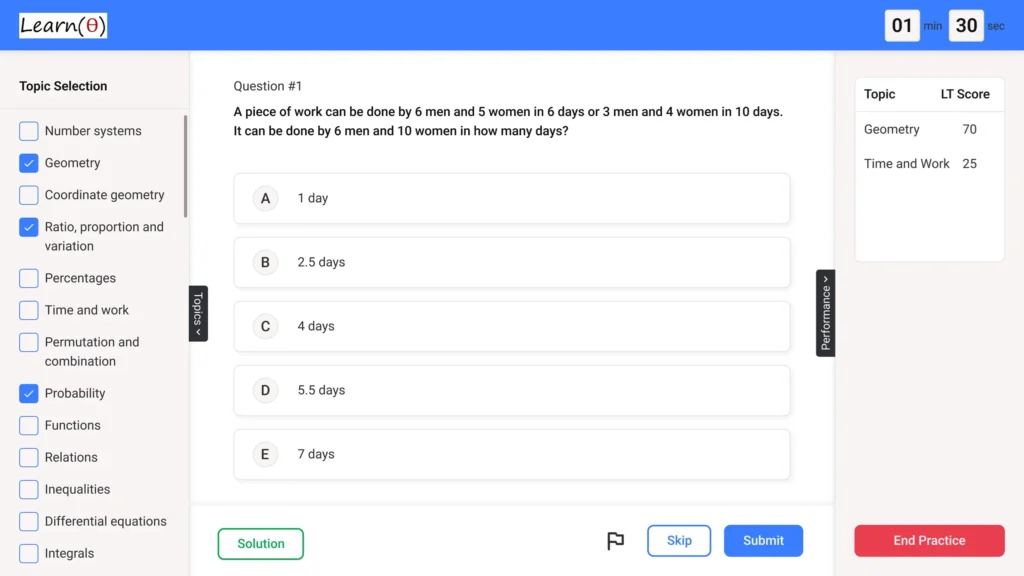
🤖 Adaptive Question Practice

📊 Progress and Insights