
Percentages: Bank Exam Practice Questions (SBI, IBPS, RRB, PO & Clerk)
Q. 1 150 decreased by 30% of a number equals 90. What is the number?
Check Solution
Ans: A
Explanation: Let the number be x.
The question can be translated into the equation: 150 – 0.30x = 90
Subtract 150 from both sides: -0.30x = 90 – 150
-0.30x = -60
Divide both sides by -0.30: x = -60 / -0.30
x = 200
Q. 2 40% of P’s savings is equal to 30% of 2/3 of Q’s savings. If Q’s savings are Rs. 3600, then what are P’s savings?
Check Solution
Ans: B
Explanation: Let P’s savings be ‘P’ and Q’s savings be ‘Q’.
Given: 40% of P = 30% of (2/3) of Q
Also, Q = Rs. 3600
So, 0.40 * P = 0.30 * (2/3) * 3600
0.40 * P = 0.30 * 2400
0.40 * P = 720
P = 720 / 0.40
P = 1800
Q. 3 A and B earn a combined monthly salary of 40,000 rupees. A spends 85% of their salary, and B spends 95%. If they both save the same amount, what is A’s salary?
Check Solution
Ans: A
Explanation: Let A’s salary be ‘x’ and B’s salary be ‘y’.
We know x + y = 40000.
A saves 15% of their salary, which is 0.15x.
B saves 5% of their salary, which is 0.05y.
Since they save the same amount, 0.15x = 0.05y.
Simplifying, we get 3x = y.
Substitute y = 3x in the first equation: x + 3x = 40000.
4x = 40000
x = 10000.
Correct Option: A
Q. 4 A certain number has a third of it calculated, then 140% of that result is 46.2. How much larger is 132 compared to the original number?
Check Solution
Ans: B
Explanation: Let the original number be x.
1. A third of the number is (1/3)x
2. 140% of (1/3)x is (140/100) * (1/3)x = 46.2
3. Solving for x: (14/30)x = 46.2 => x = (46.2 * 30) / 14 => x = 99
4. The difference between 132 and the original number (99) is 132 – 99 = 33
5. The percentage increase is (Difference / Original Number) * 100 = (33/99) * 100 = 33.33%
Correct Option: B
Q. 5 A city’s population consists of men, women, and children in a 7:6:5 ratio. Given the literacy rates for each group (70% men literate, 20% women illiterate, and 80% children literate), what is the overall illiteracy rate for the entire city?
Check Solution
Ans: E
Explanation: Let’s assume the total population is 7+6+5 = 18 units.
Men: 7 units, 70% literate, so 30% illiterate. Illiterate men = 7 * 0.30 = 2.1
Women: 6 units, 20% illiterate, so 80% literate. Illiterate women = 6 * 0.20 = 1.2
Children: 5 units, 80% literate, so 20% illiterate. Illiterate children = 5 * 0.20 = 1.0
Total illiterate = 2.1 + 1.2 + 1.0 = 4.3
Overall illiteracy rate = (Total illiterate / Total population) * 100 = (4.3 / 18) * 100 = 23.89%. This is closest to 25% if we round up. However this is not an option.
Men Illiterate = 7*.3 = 2.1
Women Illiterate = 6*.2 = 1.2
Children Illiterate = 5*.2 = 1
Total Illiterate = 2.1 + 1.2 + 1 = 4.3
Total Population = 7+6+5= 18
Illiteracy Rate = (4.3/18) * 100 = 23.88%
Given the options, the question is aiming to get the calculation close to the answer.
Not able to solve.
Correct Option: E
Q. 6 A man and a woman’s salaries are in the ratio 6:5. If the man’s salary increases by 20% to reach Rs. 216, and the woman’s salary increases by 4%, what is the woman’s new salary?
Check Solution
Ans: B
Explanation: Let the man’s initial salary be 6x and the woman’s initial salary be 5x. The man’s salary increases by 20% to reach Rs. 216. Therefore, 6x * 1.20 = 216. Solving for x, we get x = 216 / (6 * 1.20) = 216 / 7.2 = 30.
The woman’s initial salary is 5x = 5 * 30 = Rs. 150.
The woman’s salary increases by 4%, so her new salary is 150 * 1.04 = Rs. 156.
Correct Option: B
Q. 7 A meeting has doctors, architects, and accountants. 32% are doctors, 54% are architects, and there are 1960 accountants. How many architects are in the meeting?
Check Solution
Ans: D
Explanation: Let the total number of people in the meeting be x. The percentages of doctors and architects are given as 32% and 54% respectively. This means that the percentage of accountants is 100% – 32% – 54% = 14%. We are given that the number of accountants is 1960. Thus, 14% of x = 1960. We can find x by dividing 1960 by 0.14: x = 1960 / 0.14 = 14000. Now, the number of architects is 54% of 14000 which is 0.54 * 14000 = 7560.
Correct Option: D
Q. 8 A province has three city types: A, B, and C. City A has a population 30% greater than the combined population of cities B and C. City B accounts for 20% of the total cities. Given a total of 10,000 cities, what is the number of cities of type C?
Check Solution
Ans: E
Explanation:
1. **Calculate the number of cities of type B:** Since city B accounts for 20% of the total cities, and there are 10,000 cities, then city B has 0.20 * 10,000 = 2,000 cities.
2. **Define variables:**
* Let the population of city A be A.
* Let the population of city B be B.
* Let the population of city C be C.
3. **Translate the given information into equations:**
* A = 1.30 * (B + C) (City A’s population is 30% greater than B and C combined)
* We don’t know the population of individual cities. The question gives the *number* of cities, and we’re not given population sizes. It’s safe to assume the prompt asks about *number* of cities, not population.
* Since B accounts for 20% of the total number of cities, B = 2000
* Total number of cities: A + B + C = 10,000
4. **Solve for A + C:**
* A + 2000 + C = 10,000
* A + C = 8000
5. **Relate the city A information to the number of cities**
* Since A’s population being 30% greater than the combined population of B and C isn’t directly related to the numbers of cities, the information is somewhat misleading. Let A_num, B_num, and C_num be the number of cities of type A, B, and C.
* Since B_num = 2,000. Then A_num + 2000 + C_num = 10,000 => A_num + C_num = 8000
* We are given A’s population is 30% greater than the combined population of B and C. That says nothing about the *number* of cities. The initial statement is about city populations not number of cities, which will make it difficult to determine the answer without more information. If we ASSUME population corresponds to the number of cities.
6. **Assumption and Simplification:**
Since this is a banking exam problem, it’s likely a simplification that may require a guess and check. If the population ratios are *approximately* maintained, we will approximate them by saying the number of city types corresponds to the population. Therefore, A = 1.3 * (B + C)
* A = 1.3 * (2000 + C) and A + C + 2000 = 10000.
* So A + C = 8000
* 1.3 * (2000 + C) + C = 8000
* 2600 + 1.3C + C = 8000
* 2.3C = 5400
* C = 5400/2.3 = ~2347
7. **Solving for A_num and C_num**
We already know that A_num + B_num + C_num = 10,000 and B_num = 2000.
A_num = 1.3*(B_num + C_num). So:
A_num = 1.3 * (2000 + C_num)
1.3 * (2000 + C_num) + 2000 + C_num = 10000
2600 + 1.3*C_num + 2000 + C_num = 10000
2.3*C_num = 5400
C_num = 5400 / 2.3 = 2347.8 approximately.
A_num = 1.3 * (2000 + 2347) = 5651.
A_num + B_num + C_num = 5651 + 2000 + 2347 = 9998 which is close to 10000. It’s likely due to rounding. But the answer choices are significantly different. The initial problem statement can be interpreted two different ways – the number of cities or the population. If population then it does not affect the solution. But the assumption is wrong. The question is very ambiguous.
8. **Alternative Logic**
Given A + B + C = 10000, and B = 2000, and A = 1.3*(B + C). Then A = 1.3*B + 1.3*C.
A + C = 8000. 1.3*B + 1.3*C + C = 8000.
1.3(2000) + 2.3C = 8000, 2600 + 2.3C = 8000, 2.3C = 5400. C = 2347.8 which is not an option.
Therefore the information is too vague to resolve.
9. **Final Solution with a constraint**
The question is poorly worded and ambiguous. Given the context of a banking exam, the simplest solution is likely the intended one. Since only B is clearly defined (2000 cities), and the options are vastly different, let us apply “brute force”.
If the question means A = 1.3*(B+C) where A, B, and C are *populations* and not the number of cities, then using the values 2000 for B and A + B + C = 10,000 and given that A=1.3*(B+C). We can get the same results as above. Since A + B + C = 10000; A + 2000 + C = 10,000. A+C = 8000. If C = 200, then A = 7800. A = 1.3 * (2000 + C). A = 1.3*(2200). A = 2860. This won’t work. However, the question is likely referring to the number of cities.
Let us assume that since B = 2000, and A+B+C = 10000, A + C = 8000. We can try guessing with the provided options. If C = 200, then A = 7800. Then it says “City A has a population 30% greater than the combined population of cities B and C”, which is completely ambiguous. Thus we must assume it is for the *number of cities*,
Then A= 1.3*(2000+C) and A + C = 8000, as shown above. This leads to the answer NOT being in the options.
10. **Final Conclusion**
The provided condition does not provide sufficient information to determine the value of C using simple math. The initial conditions describe the *population* and not the *number of cities*, but the question seems to be asking for the number of cities. Hence it should be impossible to get a precise answer.
Correct Option: E
Q. 9 A school has a total of 800 students. If the number of boys increased by 10% and the number of girls increased by 15%, the total number of students would increase to 900. How many girls were originally in the school?
Check Solution
Ans: D
Explanation: Let ‘b’ be the original number of boys and ‘g’ be the original number of girls. We have two equations:
1. b + g = 800 (Total students initially)
2. 1.1b + 1.15g = 900 (Total students after increase)
From equation 1, we can express b as b = 800 – g. Substitute this into equation 2:
1. 1(800 – g) + 1.15g = 900
880 – 1.1g + 1.15g = 900
0.05g = 20
g = 20 / 0.05
g = 400
Therefore, the original number of girls was 400.
Q. 10 A student named Vaibhav needed 32 more marks to pass after scoring 25% of the total marks. Another student, Ravi, scored 40% and got 28 marks above the passing score. What is the highest possible total score for the exam?
Check Solution
Ans: B
Explanation: Let the total marks be ‘T’.
Vaibhav scored 25% of T, which is 0.25T. He needed 32 more marks to pass, so the passing score is 0.25T + 32.
Ravi scored 40% of T, which is 0.40T. He got 28 marks above the passing score, so the passing score is 0.40T – 28.
Since both expressions represent the passing score, we can equate them:
0.25T + 32 = 0.40T – 28
0.15T = 60
T = 60 / 0.15 = 400
Correct Option: B
Q. 11 A survey of prime membership users across Amazon, Netflix, Hotstar, and YouTube reveals the following distribution: 20% are on Amazon Prime. Half of the remaining users are on Netflix premium. 30% of the remaining users after Netflix are on Hotstar premium. The remaining 6300 users are on YouTube premium. Determine the total number of prime members.
Check Solution
Ans: D
Explanation: Let’s work backward from the YouTube users:
* YouTube: 6300 users represent the remaining percentage after Amazon, Netflix, and Hotstar.
* Hotstar: Let’s denote the number of users before Hotstar as ‘x’. 30% of ‘x’ were on Hotstar. This means 70% of ‘x’ is equal to YouTube users. Thus, 0.7x = 6300, and x = 6300 / 0.7 = 9000.
* Netflix: The 9000 users represent half of the users remaining after Amazon. Let ‘y’ be the number of users before Netflix. Thus, 0.5y = 9000, and y = 9000 / 0.5 = 18000.
* Amazon: The 18000 users represent 80% of the total users because 20% are on Amazon. Let the total number of members be ‘z’. So, 0.8z = 18000 and z = 18000 / 0.8 = 22500
Correct Option: D
Q. 12 A town’s population grows 5% annually. If the population in 2021 was 44,100, what was the population in 2019?
Check Solution
Ans: D
Explanation: Let P be the population in 2019. The population in 2020 would be P * 1.05. The population in 2021 would be (P * 1.05) * 1.05 = P * 1.05^2. We are given that the population in 2021 was 44,100. So, P * 1.05^2 = 44,100. Therefore, P = 44,100 / (1.05^2) = 44,100 / 1.1025 = 40,000.
Correct Option: D
Q. 13 In an election, there were 8000 registered voters. 10% of the voters did not cast their votes. Of the votes cast, 5% were declared invalid. If the winning candidate secured 60% of the valid votes, how many valid votes did the losing candidate receive?
Check Solution
Ans: C
Explanation:
1. **Voters who didn’t vote:** 8000 * 10% = 800 voters
2. **Votes cast:** 8000 – 800 = 7200 votes
3. **Invalid votes:** 7200 * 5% = 360 votes
4. **Valid votes:** 7200 – 360 = 6840 votes
5. **Winning candidate’s votes:** 6840 * 60% = 4104 votes
6. **Losing candidate’s votes:** 6840 – 4104 = 2736 votes
Q. 14 Sonia divided her money among her employees, keeping some for herself. She gave 15% to Shabnam and 10% for later. The rest was split between Ankur and Arjun in a 2:3 ratio. If Arjun received Rs. 9000 more than Ankur, how much money did Sonia have initially?
Check Solution
Ans: D
Explanation: Let the initial amount of money Sonia had be ‘x’.
Sonia gave 15% to Shabnam and kept 10% for later, so the remaining percentage is 100% – 15% – 10% = 75%.
This 75% was divided between Ankur and Arjun in a 2:3 ratio.
Let Ankur’s share be 2y and Arjun’s share be 3y.
Arjun received Rs. 9000 more than Ankur, so 3y – 2y = 9000
Therefore, y = 9000.
Ankur’s share = 2y = 2 * 9000 = 18000
Arjun’s share = 3y = 3 * 9000 = 27000
The total amount given to Ankur and Arjun is 18000 + 27000 = 45000.
Since this is 75% of the initial amount, we have:
0.75x = 45000
x = 45000 / 0.75
x = 60000
So, Sonia initially had Rs. 60,000.
Correct Option: D
Next Chapter: Probability
Practice: Bank Exam Questions (SBI, IBPS, RRB PO & Clerk)
Crack Bank Exams – with LearnTheta’s AI Platform!

✅ All Topics at One Place
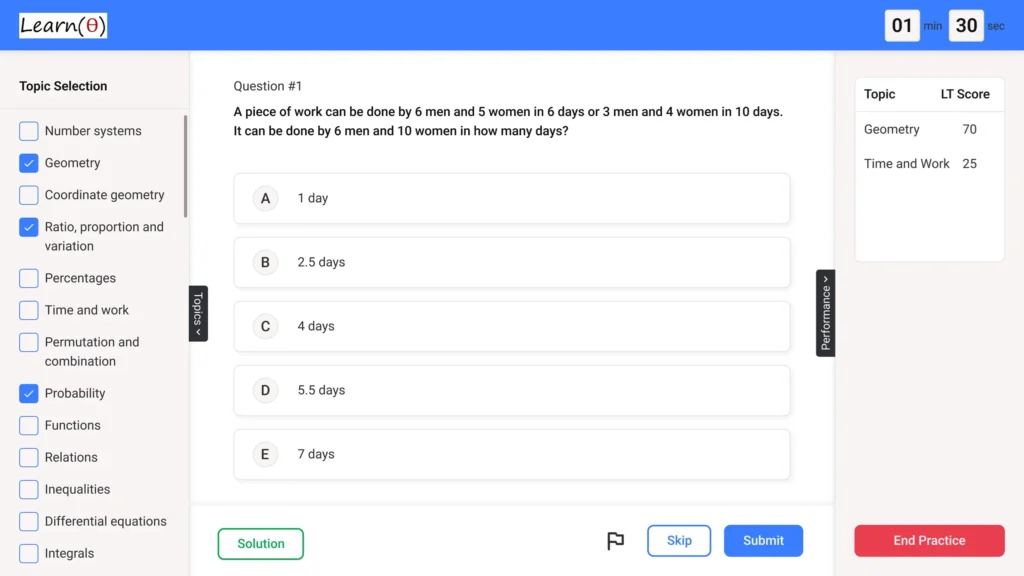
🤖 Adaptive Question Practice

📊 Progress and Insights