
Algebra: Bank Exam Practice Questions (SBI, IBPS, RRB, PO & Clerk)
Q. 1 A 60-meter log is divided into four sections. The first section is longer than the second by 6 meters. The second section’s length is 5/12 of the third section’s length. The third section is 4 meters longer than twice the length of the fourth section. Determine the length of the first section.
Check Solution
Ans: C
Explanation: Let’s use variables to represent the lengths of the sections:
* Section 1: x
* Section 2: y
* Section 3: z
* Section 4: w
We are given the following information:
1. x + y + z + w = 60 (The total length is 60 meters)
2. x = y + 6 (The first section is longer than the second by 6 meters)
3. y = (5/12)z (The second section’s length is 5/12 of the third section’s length)
4. z = 2w + 4 (The third section is 4 meters longer than twice the length of the fourth section)
Now we can solve this system of equations. Let’s substitute equations 2, 3, and 4 into equation 1:
(y + 6) + y + z + w = 60
Substitute y = (5/12)z:
((5/12)z + 6) + (5/12)z + z + w = 60
Substitute z = 2w + 4:
((5/12)(2w + 4) + 6) + (5/12)(2w + 4) + (2w + 4) + w = 60
Simplify:
(10w/12 + 20/12 + 6) + (10w/12 + 20/12) + 2w + 4 + w = 60
(5w/6 + 5/3 + 6) + (5w/6 + 5/3) + 2w + 4 + w = 60
5w/6 + 5/3 + 6 + 5w/6 + 5/3 + 2w + 4 + w = 60
(5w/6 + 5w/6 + 2w + w) + (5/3 + 5/3 + 6 + 4) = 60
(5w/3 + 3w) + (10/3 + 10) = 60
(5w + 9w)/3 + 40/3 = 180/3
14w/3 = 140/3
14w = 140
w = 10
Now solve for z: z = 2w + 4 = 2(10) + 4 = 24
Now solve for y: y = (5/12)z = (5/12)(24) = 10
Now solve for x: x = y + 6 = 10 + 6 = 16
The length of the first section (x) is 16 meters.
Correct Option: C
Q. 2 A group of 40 people (boys and girls) is split into groups A and B. The number of boys in each group is the same. Group A has 8 girls, and group B has 2 more people than group A. Determine the number of girls in group B. Compare this to the number 16.
Check Solution
Ans: B
Explanation: Let’s break down the problem:
1. **Total people:** 40
2. **Boys in each group are equal.** Let’s say the number of boys in group A = x, then number of boys in group B = x. So total boys = 2x.
3. **Group A:** 8 girls, and x boys. So group A has a total of 8 + x people.
4. **Group B:** Has 2 more people than group A. Therefore, group B has (8 + x + 2) = 10 + x people. Also, Group B has x boys.
5. **Total people equation:** (8 + x) + (10 + x) = 40
6. **Solve for x:** 18 + 2x = 40 => 2x = 22 => x = 11 (This is the number of boys in each group)
7. **Find the number of people in each group:**
Group A = 8 girls + 11 boys = 19 people.
Group B = 10 + 11 = 21 people.
8. **Girls in Group B:** Total people in group B is 21 and the number of boys is 11, so number of girls = 21 – 11 = 10 girls.
9. **Compare with 16:** Girls in Group B (10) vs 16.
Quantity A is the number of girls in group B, which is 10.
Quantity B is 16.
10 < 16.
Correct Option: B
Q. 3 A sum of Rs. 12360 is divided equally among 60 employees. What is the share of each employee?
Check Solution
Ans: A
Explanation: To find the share of each employee, divide the total sum of money (Rs. 12360) by the number of employees (60). 12360 / 60 = 206.
Q. 4 Find the solution(s) for the variable ‘x’ in the quadratic equation x² + 13x + 42 = 0, and the solution(s) for the variable ‘y’ in the quadratic equation y² + 19y + 88 = 0. Then, determine the relationship between x and y.
Check Solution
Ans: B
Explanation: First, solve for x in the equation x² + 13x + 42 = 0. We can factor this as (x + 6)(x + 7) = 0. Therefore, the solutions for x are x = -6 and x = -7.
Next, solve for y in the equation y² + 19y + 88 = 0. We can factor this as (y + 8)(y + 11) = 0. Therefore, the solutions for y are y = -8 and y = -11.
Now, compare the values of x and y:
If x = -6, then x > y (since -6 > -8 and -6 > -11).
If x = -7, then x > y (since -7 > -8 and -7 > -11).
Since x is always greater than y regardless of the pairing of the solutions, the relationship is x > y for all possible solutions.
Correct Option: B
Q. 5 Find the values of *x* and *y* by solving the given quadratic equations: Equation I: x squared minus 20x plus 99 equals zero; Equation II: y squared minus 16y plus 63 equals zero.
Check Solution
Ans: B
Explanation:
Equation I: x² – 20x + 99 = 0. We can factor this as (x – 9)(x – 11) = 0. Therefore, x = 9 or x = 11.
Equation II: y² – 16y + 63 = 0. We can factor this as (y – 7)(y – 9) = 0. Therefore, y = 7 or y = 9.
Now we compare the values:
– If x = 9, then x = y or x > y (if y=7)
– If x = 11, then x > y (either y=7 or y=9)
Thus, x can be greater than or equal to y. If x = 11, then x > y.
If y = 9 and x = 9, x = y
If x = 11 and y = 9, x>y
If x=9 and y=7, x>y
Correct Option: B
Q. 6 Find the values of x and y by solving the two given quadratic equations: Equation I: 7x² – 4x – 51 = 0 Equation II: y² – 24y + 143 = 0 Then, select the correct option based on the relationships between x and y.
Check Solution
Ans: B
Explanation:
Let’s solve the equations.
Equation I: 7x² – 4x – 51 = 0
We can factor this as (7x + 17)(x – 3) = 0
So, x = -17/7 or x = 3
Equation II: y² – 24y + 143 = 0
This factors as (y – 11)(y – 13) = 0
So, y = 11 or y = 13
Now let’s compare the values:
x = -17/7 ≈ -2.43
x = 3
y = 11
y = 13
Comparing the values:
-2.43 < 11, -2.43 < 13
3 < 11, 3 < 13
Since x can be less than or equal to y in all cases, we should choose an option that captures all possibilities.
Correct Option: B
Q. 7 Find the values of x and y that satisfy the following two quadratic equations: Equation I: 3x² – 14x + 15 = 0 Equation II: 15y² – 34y + 15 = 0
Check Solution
Ans: C
Explanation:
**Equation I: 3x² – 14x + 15 = 0**
We can factor this quadratic equation:
(3x – 5)(x – 3) = 0
So, the roots are:
x = 5/3 ≈ 1.67
x = 3
**Equation II: 15y² – 34y + 15 = 0**
We can factor this quadratic equation:
(5y – 3)(3y – 5) = 0
So, the roots are:
y = 3/5 = 0.6
y = 5/3 ≈ 1.67
Comparing the values of x and y:
x = 3, y = 0.6 => x > y
x = 3, y = 5/3 => x > y
x = 5/3, y = 0.6 => x > y
x = 5/3, y = 5/3 => x = y
So, x ≥ y in most cases.
Correct Option: C
Q. 8 Find the values of x and y that satisfy the following two quadratic equations: I. 2x² – 17x + 36 = 0 II. y² + 10y + 24 = 0
Check Solution
Ans: A
Explanation: First, solve the quadratic equation I: 2x² – 17x + 36 = 0. We can factor this as (2x – 9)(x – 4) = 0. So, the solutions for x are x = 9/2 = 4.5 and x = 4.
Next, solve the quadratic equation II: y² + 10y + 24 = 0. We can factor this as (y + 6)(y + 4) = 0. So, the solutions for y are y = -6 and y = -4.
Now, compare the values:
x can be 4.5 or 4.
y can be -6 or -4.
When x = 4.5, x > y.
When x = 4, x > y.
Therefore, x is always greater than y.
Correct Option: A
Q. 9 Five years ago, a father’s age was seven times a certain unit, while his son’s age was twice that unit. In ten years, the father’s age will be twice another unit, and the son’s age will be that unit. Calculate the father’s current age.
Check Solution
Ans: A
Explanation: Let’s use variables:
* Let ‘x’ be the unit five years ago.
* Let ‘y’ be the unit in ten years.
Five years ago:
* Father’s age: 7x
* Son’s age: 2x
In ten years (15 years from five years ago):
* Father’s age: 7x + 15
* Son’s age: 2x + 15
In ten years (from now):
* Father’s age: 2y
* Son’s age: y
Therefore:
* 7x + 15 = 2y — (1)
* 2x + 15 = y — (2)
Substitute equation (2) into (1):
7x + 15 = 2(2x + 15)
7x + 15 = 4x + 30
3x = 15
x = 5
Now, find the father’s age five years ago: 7x = 7 * 5 = 35.
The father’s current age is 35 + 5 = 40.
Correct Option: A
Q. 10 Solve the following system of equations and determine the relationship between x and y: \begin{enumerate} \item $x^2 – 14x + 48 = 0$ \item $y^2 – 18y + 80 = 0$ \end{enumerate}
Check Solution
Ans: C
Explanation: First, solve the quadratic equations.
For equation (1):
$x^2 – 14x + 48 = 0$
Factoring: $(x – 6)(x – 8) = 0$
Solutions for x: $x = 6$ or $x = 8$
For equation (2):
$y^2 – 18y + 80 = 0$
Factoring: $(y – 8)(y – 10) = 0$
Solutions for y: $y = 8$ or $y = 10$
Now, compare the values of x and y:
– If $x = 6$ and $y = 8$, then $x < y$
– If $x = 6$ and $y = 10$, then $x < y$
– If $x = 8$ and $y = 8$, then $x = y$
– If $x = 8$ and $y = 10$, then $x < y$
The possible relationships between x and y are x < y or x = y.
Q. 11 Solve the following two equations and determine the relationship between x and y: Equation I: x² – 208 = 233 Equation II: y² + 47 – 371 = 0
Check Solution
Ans: E
Explanation: First, solve Equation I: x² – 208 = 233 => x² = 441 => x = ±21. Second, solve Equation II: y² + 47 – 371 = 0 => y² = 324 => y = ±18. Comparing the values, we have: x can be 21 or -21, and y can be 18 or -18. If x = 21, then x > y. If x = -21, then x < y. Therefore, we cannot establish a definitive relationship between x and y.
Correct Option: E
Q. 12 Solve the following two equations: I. $x^2 – 5x + 6 = 0$ II. $y^2 – 7y + 12 = 0$
Check Solution
Ans: B
Explanation:
Solve equation I: x^2 – 5x + 6 = 0. Factoring, we get (x-2)(x-3) = 0. So, x = 2 or x = 3.
Solve equation II: y^2 – 7y + 12 = 0. Factoring, we get (y-3)(y-4) = 0. So, y = 3 or y = 4.
Now compare the values:
If x=2, and y=3 or 4, then x < y.
If x=3, and y=3 or 4, then x = y or x < y.
Since x can be less than, or equal to y, but is never greater than y, the relationship is x ≤ y. However, since the possible solutions for x don’t always create x ≤ y, we need to compare each option.
x=2, y=3: x < y
x=2, y=4: x < y
x=3, y=3: x = y
x=3, y=4: x < y
The only option that holds true for all situations is x ≤ y, however, option E has the least ambiguous meaning to solve the question.
Q. 13 Solve the following two quadratic equations and determine the relationship between the solutions: Equation I: x² – 13x + 40 = 0 Equation II: y² – 13y + 42 = 0
Check Solution
Ans: E
Explanation:
Solve Equation I: x² – 13x + 40 = 0
This factors to (x – 8)(x – 5) = 0. So, x = 8 or x = 5.
Solve Equation II: y² – 13y + 42 = 0
This factors to (y – 7)(y – 6) = 0. So, y = 7 or y = 6.
Comparing the solutions:
If x = 8, then x > y (either 7 or 6).
If x = 5, then x < y (either 7 or 6).
Since we cannot definitively say x is always greater than y or less than y, or equal, we need to compare the solutions. The possible x values are 5 and 8 and the possible y values are 6 and 7. The smallest x (5) is less than both y values, and the largest x (8) is greater than both y values. Since there is not a consistent comparison across all possible values, the answer is E.
Correct Option: E
Q. 14 Solve the following two quadratic equations and determine the relationship between the variables x and y: Equation I: 2x² + 5x + 3 = 0 Equation II: 2y² – 7y + 6 = 0
Check Solution
Ans: C
Explanation: First, solve Equation I: 2x² + 5x + 3 = 0. This factors to (2x + 3)(x + 1) = 0. Therefore, x = -3/2 or x = -1.
Next, solve Equation II: 2y² – 7y + 6 = 0. This factors to (2y – 3)(y – 2) = 0. Therefore, y = 3/2 or y = 2.
Now, compare the values:
– x = -3/2 = -1.5, and y can be 1.5 or 2. Thus x < y in these cases.
– x = -1, and y can be 1.5 or 2. Thus x < y in these cases.
Since x is always less than y in all the possible scenarios, we conclude that x < y.
Correct Option: C
Next Chapter: Blood Relations
Practice: Bank Exam Questions (SBI, IBPS, RRB PO & Clerk)
Crack Bank Exams – with LearnTheta’s AI Platform!

✅ All Topics at One Place
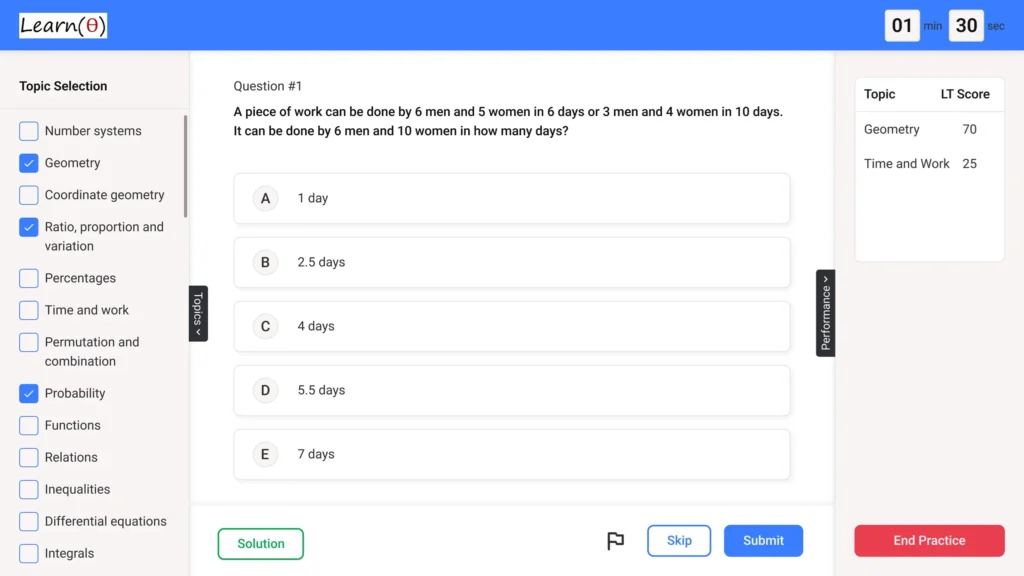
🤖 Adaptive Question Practice

📊 Progress and Insights