
Scheduling: CAT Previous Year Questions
Q. 1 Instructions
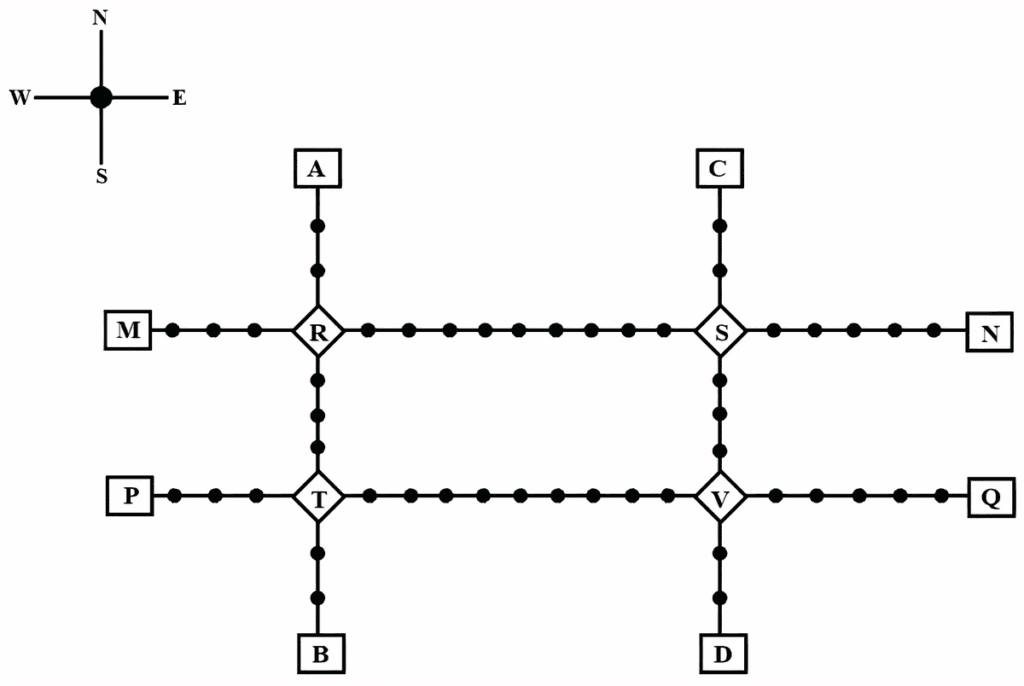
Given above is the schematic map of the metro lines in a city with rectangles denoting terminal stations (e.g. A), diamonds denoting junction stations (e.g. R) and small filled-up circles denoting other stations. Each train runs either in east-west or north-south direction, but not both. All trains stop for 2 minutes at each of the junction stations on the way and for 1 minute at each of the other stations. It takes 2 minutes to reach the next station for trains going in east-west direction and 3 minutes to reach the next station for trains going in northsouth direction. From each terminal station, the first train starts at 6 am; the last trains leave the terminal stations at midnight. Otherwise, during the service hours, there are metro service every 15 minutes in the north-south lines and every 10 minutes in the east-west lines. A train must rest for at least 15 minutes after completing a trip at the terminal station, before it can undertake the next trip in the reverse direction. (All questions are related to this metro service only. Assume that if someone reaches a station exactly at the time a train is supposed to leave, (s)he can catch that train.)
If Hari is ready to board a train at 8:05 am from station M, then when is the earliest that he can reach station N?
Check Solution
Ans: A
A train departs station M in the east-west direction at regular 10-minute intervals.
The inaugural departure from station M is at 6:00 am.
Consequently, subsequent train departures from M occur at 6:10 am, 6:20 am, 6:30 am, and so forth.
Hari arrived at station M at 8:05 am.
Therefore, the earliest Hari can board a train from station M is at 8:10 am.
There are 19 stations located between M and N, with two of these stations serving as junctions.
The duration of travel between any two consecutive stations in the east-west direction is 2 minutes.
Hence, the total time the train is in motion between M and N (excluding any stops) is calculated as:
$20\text{ stations} \times 2\text{ minutes/station} = 40\text{ minutes}$
Stoppages at junction stations last for 2 minutes, while at other stations, they are 1 minute each.
The aggregate stoppage time for the train’s journey from M to N is:
$(17 \text{ regular stations} \times 1\text{ minute/station}) + (2\text{ junction stations} \times 2\text{ minutes/station}) = 17 + 4 = 21\text{ minutes}$
Thus, the complete journey duration is the sum of travel time and stoppage time:
$40\text{ minutes} + 21\text{ minutes} = 61\text{ minutes}$
Therefore, Hari is expected to arrive at N at 8:10 am + 61 minutes = 9:11 am.
Q. 2 If Priya is ready to board a train at 10:25 am from station T, then when is the earliest that she can reach station S?
Check Solution
Ans: A
Priya has two possible routes to travel from T to S: via R or via V.
**Scenario 1: T-V-S**
* **East-West Travel (T to V):**
* The first eastbound train from P reaches T at 6:00 am + (4 * 2 minutes) + (3 * 1 minute) = 6:11 am.
* As T is a transit point, this train waits for 2 minutes, departing at 6:13 am.
* Priya is looking to board an eastbound train from T. The earliest she can board such a train is at 10:33 am.
* There are 9 stations between T and V.
* The travel duration from T to V is calculated as (10 * 2 minutes) + (9 * 1 minute) = 29 minutes.
* Therefore, Priya will arrive at V at the latest by 10:33 am + 29 minutes = 11:02 am.
* **North-South Travel (V to S):**
* The first northbound train from D arrives at V at 6:00 am + (3 * 3 minutes) + (2 * 1 minute) = 6:11 am.
* Since V is a transit point, this train stops for 2 minutes and leaves at 6:13 am.
* Trains depart from D in the north-south direction every 15 minutes.
* The latest Priya can board a north-south train from V is at 11:13 am.
* There are 3 stations between V and S.
* The travel time between V and S is calculated as (4 * 3 minutes) + (3 * 1 minute) = 15 minutes.
* Priya reaches S at 11:13 am + 15 minutes = 11:28 am.
**Scenario 2: T-R-S**
* **North-South Travel (T to R):**
* The first northbound train from B arrives at T at 6:00 am + (3 * 3 minutes) + (2 * 1 minute) = 6:11 am.
* As T is a transit point, this train waits for 2 minutes, departing at 6:13 am.
* Eastbound trains depart from P every 15 minutes. The latest Priya can board such a train is at 10:28 am.
* Priya will board a north-south train from T to R, as this option becomes available earlier (10:28 am) than the east-west train.
* There are 3 stations between T and R.
* The travel duration from T to R is calculated as (4 * 3 minutes) + (3 * 1 minute) = 15 minutes.
* Priya will reach R at the latest by 10:28 am + 15 minutes = 10:43 am.
* **East-West Travel (R to S):**
* The first eastbound train from M arrives at R at 6:00 am + (4 * 2 minutes) + (3 * 1 minute) = 6:11 am.
* As R is a transit point, this train stops for 2 minutes and leaves at 6:13 am.
* Trains depart from M in the east-west direction every 10 minutes.
* The latest Priya can board an east-west train from R is at 10:43 am.
* There are 9 stations between R and S.
* The travel time between R and S is calculated as (10 * 2 minutes) + (9 * 1 minute) = 29 minutes.
* Priya reaches S at 10:43 am + 29 minutes = 11:12 am.
Comparing the two scenarios, Scenario 2 results in a shorter travel time. Therefore, the answer is 11:12 am.
Q. 3 Haripriya is expected to reach station S late. What is the latest time by which she must be ready to board at station S if she must reach station B before 1 am via station R?
Check Solution
Ans: A
Travel duration from S to R = (10 segments * 2 minutes/segment) + (9 segments * 1 minute/segment) = 20 + 9 = 29 minutes.
There is a 2-minute stop at R.
Travel duration from R to B = (7 segments * 3 minutes/segment) + (1 segment * 2 minutes/segment) + (5 segments * 1 minute/segment) = 21 + 2 + 5 = 28 minutes.
For the north-south route, the initial train departing from A reaches R at:
Arrival time at R = 6:00 am + (3 segments * 3 minutes/segment) + (2 segments * 1 minute/segment) = 6:00 am + 9 minutes + 2 minutes = 6:11 am.
As R is a transit point, this train observes a 2-minute pause, departing R at 6:13 am.
A train departs from A towards the north-south direction every 15 minutes.
The final train to leave A departs at 12:00 am, reaching R at 12:13 am. Consequently, Haripriya must arrive at R no later than 12:13 am.
Travel duration from S to R = (10 segments * 2 minutes/segment) + (9 segments * 1 minute/segment) = 20 + 9 = 29 minutes.
Therefore, Haripriya needs to board the train at S by 11:44 pm (12:13 am – 29 minutes).
For the east-west route, the initial train departing from N reaches S at:
Arrival time at S = 6:00 am + (6 segments * 2 minutes/segment) + (5 segments * 1 minute/segment) = 6:00 am + 12 minutes + 5 minutes = 6:17 am.
Since S is a transit point, this train pauses for 2 minutes, departing S at 6:19 am.
A train departs from N towards the east-west direction every 10 minutes.
Hence, Haripriya should board the train that departs from S at 11:39 pm.
Q. 4 What is the minimum number of trains that are required to provide the service on the AB line (considering both north and south directions)?
Check Solution
Ans: 8
Time to traverse from point A to point B is calculated as follows:
$ \left(10 \times 3\right) + \left(7 \times 1\right) + \left(2 \times 2\right) = 41 \text{ minutes} $
Following any trip, a train must observe a minimum idle period of 15 minutes before commencing its next journey.
Consequently, if a train departs from A at 6 am towards B, the earliest it can begin its return journey from B to A is at 7 am. This is because, in both the northbound and southbound directions, a train departs from each terminal (A and B) every 15 minutes.
Therefore, the total number of trains needed is determined by:
$ \left(\frac{60}{15}\right) \times 2 = 8 $
Q. 5 What is the minimum number of trains that are required to provide the service in this city?
Check Solution
Ans: 48
Journey duration from point A to point B = $\left(10\times3\right)+\left(7\times1\right)+\left(2\times2\right)=41$ minutes
Following any trip, a train requires a minimum 15-minute pause before commencing its subsequent journey.
Therefore, if a train departs from A at 6 am for B, it will commence its return trip from B to A no later than 7 am. This is because, for north-south routes, a train departs from both A and B every 15 minutes.
Consequently, the total count of trains needed for the north-south routes is calculated as $\left(\frac{60}{15}\right)\times2\times2=16$.
Journey duration from point M to point N = $\left(20\times2\right)+\left(17\times1\right)+\left(2\times2\right)=61$ minutes
Following any trip, a train requires a minimum 15-minute pause before commencing its subsequent journey.
Therefore, if a train departs from M at 6 am for N, it will commence its return trip from N to M no later than 7:20 am. This is because, for east-west routes, a train departs from both M and N every 15 minutes.
Consequently, the total count of trains needed for the east-west routes is calculated as $\left(\frac{80}{10}\right)\times2\times2=32$.
The aggregate number of trains required to serve the city is 16 + 32 = 48.
Q. 6 Instructions
A shopping mall has a large basement parking lot with parking slots painted in it along a single row. These slots are quite narrow; a compact car can fit in a single slot but an SUV requires two slots. When a car arrives, the parking attendant guides the car to the first available slot from the beginning of the row into which the car can fit.
For our purpose, cars are numbered according to the order in which they arrive at the lot. For example, the first car to arrive is given a number 1, the second a number 2, and so on. This numbering does not indicate whether a car is a compact or an SUV. The configuration of a parking lot is a sequence of the car numbers in each slot. Each single vacant slot is represented by letter V.
For instance, suppose cars numbered 1 through 5 arrive and park, where cars 1, 3 and 5 are compact cars and 2 and 4 are SUVs. At this point, the parking lot would be described by the sequence 1, 2, 3, 4, 5. If cars 2 and 5 now vacate their slots, the parking lot would now be described as 1, V, V, 3, 4. If a compact car (numbered 6) arrives subsequently followed by an SUV (numbered 7), the parking lot would be described by the sequence 1, 6, V, 3, 4, 7.
Answer the following questions INDEPENDENTLY of each other.
Suppose eight cars have arrived, of which two have left. Also suppose that car 4 is a compact and car 7 is an SUV. Which of the following is a POSSIBLE current configuration of the parking lot?
Check Solution
Ans: D
Let’s examine possibility number 4.
The arrangement of vehicles is 8, 2, 3, V, 5, 6, 7. This configuration is readily achievable.
Imagine vehicles 1 through 7 arriving in succession.
Subsequently, vehicle 1 departs, and vehicle 8 occupies its former position.
Finally, vehicle 4 departs. Therefore, it is evident that this particular assembly of vehicles can occur.
Q. 7 Suppose the sequence at some point of time is 4, 5, 6, V, 3. Which of the following is NOT necessarily true?
Check Solution
Ans: C
The initial arrangement presented is 4, 5, 6, V, 3.
This arrangement can be achieved if vehicles 1, 2, and 3 enter, followed by vehicles 1 and 2 exiting. Subsequently, vehicles 4, 5, and 6 arrive.
At this point, there are four positions preceding vehicle 3. This scenario implies that vehicles 1 and 2 were originally SUVs. Of these four preceding positions, three are now occupied by vehicles 4, 5, and 6, indicating these are compact cars. Vehicle 3’s classification (SUV or compact) does not alter the eventual outcome.
Q. 8 Suppose that car 4 is not the first car to leave and that the sequence at a time between the arrival of the car 7 and car 8 is V, 7, 3, 6, 5. Then which of the following statements MUST be false?
Check Solution
Ans: D
Here, vehicles 3 and 5 remain in their original spots. This indicates that vehicle 4 was not the initial one to depart; either vehicle 1 or vehicle 2 exited before vehicle 4. Let’s assume only vehicle 2 left before vehicle 4. If vehicle 2 is an SUV, then vehicle 6 was occupying that particular space. Consequently, vehicle 2 and vehicle 7 are identified as compact vehicles. The fourth option is the correct one.

Q. 9 Instructions
Three doctors, Dr. Ben, Dr. Kane and Dr. Wayne visit a particular clinic Monday to Saturday to see patients. Dr. Ben sees each patient for 10 minutes and charges Rs. 100/-. Dr. Kane sees each patient for 15 minutes and charges Rs. 200/-, while Dr. Wayne sees each patient for 25 minutes and charges Rs. 300/-. The clinic has three rooms numbered 1, 2 and 3 which are assigned to the three doctors as per the following table.
The clinic is open from 9 a.m. to 11.30 a.m. every Monday to Saturday.
On arrival each patient is handed a numbered token indicating their position in the queue, starting with token number 1 every day. As soon as any doctor becomes free, the next patient in the queue enters that emptied room for consultation. If at any time, more than one room is free then the waiting patient enters the room with the smallest number. For example, if the next two patients in the queue have token numbers 7 and 8 and if rooms numbered 1 and 3 are free, then patient with token number 7 enters room number 1 and patient with token number 8 enters room number 3.
What is the maximum number of patients that the clinic can cater to on any single day?
Check Solution
Ans: C
If each doctor attended to patients sequentially, then over a 2.5-hour period, Ben could assist 15 individuals, Kane could assist 10, and Wayne could assist 6.
This means that a combined total of 31 patients can be attended to on any given day.
Q. 10 The queue is never empty on one particular Saturday. Which of the three doctors would earn the maximum amount in consultation charges on that day?
Check Solution
Ans: B
Assuming each doctor attends to patients sequentially, within a 2.5-hour period:
Ben will attend to 15 patients.
Kane will attend to 10 patients.
Wayne will attend to 6 patients.
Consequently, their earnings will be:
Ben’s earnings: 15 patients * Rs 100/patient = Rs 1500
Kane’s earnings: 10 patients * Rs 200/patient = Rs 2000
Wayne’s earnings: 6 patients * Rs 300/patient = Rs 1800
Therefore, Kane will achieve the highest earnings from consultation fees on that particular day.
Option B
Q. 11 Instructions
Healthy Bites is a fastfood joint serving three items, burgers, fries and ice cream. It has two employees Anish and Bani who prepare the items ordered by the clients. Preparation time is 10 minutes for a burger and 2 minutes for an order of Ice cream. An employee can prepare only one of these items at a time. The fries are prepared in an automatic fryer which can prepare upto to 3 portions of fries at a time, and takes 5 minutes irrespective of the number of portions. The fryer does not need an employee to constantly attend to it, and we can ignore the time taken by an employee to start and stop the fryer; thus, an employee can be engaged in preparing other items while the frying is on. However fries cannot be prepared in anticipation of future orders.
Healthy Bites wishes to serve the orders as early as possible. The individual items in any order are served as and when ready; however,the order is considered to be completely served only when all the items of that order are served.
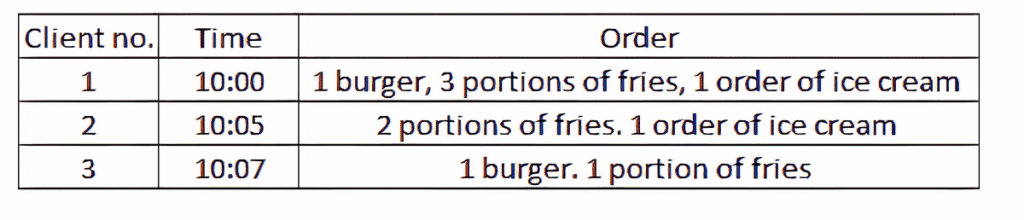
The table below gives the orders of three clients and the times at which they placed their orders:
Assume that only one client’s order can be processed at any given point of time. So, Anish or Bani cannot start preparing a new order while a previous order is being prepared.
At what time is the order placed by Client 1 completely served?
Check Solution
Ans: B
It is provided that:
1 burger requires 10 minutes to prepare.
1 ice cream requires 2 minutes to prepare.
3 portions of fries require 5 minutes to prepare using the machine (no operator needed).
Customer 1 placed an order for:
1 burger
3 portions of fries
1 ice cream
The burger will take 10 minutes to complete. During this time, the remaining items in the order can be prepared.
Q. 12 Suppose the employees are allowed to process multiple orders at a time, but the preference would be to finish orders of clients who placed their orders earlier.
Also assume that the fourth client came in only at 10:35. Between 10:00 and 10:30, for how many minutes is exactly one of the employees idle?
Check Solution
Ans: B
It is stated that:
– A single burger requires 10 minutes of processing.
– A single ice cream requires 2 minutes of processing.
– Three servings of fries require 5 minutes of processing.
These tasks are performed by machinery, requiring no direct operator intervention.
Staff are permitted to handle multiple orders concurrently. However, the priority is to complete orders based on their submission time.
The initial order consists of:
– 1 burger
– 1 ice cream
– 3 servings of fries
Anish can commence work on the burger, while Bani can begin preparing the ice cream.
The burger will be completed by 10:10.
The ice cream will be completed by 10:02.
The fries will be completed by 10:05.
A second order is submitted at 10:05, comprising:
– 1 ice cream
– 1 serving of fries
Bani is available to work on the ice cream from 10:05 and can also handle the fries.
Bani will be exclusively available between 10:02 and 10:05, a duration of 3 minutes.
The ice cream from this second order will be ready by 10:07.
The fries from this second order will be ready by 10:10.
A third order is submitted at 10:07, consisting of:
– 1 burger
– 1 serving of fries
Bani will immediately commence preparation of the burger for this third order. He will complete it by 10:17.
Anish will have finished the first burger at 10:10. He will then be available until 10:17, a period of 7 minutes.
Consequently, exactly one individual is unoccupied for a duration of 10 minutes.