
Profit & Loss: Bank Exam Practice Questions (SBI, IBPS, RRB)
In SBI, IBPS and RRB exams, Profit & Loss questions include basic CP/SP and profit percentage problems, discount and marked price questions, successive profit/loss, false weighing, and partnership-based profit sharing. They also ask caselet/DI questions where profits are divided based on investment and time, especially in mains exams.
Q. 1 A bag’s cost is 72% of its marked price. A 46% discount is applied to the bag. A toy’s marked price equals the bag’s cost. If a 20% discount on the toy is worth Rs. 20, what is the bag’s loss in rupees?
Check Solution
Ans: D
Explanation: Let the bag’s marked price be ‘M’. The bag’s cost price is 0.72M. The toy’s marked price is also 0.72M (since it equals the bag’s cost). A 20% discount on the toy is worth Rs. 20. Therefore, 0.20 * 0.72M = 20. Solving for M: 0.144M = 20, so M = 20 / 0.144 = 138.89 (approximately). The bag’s cost is 0.72M = 0.72 * 138.89 = 100 (approximately). The selling price of the bag after a 46% discount is 0.54M = 0.54 * 138.89= 75 (approximately). The loss is Cost Price – Selling Price = 100 – 75 = 25. Therefore the correct answer is D
Correct Option: D
Q. 2 A dress originally priced at Rs. 2000 is sold with a series of discounts: 20%, then 10%, and finally 10% on the progressively reduced prices. Calculate the final price a customer pays after all discounts are applied.
Check Solution
Ans: C
Explanation:
1. After the first discount of 20%, the price becomes 2000 * (1 – 0.20) = 2000 * 0.80 = Rs. 1600.
2. After the second discount of 10%, the price becomes 1600 * (1 – 0.10) = 1600 * 0.90 = Rs. 1440.
3. After the third discount of 10%, the price becomes 1440 * (1 – 0.10) = 1440 * 0.90 = Rs. 1296.
Correct Option: C
Q. 3 A laptop’s marked price is Rs. 24,000, which is 20% higher than what it cost to make. If the laptop is sold for a profit of Rs. 1000, what percentage discount was offered on the marked price?
Check Solution
Ans: A
Explanation:
1. **Find the cost price:** The marked price (Rs. 24,000) is 120% of the cost price. Let the cost price be ‘x’. So, 1.20x = 24000. Therefore, x = 24000 / 1.20 = Rs. 20,000.
2. **Find the selling price:** The laptop is sold for a profit of Rs. 1000. Selling price = Cost price + Profit = 20000 + 1000 = Rs. 21,000.
3. **Find the discount:** Discount = Marked price – Selling price = 24000 – 21000 = Rs. 3,000.
4. **Calculate the discount percentage:** Discount percentage = (Discount / Marked price) * 100 = (3000 / 24000) * 100 = 12.5%.
Correct Option: A
Q. 4 A retailer buys a television for $800. He marks up the price by 75% and then offers a discount of 20% on the marked price. What is the retailer’s profit or loss?
Check Solution
Ans: B
Explanation:
1. **Calculate the markup:** The retailer marks up the price by 75% of $800, which is (75/100) * $800 = $600.
2. **Calculate the marked price:** The marked price is the original price plus the markup: $800 + $600 = $1400.
3. **Calculate the discount:** The discount is 20% of the marked price, which is (20/100) * $1400 = $280.
4. **Calculate the selling price:** The selling price is the marked price minus the discount: $1400 – $280 = $1120.
5. **Calculate the profit:** The profit is the selling price minus the original cost: $1120 – $800 = $320.
6. **Calculate the profit percentage:** The profit percentage is (Profit / Cost Price) * 100 = ($320 / $800) * 100 = 40%.
Q. 5 A retailer marked up the price of a shirt by 50% above its cost price. He then offered a discount of 25% on the marked price. If the retailer made a profit of Rs. 150 on the shirt, what was the cost price of the shirt?
Check Solution
Ans: D
Explanation: Let the cost price be C. The marked price is C + 0.5C = 1.5C. The selling price is 1.5C – 0.25(1.5C) = 1.5C – 0.375C = 1.125C. The profit is the selling price minus the cost price, so 1.125C – C = 150. This simplifies to 0.125C = 150. Dividing both sides by 0.125 (or multiplying by 8) gives C = 1200.
Q. 6 A shopkeeper increases the price of an item by 50% and then offers two discounts: 20% and 15%. If the shopkeeper makes a profit of Rs. 400, what was the original cost of the item?
Check Solution
Ans: C
Explanation: Let the original cost price be C.
The shopkeeper increases the price by 50%, so the marked price becomes 1.5C.
The shopkeeper offers a 20% discount, so the price becomes 1.5C * (1 – 0.20) = 1.5C * 0.8 = 1.2C.
Then they offer a 15% discount, so the selling price becomes 1.2C * (1 – 0.15) = 1.2C * 0.85 = 1.02C.
The profit is the selling price minus the cost price, which is 1.02C – C = 0.02C.
The profit is given as Rs. 400.
So, 0.02C = 400
C = 400 / 0.02 = 20000.
The original cost was Rs. 20,000.
Correct Option: C
Q. 7 A shopkeeper marked up the price of an item by 20% and then offered a discount of 10% to a customer. If the final selling price of the item was Rs. 1080, what was the original cost price of the item for the shopkeeper?
Check Solution
Ans: A
Explanation: Let the original cost price be ‘x’. The shopkeeper marked up the price by 20%, so the marked price is 1.20x. Then, he offered a discount of 10% on the marked price. So, the selling price is 90% of the marked price or 0.9 * 1.20x = 1.08x. We are given the selling price is Rs. 1080. Therefore, 1.08x = 1080. To find x, divide 1080 by 1.08: x = 1080 / 1.08 = 1000.
Q. 8 A shopkeeper marks up the original price of an item by Rs. 240. He then offers a 20% discount. Despite the discount, he still earns a profit of Rs. 96. What was the original cost of the item?
Check Solution
Ans: E
Explanation: Let the original cost of the item be ‘x’. The shopkeeper marks up the price by Rs. 240, so the marked price is x + 240. He offers a 20% discount on the marked price. This means the selling price is 80% of the marked price: 0.8 * (x + 240). The shopkeeper earns a profit of Rs. 96, which means the selling price is also the original cost plus the profit: x + 96. Therefore, we can set up the equation: 0.8 * (x + 240) = x + 96. Expanding the equation: 0.8x + 192 = x + 96. Subtracting 0.8x from both sides: 192 = 0.2x + 96. Subtracting 96 from both sides: 96 = 0.2x. Dividing both sides by 0.2: x = 480.
Correct Option: E
Q. 9 A shopkeeper marks up the price of a shirt by 50% and then offers a discount of 20%. If the original cost price of the shirt was Rs. 800, what is the selling price?
Check Solution
Ans: A
Explanation:
1. **Calculate the marked-up price:** The shopkeeper marks up the price by 50% of the original cost price. 50% of Rs. 800 is (50/100) * 800 = Rs. 400. The marked-up price is 800 + 400 = Rs. 1200.
2. **Calculate the discount amount:** The discount is 20% of the marked-up price. 20% of Rs. 1200 is (20/100) * 1200 = Rs. 240.
3. **Calculate the selling price:** The selling price is the marked-up price minus the discount. Selling price = 1200 – 240 = Rs. 960.
Q. 10 A shopkeeper offers successive discounts of 15% and 5% on the marked price of an article and still makes a profit of Rs. 85. If the marked price of the article is Rs. 700, find the cost price of the article.
Check Solution
Ans: E
Explanation:
1. Calculate the selling price after the discounts:
– First discount: 15% of Rs. 700 = 0.15 * 700 = Rs. 105
– Price after first discount: 700 – 105 = Rs. 595
– Second discount: 5% of Rs. 595 = 0.05 * 595 = Rs. 29.75
– Selling Price: 595 – 29.75 = Rs. 565.25
2. Calculate the cost price:
– Profit = Selling Price – Cost Price
– Cost Price = Selling Price – Profit
– Cost Price = 565.25 – 85 = Rs. 480.25
Q. 11 A shopkeeper offers two successive discounts of 20% and 15% on a shirt. If the selling price of the shirt after the discounts is Rs. 612, what was the marked price of the shirt?
Check Solution
Ans: C
Explanation: Let the marked price be ‘x’. After a 20% discount, the price becomes 0.8x. After a 15% discount on 0.8x, the price becomes 0.85 * 0.8x = 0.68x. We are given that 0.68x = 612. Therefore, x = 612 / 0.68 = 900.
Q. 12 A shopkeeper raises the price of an item by 40% of its original cost. When he offers a 10% discount, he makes a certain profit. If he increases the discount to 15%, his profit decreases by 21 rupees. What profit or loss would he make if he offered a 20% discount on the marked price?
Check Solution
Ans: B
Explanation:
Let the original cost price be C.
The shopkeeper raises the price by 40%, so the marked price M = C + 0.4C = 1.4C.
When the discount is 10%, the selling price is S1 = M – 0.1M = 0.9M = 0.9(1.4C) = 1.26C.
The profit in this case is P1 = S1 – C = 1.26C – C = 0.26C.
When the discount is 15%, the selling price is S2 = M – 0.15M = 0.85M = 0.85(1.4C) = 1.19C.
The profit in this case is P2 = S2 – C = 1.19C – C = 0.19C.
The profit decreases by 21 rupees: P1 – P2 = 21, so 0.26C – 0.19C = 21, which means 0.07C = 21.
Therefore, C = 21 / 0.07 = 300.
The marked price M = 1.4C = 1.4 * 300 = 420.
If the discount is 20%, the selling price is S3 = M – 0.2M = 0.8M = 0.8 * 420 = 336.
The profit is P3 = S3 – C = 336 – 300 = 36.
Correct Option: B
Q. 13 Alice and Bob started a partnership. Alice invested twice the amount Bob invested, and her investment was for a period of 4 months. Bob’s investment was for 6 months. If Alice received a profit of Rs. 12,000, what was their total profit?
Check Solution
Ans: B
Explanation: Let Bob’s investment be ‘x’. Then Alice’s investment is ‘2x’. The profit is divided in the ratio of (investment * time). Therefore, the ratio of Alice’s profit to Bob’s profit is (2x * 4) : (x * 6) which simplifies to 8:6 or 4:3. Alice’s profit is Rs. 12,000, which corresponds to the ratio 4. So, Bob’s profit corresponds to ratio 3. Bob’s profit = (3/4) * 12000 = Rs. 9000. Total profit = Alice’s profit + Bob’s profit = 12000 + 9000 = Rs. 21,000.
Q. 14 Dinesh and Mahesh both make a 20% profit, but Dinesh calculates his profit based on the cost, and Mahesh calculates his based on the selling price. Their profit difference is Rs. 200, and their selling prices are identical. What is their selling price?
Check Solution
Ans: D
Explanation: Let’s denote Dinesh’s cost as Cd and Mahesh’s cost as Cm. The selling price is S.
Dinesh’s profit: 0.20 * Cd
Mahesh’s profit: 0.20 * S
Selling Price (S) = Cost + Profit
Dinesh: S = Cd + 0.20Cd = 1.20Cd => Cd = S/1.2
Mahesh: S = Cm + 0.20S => 0.8S = Cm => Cm = 0.8S
The profit difference is Rs. 200:
S/1.2 – 0.8S = 200 (as 1/1.2 is greater than 0.8, we can’t do reverse)
(5/6)S – (4/5)S = 200
(25-24)/30 * S = 200
S/30 = 200
S = 6000
Correct Option: D
Q. 15 P and Q invest in a venture with a 2:3 ratio. P leaves after 9 months. If their profit sharing ratio is 3:8, how long did Q’s investment last?
Check Solution
Ans: E
Explanation: Let P’s investment be 2x and Q’s investment be 3x. P invested for 9 months. Let Q’s investment last for y months. Profit sharing is proportional to (investment * time). Thus, (2x * 9) / (3x * y) = 3 / 8. Simplifying, 18 / (3y) = 3 / 8. Cross-multiplying, 144 = 9y. Therefore, y = 144 / 9 = 16 months.
Correct Option: E
Q. 16 Ratul invested a certain amount, which was 20% greater than Rakesh’s investment. Rakesh’s investment, in turn, was 50% more than Rudra’s investment. Given that the combined investment of all three individuals totaled Rs. 3,225, what was the amount invested by Ratul?
Check Solution
Ans: D
Explanation: Let’s use variables to represent the investments:
* Let Rudra’s investment be R.
* Rakesh’s investment was 50% more than Rudra’s, so Rakesh invested 1.5R.
* Ratul’s investment was 20% greater than Rakesh’s, so Ratul invested 1.2 * (1.5R) = 1.8R.
The combined investment is Rs. 3,225. Therefore:
R + 1.5R + 1.8R = 3225
4.3R = 3225
R = 3225 / 4.3 = 750
Ratul’s investment was 1.8R = 1.8 * 750 = 1350
Correct Option: D
Q. 17 Sam purchased two items, A and B, for a combined price of 5000 rupees. He sold item A at a 25% loss and item B at a 6% profit. Overall, he lost 165 rupees on the sale of both. What was the original price of item A?
Check Solution
Ans: E
Explanation: Let the cost price of item A be ‘x’ and the cost price of item B be ‘5000 – x’.
Selling price of A = x – 0.25x = 0.75x
Selling price of B = (5000 – x) + 0.06(5000 – x) = (5000 – x) + 300 – 0.06x = 5300 – 1.06x
Total loss = Cost Price – Selling Price
Overall selling price = 0.75x + 5300 – 1.06x = 5300 – 0.31x
Total cost price = 5000
Loss = 5000 – (5300 – 0.31x) = 165
5000 – 5300 + 0.31x = 165
-300 + 0.31x = 165
0.31x = 465
x = 465 / 0.31
x = 1500
Correct Option: E
Q. 18 Two shops, A and B, sell a laptop with a marked price of Rs. 48,000. Shop A offers a discount of 8% on the first Rs. 25,000 and 5% on the remaining amount. Shop B gives a 10% discount on the entire price. Determine the final price of the laptop at both shops.
Check Solution
Ans: C
Explanation:
Shop A:
Discount on first Rs. 25,000 = 8% of 25000 = (8/100) * 25000 = Rs. 2000
Price after discount on first 25000 = 25000 – 2000 = Rs. 23000
Remaining amount = 48000 – 25000 = Rs. 23000
Discount on remaining amount = 5% of 23000 = (5/100) * 23000 = Rs. 1150
Price after discount on remaining amount = 23000 – 1150 = Rs. 21850
Total price at Shop A = 23000 + 21850 = Rs. 44850
Shop B:
Discount on entire price = 10% of 48000 = (10/100) * 48000 = Rs. 4800
Price after discount at Shop B = 48000 – 4800 = Rs. 43200
Therefore, A = Rs. 44850 and B = Rs. 43200.
Correct Option: C
Next Chapter: Ratio and Proportion
Practice: Bank Exam Questions (SBI, IBPS, RRB PO & Clerk)
Crack Bank Exams – with LearnTheta’s AI Platform!

✅ All Topics at One Place
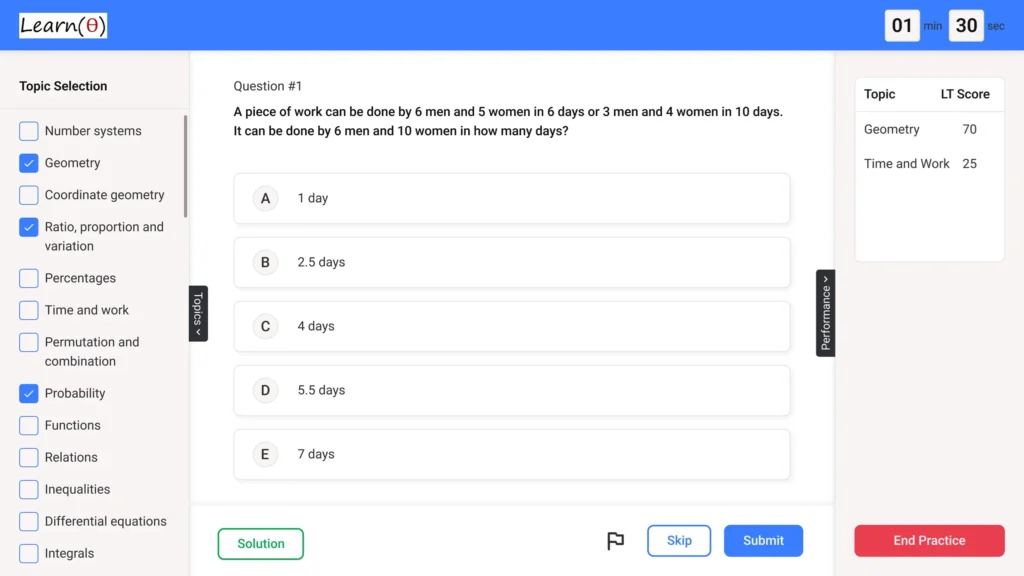
🤖 Adaptive Question Practice
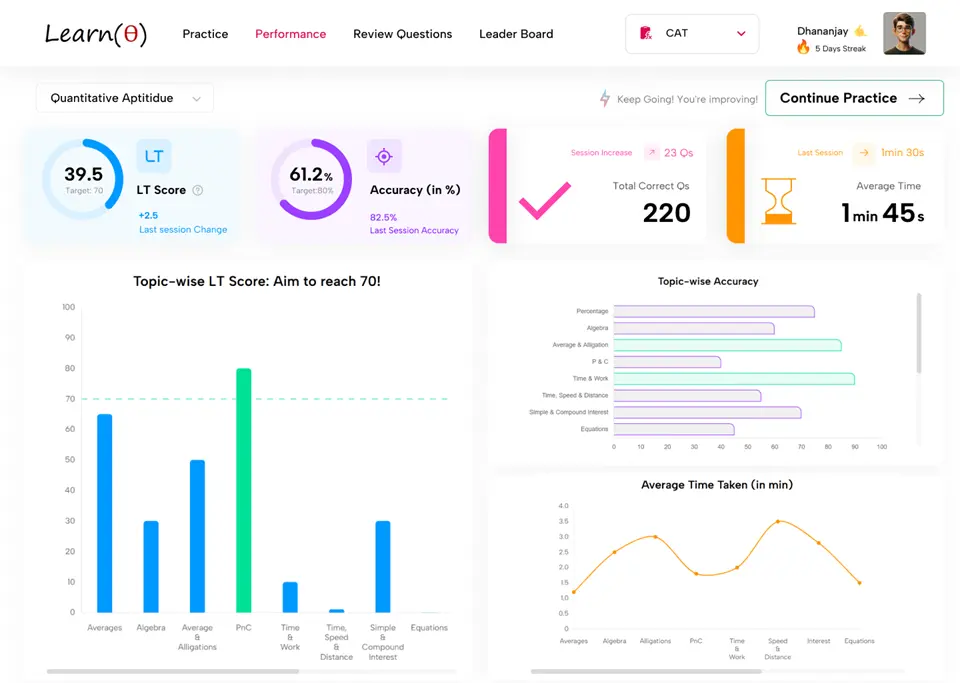
📊 Progress and Insights