
Averages & Mixtures: Bank Exams (SBI, IBPS, RRB)
Q. 1 A 400-liter mixture of milk and water contains milk and water in the ratio of 7:3. How much water should be added to the mixture so that the new mixture contains milk and water in the ratio of 2:3?
Check Solution
Ans: E
Explanation:
1. Calculate the initial amounts:
Milk: (7/10) * 400 liters = 280 liters
Water: (3/10) * 400 liters = 120 liters
2. Set up the equation: Let ‘x’ be the amount of water to be added. The amount of milk remains constant at 280 liters. The new ratio of milk to water should be 2:3.
280 / (120 + x) = 2 / 3
3. Solve for x:
280 * 3 = 2 * (120 + x)
840 = 240 + 2x
600 = 2x
x = 300 liters
4. Verify by calculating total volume with 300L water added:
Total water becomes 120 + 300 = 420 liters
New total volume is 400 + 300 = 700 liters
Milk percentage: 280/700 = 2/5 (40%)
Water percentage: 420/700 = 3/5 (60%)
* Milk to water ratio is 2:3.
Q. 2 A 60-liter mixture of milk has ‘x’ liters removed and replaced with water. This process is done three times total. If the final amount of milk remaining is 43.74 liters, what is the value of ‘x’?
Check Solution
Ans: D
Explanation: Let’s analyze the problem. Each time, ‘x’ liters of the mixture is removed, and replaced with water. The amount of milk remaining after one replacement is (60-x) liters, and the total volume remains constant at 60 liters. After the first replacement, the fraction of milk is (60-x)/60. After the second replacement the fraction of milk is [(60-x)/60] * [(60-x)/60]. After the third replacement, the fraction of milk is [(60-x)/60]^3. The amount of milk is equal to the fraction multiplied by the original amount: 60 * [(60-x)/60]^3 = 43.74. We can simplify this to: [(60-x)/60]^3 = 43.74/60 = 0.81. Taking the cube root of both sides: (60-x)/60 = 0.9. Therefore, 60 – x = 54, so x = 60 – 54 = 6.
Correct Option: D
Q. 3 A bottle contains a mixture of Solution A and Solution B, initially in a 3:2 ratio. After removing 10 liters of the mixture and replacing it with Solution B, the ratio changes to 2:3. What is the total volume of the mixture in the bottle?
Check Solution
Ans: C
Explanation: Let the initial volume of Solution A be 3x and Solution B be 2x. The total volume is 5x. When 10 liters are removed, the ratio of A:B remains the same (3:2). So, 10 liters contain (3/5)*10 = 6 liters of A and (2/5)*10 = 4 liters of B. After removing 10 liters, we have 3x-6 liters of A and 2x-4 liters of B. Then, we add 10 liters of B. So we have 3x-6 liters of A and 2x-4+10 = 2x+6 liters of B. The new ratio is 2:3, so (3x-6)/(2x+6) = 2/3. Cross-multiplying, we get 3(3x-6) = 2(2x+6), which simplifies to 9x-18 = 4x+12. This gives 5x = 30, so x = 6. The total volume is initially 5x = 5*6 = 30 liters.
Correct Option: C
Q. 4 A cricketer’s batting average was 48 after 20 innings. He then played more innings, scoring 240 runs, which lowered his average to 40. Determine the total number of innings the cricketer played before retiring.
Check Solution
Ans: D
Explanation:
Let ‘x’ be the number of additional innings played.
After 20 innings, the total runs scored were 20 * 48 = 960 runs.
After playing ‘x’ more innings, the total number of innings became 20 + x.
The total runs scored became 960 + 240 = 1200 runs.
The new average is 40. Therefore, (1200) / (20 + x) = 40.
Multiplying both sides by (20 + x), we get 1200 = 40 * (20 + x).
1200 = 800 + 40x
400 = 40x
x = 10
The total number of innings before retiring is 20 + x = 20 + 10 = 30.
Correct Option: D
Q. 5 A family’s average age was 30 six years ago (father, mother, son). Now, including the daughter, the average age is 29. The current average age of the father and mother is 46. What’s the age difference between the son and the daughter now?
Check Solution
Ans: C
Explanation: Let’s break this problem down step by step:
1. **Six years ago:** The sum of the ages of the father, mother, and son was 30 * 3 = 90.
2. **Current sum of father, mother, and son’s ages:** Since 6 years have passed, the current sum of their ages is 90 + (6 * 3) = 90 + 18 = 108.
3. **Current sum of all four (father, mother, son, and daughter):** The average age of all four is now 29, so their total age sum is 29 * 4 = 116.
4. **Daughter’s current age:** The daughter’s current age is the difference between the sum of all four and the sum of the father, mother, and son: 116 – 108 = 8 years old.
5. **Current sum of father and mother’s ages:** The current average age of the father and mother is 46, so their combined age is 46 * 2 = 92.
6. **Son’s current age:** The son’s age is the difference between the sum of the father, mother and son’s ages and the sum of father and mother’s age: 108 – 92 = 16 years old.
7. **Age difference:** The difference in age between the son and daughter is 16 – 8 = 8 years.
Correct Option: C
Q. 6 A group’s average weight went up from 28 kg to 32 kg after three new members, weighing 32 kg, 34 kg, and 46 kg, joined. How many members were in the group originally?
Check Solution
Ans: A
Explanation: Let ‘n’ be the original number of members.
Let ‘S’ be the sum of their original weights.
Original average weight = S/n = 28 kg
So, S = 28n
After joining, the new sum of weights is S + 32 + 34 + 46 = S + 112
The new number of members is n + 3
New average weight = (S + 112) / (n + 3) = 32
Substituting S = 28n:
(28n + 112) / (n + 3) = 32
28n + 112 = 32(n + 3)
28n + 112 = 32n + 96
112 – 96 = 32n – 28n
16 = 4n
n = 4
Correct Option: A
Q. 7 A mixture of alcohol and water, initially containing a volume of Y liters with a 1:4 ratio of alcohol to water, has two-thirds of its volume removed. Then, 250 ml of water is added to the remaining mixture, resulting in a new alcohol-to-water ratio of 4:19. Determine the initial volume, Y.
Check Solution
Ans: D
Explanation: Let’s break down the problem step-by-step.
1. Initial Mixture: The mixture has a ratio of alcohol:water = 1:4. This means out of Y liters, alcohol constitutes Y/5 liters and water constitutes 4Y/5 liters.
2. Removal of Two-Thirds: After removing two-thirds of the mixture, one-third remains. So, the remaining volume is Y/3 liters. The ratio of alcohol and water will remain the same. Alcohol remaining: (Y/5) * (1/3) = Y/15 liters. Water remaining: (4Y/5) * (1/3) = 4Y/15 liters.
3. Addition of Water: 250 ml (or 0.25 liters) of water is added. The new amounts are: Alcohol = Y/15 liters. Water = 4Y/15 + 0.25 liters.
4. New Ratio: The new alcohol-to-water ratio is 4:19. Therefore, (Y/15) / (4Y/15 + 0.25) = 4/19.
5. Solving for Y: Cross-multiplying, 19Y/15 = 16Y/15 + 1. Simplifying, 3Y/15 = 1 which means Y/5 = 1, so Y = 5.
Correct Option: D
Q. 8 A shopkeeper mixes two types of rice. The first type costs $1.50 per kilogram and the second type costs $2.00 per kilogram. He mixes them in a ratio of 3:2 by weight. What is the average cost per kilogram of the mixture?
Check Solution
Ans: E
Explanation: Let’s assume the shopkeeper mixes 3 kg of the first type of rice and 2 kg of the second type. The cost of 3 kg of the first type is 3 * $1.50 = $4.50. The cost of 2 kg of the second type is 2 * $2.00 = $4.00. The total cost of the mixture is $4.50 + $4.00 = $8.50. The total weight of the mixture is 3 kg + 2 kg = 5 kg. The average cost per kilogram of the mixture is $8.50 / 5 kg = $1.70.
Q. 9 A student’s average score in 5 exams was 75. What score does the student need to achieve in their next exam to raise their average to 80?
Check Solution
Ans: B
Explanation: The student’s total score in the first 5 exams is 5 * 75 = 375. To have an average of 80 after 6 exams, the total score needed is 6 * 80 = 480. Therefore, the student needs to score 480 – 375 = 105 in the next exam.
Q. 10 Abhishek’s average monthly spending for the first four months was Rs. 2600. His average monthly spending then increased by Rs. 400 for the next five months. He spent Rs. 5600 in the remaining three months. If his annual income was Rs. 50000, what percentage of his income did he save during the year?
Check Solution
Ans: C
Explanation:
1. **Calculate spending for the first four months:** Average spending = Rs. 2600. Total spending = 2600 * 4 = Rs. 10400
2. **Calculate spending for the next five months:** Increased spending = 2600 + 400 = Rs. 3000. Total spending = 3000 * 5 = Rs. 15000
3. **Calculate spending for the remaining three months:** Given as Rs. 5600
4. **Calculate total spending for the year:** 10400 + 15000 + 5600 = Rs. 31000
5. **Calculate total savings:** Annual income = Rs. 50000. Savings = 50000 – 31000 = Rs. 19000
6. **Calculate the percentage of savings:** (Savings / Income) * 100 = (19000 / 50000) * 100 = 38%
Correct Option: C
Q. 11 In a group of 7 numbers, the average of the first three is 12 and the average of the last three is 15. If the average of all seven numbers is 14, then find the fourth number.
Check Solution
Ans: C
Explanation: Let the seven numbers be a, b, c, d, e, f, and g. We are given the following information:
* (a + b + c) / 3 = 12 => a + b + c = 36
* (e + f + g) / 3 = 15 => e + f + g = 45
* (a + b + c + d + e + f + g) / 7 = 14 => a + b + c + d + e + f + g = 98
We can substitute the values from the first two equations into the third equation:
36 + d + 45 = 98
81 + d = 98
d = 98 – 81
d = 17
Since we are asked to find the average of the fourth number, and we only have the fourth number we are looking for is the fourth number itself. Therefore, the average of the fourth number is the fourth number.
Q. 12 Sachin has a batting average of 60 across 50 innings. His highest and lowest scores differ by 182 runs. If you remove those two scores, his average over the other 48 innings is 58. What was Sachin’s lowest score?
Check Solution
Ans: B
Explanation: Let H be Sachin’s highest score and L be his lowest score. Let S be the sum of scores in the 48 innings (excluding H and L).
Total score in 50 innings = 60 * 50 = 3000
Total score in 48 innings = 58 * 48 = 2784
H + L = 3000 – 2784 = 216
We are also given that H – L = 182
Adding the two equations: 2H = 216 + 182 = 398, so H = 199
Then L = 216 – 199 = 17
Correct Option: B
Q. 13 The average score of 20 students in a class increased by 2 marks when a new student replaced a student who scored 25 marks. What is the score of the new student?
Check Solution
Ans: D
Explanation: Let the initial sum of scores of the 20 students be S. The average score is S/20. When a student with a score of 25 is replaced by a new student with score x, the new sum of scores becomes S – 25 + x. The new average is (S – 25 + x)/20. The question says the average increased by 2 marks. Therefore, (S – 25 + x)/20 = S/20 + 2. Multiplying by 20, we get S – 25 + x = S + 40. Simplifying, x – 25 = 40. Therefore, x = 65.
Q. 14 The average weight of 10 boys in a class is 40 kg. If the weight of the teacher is included, the average weight increases by 2 kg. What is the weight of the teacher?
Check Solution
Ans: A
Explanation: The total weight of the 10 boys is 10 * 40 kg = 400 kg. When the teacher is included, the average weight becomes 40 kg + 2 kg = 42 kg. The total number of people is now 10 boys + 1 teacher = 11 people. The total weight of the 11 people is 11 * 42 kg = 462 kg. The weight of the teacher is the difference between the two totals: 462 kg – 400 kg = 62 kg.
Q. 15 The average weight of a group of 5 students is 40 kg. If two more students are added to the group, the new average weight becomes 42 kg. Find the average weight of the two new students.
Check Solution
Ans: A
Explanation: First, find the total weight of the initial 5 students: 5 students * 40 kg/student = 200 kg. Next, find the total weight of all 7 students: 7 students * 42 kg/student = 294 kg. Then, subtract the initial total weight from the new total weight to find the combined weight of the two new students: 294 kg – 200 kg = 94 kg. Finally, divide the combined weight of the two new students by 2 to find their average weight: 94 kg / 2 students = 47 kg.
Q. 16 There are five numbers. The first is 5 greater than the second. The second is half the third. The third is two-thirds of the fourth. The fourth is double the fifth. If the average of all five numbers is 18, what is the average of the smallest and largest numbers?
Check Solution
Ans: A
Explanation: Let’s represent the numbers algebraically:
* Let the fifth number be x.
* The fourth number is 2x.
* The third number is (2/3) * (2x) = 4x/3.
* The second number is (1/2) * (4x/3) = 2x/3.
* The first number is (2x/3) + 5.
The average of the five numbers is 18, so:
[(2x/3) + 5 + 2x/3 + 4x/3 + 2x + x] / 5 = 18
Multiply both sides by 5:
(2x/3) + 5 + 2x/3 + 4x/3 + 2x + x = 90
Combine like terms:
(8x/3) + 3x + 5 = 90
(8x + 9x)/3 = 85
17x/3 = 85
17x = 255
x = 15
Now we can calculate the numbers:
* Fifth number: x = 15
* Fourth number: 2x = 30
* Third number: (4/3)x = (4/3)*15 = 20
* Second number: (2/3)x = (2/3)*15 = 10
* First number: (2/3)x + 5 = 10 + 5 = 15
The smallest number is 10, and the largest number is 30.
The average of the smallest and largest numbers is (10 + 30) / 2 = 40 / 2 = 20.
Correct Option: A
Next Chapter: Number Series
Practice: Bank Exam Questions (SBI, IBPS, RRB PO & Clerk)
Crack Bank Exams – with LearnTheta’s AI Platform!

✅ All Topics at One Place
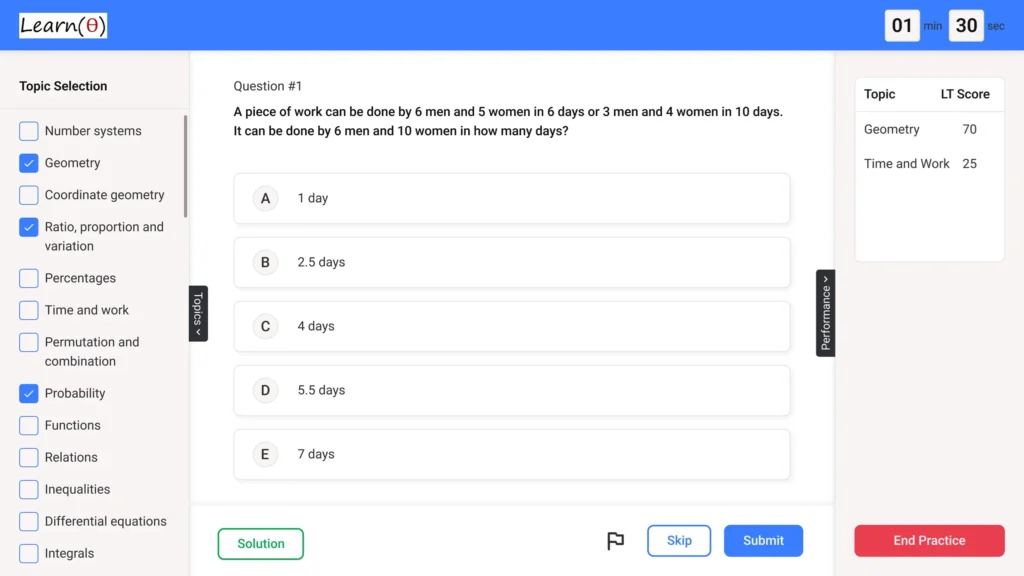
🤖 Adaptive Question Practice

📊 Progress and Insights