
Simplification for SSC CGL Exam
Q. 1 Simplify the expression:$\frac{52 – 1170 \div 26 + 13 \times 2}{2 + \left(1\frac{1}{8} \text{ of } 2\right) – 1\frac{1}{4}}$
Check Solution
Ans: B
Explanation: First, we simplify the numerator: 52 – 1170 ÷ 26 + 13 × 2 = 52 – 45 + 26 = 33.
Next, we simplify the denominator: 2 + (1 1/8 of 2) – 1 1/4 = 2 + (9/8 * 2) – 5/4 = 2 + 9/4 – 5/4 = 2 + 4/4 = 2 + 1 = 3.
Finally, we calculate the division: 33 / 3 = 11.
Correct Option: B
Q. 2 Calculate the result of the following expression: $0.5\bar 6 – 0.7\overline {23} + 0.3\bar 9 \times 0.\bar 7$.
Check Solution
Ans: D
Explanation: First, convert the repeating decimals to fractions:
$0.5\bar 6 = 0.5666… = 5/10 + 6/90 = 45/90 + 6/90 = 51/90 = 17/30$
$0.7\overline {23} = 7/10 + 23/990 = 693/990 + 23/990 = 716/990 = 358/495$
$0.3\bar 9 = 0.3999… = 3/10 + 9/90 = 3/10 + 1/10 = 4/10 = 2/5$ (Note: 0.3999… is equivalent to 0.4)
$0.\bar 7 = 7/9$
Now substitute these fractional equivalents into the expression:
$17/30 – 358/495 + (2/5) \times (7/9)$
$17/30 – 358/495 + 14/45$
Find the common denominator of 30, 495 and 45: Least Common Multiple (LCM) of 30, 495, and 45 is 990. Rewrite the fractions with a denominator of 990:
$17/30 = (17 \times 33) / (30 \times 33) = 561/990$
$358/495 = (358 \times 2) / (495 \times 2) = 716/990$
$14/45 = (14 \times 22) / (45 \times 22) = 308/990$
Now, rewrite the expression using the new fractions:
$561/990 – 716/990 + 308/990$
$(561 – 716 + 308)/990$
$(869 – 716)/990$
$153/990$
Simplify the fraction: Divide both numerator and denominator by 9:
$153/990 = 17/110$
Convert to decimal:
$17/110 = 0.15454545… = 0.1\overline {54}$
Correct Option: D
Q. 3 Calculate the result of the following expression: $3\frac{1}{5} \div 4\frac{1}{2}\;of\;5\frac{1}{3} + \frac{1}{8} \div \frac{1}{2}of\frac{1}{4} – \frac{1}{4}\left( {\frac{1}{2} \div \frac{1}{8} \times \frac{1}{4}} \right)$
Check Solution
Ans: A
Explanation: First, convert mixed fractions to improper fractions: $3\frac{1}{5} = \frac{16}{5}$, $4\frac{1}{2} = \frac{9}{2}$, and $5\frac{1}{3} = \frac{16}{3}$.
Next, perform the ‘of’ operations (multiplication):
* $4\frac{1}{2} \; of \; 5\frac{1}{3} = \frac{9}{2} \times \frac{16}{3} = \frac{144}{6} = 24$
* $\frac{1}{2} \; of \; \frac{1}{4} = \frac{1}{2} \times \frac{1}{4} = \frac{1}{8}$
Now, substitute these values back into the expression:
$\frac{16}{5} \div 24 + \frac{1}{8} \div \frac{1}{8} – \frac{1}{4}\left( {\frac{1}{2} \div \frac{1}{8} \times \frac{1}{4}} \right)$
Perform the divisions:
* $\frac{16}{5} \div 24 = \frac{16}{5} \times \frac{1}{24} = \frac{16}{120} = \frac{2}{15}$
* $\frac{1}{8} \div \frac{1}{8} = \frac{1}{8} \times \frac{8}{1} = 1$
* $\frac{1}{2} \div \frac{1}{8} = \frac{1}{2} \times \frac{8}{1} = 4$
Substitute these values back into the expression:
$\frac{2}{15} + 1 – \frac{1}{4}\left( {4 \times \frac{1}{4}} \right)$
Perform the multiplication within the parenthesis:
* $4 \times \frac{1}{4} = 1$
Substitute:
$\frac{2}{15} + 1 – \frac{1}{4} (1)$
$\frac{2}{15} + 1 – \frac{1}{4}$
Perform the subtraction and addition from left to right:
$\frac{2}{15} + 1 – \frac{1}{4} = \frac{2}{15} + \frac{15}{15} – \frac{1}{4}$
$ = \frac{17}{15} – \frac{1}{4} = \frac{68}{60} – \frac{15}{60} = \frac{53}{60}$
Correct Option: A
Q. 4 Calculate the result of: $1800÷20×[(12−6)+(24−12)]$
Check Solution
Ans: D
Explanation: First, perform the divisions and subtractions inside the parentheses: 1800 / 20 = 90. Then, (12 – 6) = 6 and (24 – 12) = 12. Next, calculate the sum of the two differences: 6 + 12 = 18. Finally, multiply the result of the division by the sum: 90 * 18 = 1620.
Correct Option: D
Q. 5 Calculate the result of: $ 21.6÷3.6×2+0.25×16÷4−6 $
Check Solution
Ans: D
Explanation: Following the order of operations (PEMDAS/BODMAS):
1. **Division:** 21.6 / 3.6 = 6
2. **Multiplication:** 6 * 2 = 12
3. **Multiplication:** 0.25 * 16 = 4
4. **Division:** 4 / 4 = 1
5. **Addition:** 12 + 1 = 13
6. **Subtraction:** 13 – 6 = 7
Correct Option: D
Q. 6 Calculate the result of: $11+11×11−11÷11$
Check Solution
Ans: D
Explanation: Following the order of operations (PEMDAS/BODMAS), we perform multiplication and division before addition and subtraction.
1. Eleven multiplied by eleven: 11 * 11 = 121
2. Eleven divided by eleven: 11 / 11 = 1
3. The expression now becomes: 11 + 121 – 1
4. Eleven plus one hundred and twenty-one: 11 + 121 = 132
5. One hundred and thirty-two minus one: 132 – 1 = 131
Correct Option: D
Q. 7 Find the sum of the series: $ 1\frac{1}{2}+4\frac{1}{6}+7\frac{1}{12}+10\frac{1}{20}+\cdots $ up to 20 terms.
Check Solution
Ans: A
Explanation: First, let’s convert the mixed fractions into improper fractions: 3/2 + 25/6 + 85/12 + 201/20 + … We can rewrite the terms as (1*3)/ (1*2) + (4*6+1)/6 + (7*12+1)/12 + (10*20+1)/20. Observe the pattern in the numerators: 1, 4, 7, 10, … This is an arithmetic progression (AP) with a common difference of 3. Observe the pattern in denominators: 2, 6, 12, 20, … This can be rewritten as 1*2, 2*3, 3*4, 4*5, … Hence the general term is given by (3n-2) + 1 / n(n+1), where n varies from 1 to 20. So, we need to find the sum of (3n-2 + 1/n(n+1)) from n=1 to 20.
Let’s first find the sum of the arithmetic progression (3n-2). The sum of an AP is given by n/2 * (2a + (n-1)d), where n is the number of terms, a is the first term, and d is the common difference. In this case, n=20, a=1, d=3. The sum of the arithmetic series is 20/2 * (2*1 + (20-1)*3) = 10 * (2 + 57) = 10 * 59 = 590.
Next, let’s find the sum of the series 1/n(n+1) from n=1 to 20. 1/n(n+1) can be decomposed into 1/n – 1/(n+1). This is a telescoping series:
(1/1 – 1/2) + (1/2 – 1/3) + (1/3 – 1/4) + … + (1/20 – 1/21) = 1 – 1/21 = 20/21.
Now, add the two sums: 590 + 20/21 = (590 * 21 + 20)/21 = (12390 + 20)/21 = 12410/21.
Correct Option: A
Q. 8 Find the value of the following expression:
$180 ÷ 15 × 6 – 8 + 3$
Check Solution
Ans: B
Explanation: We follow the order of operations (PEMDAS/BODMAS): Parentheses/Brackets, Exponents/Orders, Multiplication and Division (from left to right), and Addition and Subtraction (from left to right).
1. **Division:** 180 ÷ 15 = 12
2. **Multiplication:** 12 × 6 = 72
3. **Subtraction:** 72 – 8 = 64
4. **Addition:** 64 + 3 = 67
Q. 9 What is the value of $5.6 – (9.6 \div 3.2 \times 3) + 2 \times 4.5 \div 1.5$?
Check Solution
Ans: C
Explanation: We follow the order of operations (PEMDAS/BODMAS): Parentheses/Brackets, Exponents/Orders, Multiplication and Division (from left to right), and Addition and Subtraction (from left to right).
1. Inside the parentheses:
* `9.6 ÷ 3.2 = 3`
* `3 × 3 = 9`
2. `2 × 4.5 = 9`
3. `9 ÷ 1.5 = 6`
4. The expression now is: `5.6 – 9 + 6`
5. `5.6 – 9 = -3.4`
6. `-3.4 + 6 = 2.6`
Q. 10 Simplify the following expression: $\frac{ \frac{36}{42\times6}\times7 +\frac{24\times6}{18} +\frac{3}{2-6} -\frac{4+3\times2}{8} }{ \frac{21}{3\times7} }$
Check Solution
Ans: C
Explanation: Let’s break this down using the order of operations (PEMDAS/BODMAS):
1. **Parentheses/Brackets & “of”:**
* (42 of 6) = 42 * 6 = 252
* (2 – 6) = -4
* (3 of 7) = 3 * 7 = 21
* (4 + 3 * 2) = (4 + 6) = 10
2. **Exponents/Orders:** None
3. **Multiplication and Division (from left to right):**
* 36 / 252 = 1/7
* (1/7) * 7 = 1
* 24 * 6 = 144
* 144 / 18 = 8
* 3 / -4 = -3/4
* 10 / 8 = 5/4
* 21 / 21 = 1
4. **Addition and Subtraction (from left to right):**
* 1 + 8 + (-3/4) – (5/4) = 1 + 8 – 8/4 = 1 + 8 – 2 = 7
* 7 / 1 = 7
Correct Option: C
Q. 11 Simplify the following mathematical expression: $ \frac{3}{5}\times \frac{1\frac{7}{8}} {1\frac{1}{3}\times\frac{3}{16}} – \frac{3\frac{1}{5}} {4\frac{1}{2}\times5\frac{1}{3}} \times2\frac{1}{2} +\frac{1}{2} +\frac{\frac{1}{8}}{\frac{1}{4}} $
Check Solution
Ans: B
Explanation:
First, convert mixed numbers to improper fractions:
1 and 7/8 = 15/8
1 and 1/3 = 4/3
3 and 1/5 = 16/5
4 and 1/2 = 9/2
5 and 1/3 = 16/3
2 and 1/2 = 5/2
Now, rewrite the expression:
(3/5) * (15/8) / ((4/3) * (3/16)) – (16/5) / ((9/2) * (16/3)) * (5/2) + 1/2 + (1/8) / (1/4)
Simplify the “of” parts (multiplication):
(3/5) * (15/8) / (12/48) – (16/5) / (144/6) * (5/2) + 1/2 + (1/8) / (1/4)
(3/5) * (15/8) / (1/4) – (16/5) / 24 * (5/2) + 1/2 + (1/8) / (1/4)
Perform the first division (left to right):
(3/5) * (15/8) * 4 – (16/5) / 24 * (5/2) + 1/2 + (1/8) * 4
Simplify:
(45/40) * 4 – (16/5) * (1/24) * (5/2) + 1/2 + 4/8
(9/8) * 4 – (16/5) * (5/48) + 1/2 + 1/2
9/2 – (80/240) + 1
9/2 – 1/3 + 1
9/2 – 1/3 + 3/3
9/2 + 2/3
(27 + 4)/6
31/6
31/6 = 5 and 1/6
Correct Option: B
Q. 12 What is the result of the following calculation: $(26−13×2)÷2+1$
Check Solution
Ans: C
Explanation: Following the order of operations (PEMDAS/BODMAS), we first perform the multiplication: 13 * 2 = 26. Then, we subtract: 26 – 26 = 0. Next, we divide: 0 / 2 = 0. Finally, we add: 0 + 1 = 1.
Correct Option: C
Next Chapter: Statistics
Crack SSC CGL – with LearnTheta’s AI Platform!

✅ All Topics at One Place
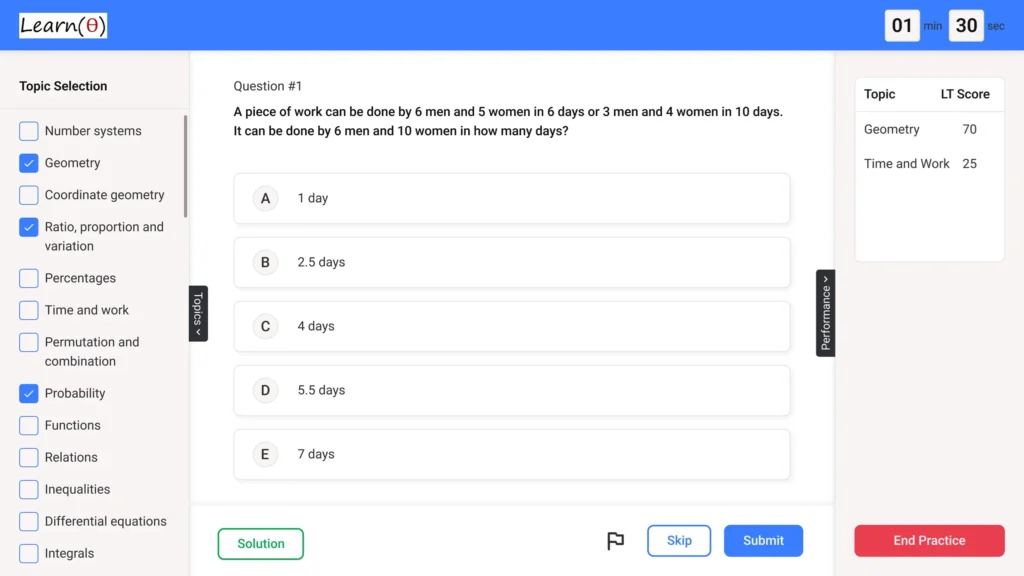
🤖 Adaptive Question Practice

📊 Progress and Insights