
Simple and Compound Interest: SSC CGL Practice Questions
Q. 1 A certain sum of money becomes Rs. 10,800 after 2 years and Rs. 12,150 after 3 years, compounded annually. What is the rate of interest?
Check Solution
Ans: D
Explanation: Let P be the principal amount and r be the rate of interest.
After 2 years, the amount is 10800: P(1+r)^2 = 10800 —(1)
After 3 years, the amount is 12150: P(1+r)^3 = 12150 —(2)
Divide (2) by (1):
(P(1+r)^3) / (P(1+r)^2) = 12150 / 10800
1 + r = 12150 / 10800
1 + r = 1.125
r = 0.125
r = 12.5%
Q. 2 A loan is repaid in two equal annual payments. With a 10% annual compound interest rate, and each installment being Rs. 5,808, what is approximately 60% of the total interest paid?
Check Solution
Ans: D
Explanation: Let P be the present value of the loan. The payments are annuities. We know the payment amount (Rs. 5,808), the interest rate (10% or 0.1), and the number of periods (2).
The formula for the present value of an annuity is:
PV = PMT * [1 – (1 + r)^-n] / r
Where:
PV = Present Value (the loan amount we want to find)
PMT = Payment Amount (Rs. 5,808)
r = interest rate per period (0.1)
n = number of periods (2)
P = 5808 * [1 – (1 + 0.1)^-2] / 0.1
P = 5808 * [1 – (1.1)^-2] / 0.1
P = 5808 * [1 – 1/1.21] / 0.1
P = 5808 * [1 – 0.8264] / 0.1
P = 5808 * 0.1736 / 0.1
P = 5808 * 1.736
P = 10089.408
The total paid amount is 2 * 5808 = 11616.
The total interest paid is the total paid amount minus the initial loan amount:
Total Interest = 11616 – 10089.408 = 1526.592
60% of the total interest = 0.6 * 1526.592 = 915.9552. This is approximately 916. Given the options, the closest answer is 913, but the calculation above uses the present value formula. Let’s try another approach using a cash flow diagram:
Year 1: Loan amount (P) is increased by 10% interest. Then a payment of 5808 is made.
Year 2: (P * 1.1 – 5808) is increased by 10% interest. Then a payment of 5808 is made.
Let’s assume the loan amount is x.
Year 1: x * 1.1 – 5808
Year 2: (x * 1.1 – 5808) * 1.1 – 5808 = 0
1.21x – 6388.8 – 5808 = 0
1.21x = 12196.8
x = 10080
Total paid = 2 * 5808 = 11616
Total Interest = 11616 – 10080 = 1536
60% of 1536 = 921.6. This is closest to 922.
Given the choices, we can work backward:
A. 913: Interest is 913 / 0.6 = 1521.666
Total Paid = x + 1521.666
The value seems close to previous calculations. Let’s analyze.
B. 911: Interest is 911 / 0.6 = 1518.33
C. 917: Interest is 917 / 0.6 = 1528.33
D. 922: Interest is 922 / 0.6 = 1536.6666
Since 1536 is closest to the values calculated, the closest option would be D.
Correct Option: D
Q. 3 A person invested Rs. 10,000 with B for 3 years and Rs. 6,000 with C for 4 years at the same simple interest rate. The total interest earned from both investments was Rs. 5,400. Find the annual interest rate.
Check Solution
Ans: D
Explanation: Let the annual simple interest rate be r.
Interest from B = (Principal * Rate * Time) / 100 = (10000 * r * 3) / 100 = 300r
Interest from C = (Principal * Rate * Time) / 100 = (6000 * r * 4) / 100 = 240r
Total interest = Interest from B + Interest from C
5400 = 300r + 240r
5400 = 540r
r = 5400 / 540
r = 10
Correct Option: D
Q. 4 A principal amount grows to Rs. 8,028 after 3 years and to Rs. 12,042 after 6 years, with compound interest calculated annually. What is the original principal amount?
Check Solution
Ans: A
Explanation: Let P be the principal amount and r be the annual interest rate.
After 3 years: P(1+r)^3 = 8028 —(1)
After 6 years: P(1+r)^6 = 12042 —(2)
Divide (2) by (1):
[P(1+r)^6] / [P(1+r)^3] = 12042 / 8028
(1+r)^3 = 1.5
Substitute (1+r)^3 = 1.5 in (1):
P * 1.5 = 8028
P = 8028 / 1.5
P = 5352
Correct Option: A
Q. 5 A principal amount, X, earns Rs. 28.90 more in compound interest than simple interest over two years at an annual interest rate of 8.5%. What is the value of X?
Check Solution
Ans: A
Explanation: Let the principal amount be X, the rate of interest be R (8.5% or 0.085), and the time period be T (2 years).
Simple Interest (SI) = P * R * T = X * 0.085 * 2 = 0.17X
Compound Interest (CI) = P(1+R)^T – P = X(1+0.085)^2 – X = X(1.085)^2 – X = 1.177225X – X = 0.177225X
The difference between CI and SI is given as Rs. 28.90
CI – SI = 28.90
0.177225X – 0.17X = 28.90
0.007225X = 28.90
X = 28.90 / 0.007225
X = 4000
Correct Option: A
Q. 6 A principal of Rs. 12000 amounts to Rs. 14520 in 2 years at a certain rate percent per annum, compounded annually. What is the simple interest on the same principal for the same time at thrice the original rate?
Check Solution
Ans: C
Explanation: First, we need to find the original rate of interest. We can use the compound interest formula: A = P(1 + r/100)^n, where A is the amount, P is the principal, r is the rate, and n is the number of years.
14520 = 12000(1 + r/100)^2
14520/12000 = (1 + r/100)^2
1.21 = (1 + r/100)^2
√(1.21) = 1 + r/100
1.1 = 1 + r/100
0.1 = r/100
r = 10%
Now, we calculate the simple interest at thrice the original rate, which is 3 * 10% = 30%. The simple interest formula is SI = (P * R * T) / 100, where SI is simple interest, P is principal, R is rate, and T is time.
SI = (12000 * 30 * 2) / 100
SI = 720000 / 100
SI = 7200
Q. 7 A Rs. 5,000 sum is split into two portions. The simple interest earned on the first portion over 4.2 years at 6.67% per year is twice the simple interest earned on the second portion over 2.75 years at 4% per year. Find the difference between the values of the two portions.
Check Solution
Ans: B
Explanation: Let the first portion be P1 and the second portion be P2. We know that P1 + P2 = 5000.
The simple interest on the first portion (SI1) = (P1 * 4.2 * 6.67)/100
The simple interest on the second portion (SI2) = (P2 * 2.75 * 4)/100
We are given that SI1 = 2 * SI2.
Therefore, (P1 * 4.2 * 6.67)/100 = 2 * (P2 * 2.75 * 4)/100
Simplifying, we get: P1 * 4.2 * 6.67 = 2 * P2 * 2.75 * 4
P1 * 28.014 = P2 * 22
P1 = (22/28.014) * P2
P1 ≈ 0.7853 P2
Since P1 + P2 = 5000, we substitute P1:
0. 7853 P2 + P2 = 5000
1. 7853 P2 = 5000
P2 = 5000 / 1.7853 ≈ 2800.2
P1 = 5000 – P2 = 5000 – 2800.2 ≈ 2199.8
The difference between the two portions = |P1 – P2| = |2199.8 – 2800.2| = 600.4
The closest answer is Rs.600. Using the exact values:
P1 * 28.014 = P2 * 22 => P1 = (22/28.014)P2
P1 + P2 = 5000
(22/28.014)P2 + P2 = 5000
(22 + 28.014)P2 = 5000 * 28.014
50.014 P2 = 140070
P2 = 140070 / 50.014 = 2800.57
P1 = 5000 – 2800.57 = 2199.43
Difference = 2800.57 – 2199.43 = 601.14
The closest answer should be around 600
Let’s assume the question meant 6.6666% which is 20/3.
Then,
SI1 = P1 * 4.2 * (20/3)/100 = P1 * 28/100
SI2 = P2 * 2.75 * 4 / 100 = P2 * 11/100
SI1 = 2*SI2
P1 * 28/100 = 2 * P2 * 11/100
28P1 = 22P2
P1 = 22/28 * P2 = 11/14 * P2
P1+P2 = 5000
11/14 P2 + P2 = 5000
(11+14)/14 P2 = 5000
25/14 P2 = 5000
P2 = 5000 * 14/25 = 200 * 14 = 2800
P1 = 5000-2800 = 2200
Diff = 2800-2200 = 600
Correct Option: B
Q. 8 A sum of money earns Rs. 6,000 in simple interest over 3 years. The compound interest on the same sum is Rs. 4,160 over 2 years. What is the annual interest rate?
Check Solution
Ans: B
Explanation:
Let P be the principal amount and R be the annual interest rate.
Simple Interest (SI) = (P * R * T) / 100
Given, SI over 3 years = Rs. 6000
6000 = (P * R * 3) / 100
P * R = (6000 * 100) / 3 = 200000 —-(1)
Compound Interest (CI) over 2 years = Rs. 4160
CI = P(1 + R/100)^2 – P
4160 = P(1 + R/100)^2 – P
4160 = P(1 + 2R/100 + R^2/10000) – P
4160 = P + 2PR/100 + PR^2/10000 – P
4160 = 2PR/100 + PR^2/10000 —-(2)
From (1), we know PR = 200000. Substituting this in (2):
4160 = 2(200000)/100 + 200000R/10000
4160 = 4000 + 20R
160 = 20R
R = 160 / 20 = 8
Correct Option: B
Q. 9 Calculate the compound interest, in rupees, earned on a principal of Rs. 8192 over 1 year and 3 months at an annual interest rate of 15%, with interest compounded every 5 months.
Check Solution
Ans: C
Explanation:
1. **Convert the time to compounding periods:** The interest is compounded every 5 months. 1 year and 3 months is equal to 15 months. Therefore, the number of compounding periods is 15 months / 5 months/period = 3 periods.
2. **Calculate the interest rate per compounding period:** The annual interest rate is 15%. Therefore, the interest rate per 5-month period is 15% / (12 months/year / 5 months/period) = 15% / 2.4 = 6.25% or 0.0625.
3. **Calculate the compound amount (A):** The formula for compound interest is A = P(1 + r)^n, where:
* P = Principal = Rs. 8192
* r = Interest rate per period = 0.0625
* n = Number of periods = 3
* A = 8192 * (1 + 0.0625)^3 = 8192 * (1.0625)^3 = 8192 * 1.199462890625 ≈ 9827.46
4. **Calculate the compound interest (CI):** CI = A – P = 9827.46 – 8192 = 1635.46
The closest answer is Rs. 1634.
Correct Option: C
Q. 10 If a bank pays Rs. 25,000 after 2 years on a savings account with an 8% interest rate, what will the bank pay after 4 years on the same initial amount with the same interest rate, compounded annually?
Check Solution
Ans: C
Explanation: First, we need to determine the principal amount (P). We know the future value (FV) after 2 years is Rs. 25,000, and the interest rate (r) is 8% or 0.08. The formula for compound interest is FV = P(1 + r)^n, where n is the number of years. So, 25000 = P(1 + 0.08)^2 => 25000 = P(1.08)^2 => 25000 = P(1.1664) => P = 25000 / 1.1664 = ~21433.47. Now we need to find the FV after 4 years. We use the same formula FV = P(1+r)^n. FV = 21433.47(1 + 0.08)^4 => FV = 21433.47(1.08)^4 => FV = 21433.47(1.36048896) => FV = ~29160. Alternatively, since after 2 years the bank pays 25000. For the next 2 years (from year 2 to year 4), we apply compound interest to the 25000 to find the amount after another two years. FV = 25000(1+0.08)^2 = 25000 * 1.08 * 1.08 = 25000 * 1.1664 = 29160.
Correct Option: C
Q. 11 If a sum of money amounts to Rs. 4,800 in 2 years and Rs. 5,280 in 3 years at compound interest, find the rate of interest per annum.
Check Solution
Ans: B
Explanation: Let P be the principal amount and r be the rate of interest per annum.
We are given that the amount after 2 years is Rs. 4800, and the amount after 3 years is Rs. 5280.
The formula for compound interest is: Amount = P(1 + r/100)^n, where n is the number of years.
So, for 2 years: 4800 = P(1 + r/100)^2 … (1)
And for 3 years: 5280 = P(1 + r/100)^3 … (2)
Dividing equation (2) by equation (1):
5280/4800 = [P(1 + r/100)^3] / [P(1 + r/100)^2]
5280/4800 = (1 + r/100)
1. 1 = 1 + r/100
r/100 = 0.1
r = 10%
Therefore, the rate of interest is 10%.
Since the question asks for the rate of interest, and the amounts are given for two consecutive years, we can directly find the interest rate by finding the percentage increase from year 2 to year 3.
Interest = 5280 – 4800 = 480
Percentage increase = (Interest/Amount after 2 years) * 100
= (480/4800)*100
= 10%
Q. 12 If an initial investment of Rs. 4,300 grows to Rs. 4,644 after two years with simple interest, what principal amount is needed to reach Rs. 10,104 in five years at the same interest rate?
Check Solution
Ans: B
Explanation:
First, calculate the simple interest earned in the first two years: Interest = 4644 – 4300 = Rs. 344.
Then, calculate the simple interest rate: Simple Interest = (Principal * Rate * Time) / 100. Therefore, Rate = (Simple Interest * 100) / (Principal * Time) = (344 * 100) / (4300 * 2) = 4%.
Next, use the simple interest formula to find the principal amount needed to reach Rs. 10,104 in five years.
Simple Interest = Amount – Principal, so, Principal + (Principal * Rate * Time) / 100 = Amount. Therefore,
Principal + (Principal * 4 * 5) / 100 = 10104.
Principal + Principal * 0.2 = 10104
1. 2 * Principal = 10104
Principal = 10104 / 1.2
Principal = 8420
Correct Option: B
Q. 13 If an investment grows by 32% in 4 years with simple interest, what compound interest will be earned on a principal of Rs. 24,000 over 3 years at the same interest rate?
Check Solution
Ans: D
Explanation: First, calculate the simple interest rate. Simple Interest = (Principal * Rate * Time) / 100. In this case, the interest earned is 32% of the principal over 4 years. So, 32 = (Principal * Rate * 4) / Principal * 100. This simplifies to 32 = 4 * Rate, therefore the rate of interest per year is 8%.
Next, calculate the compound interest on Rs. 24,000 for 3 years at 8%. We can use the formula: A = P(1 + R/100)^N where A is the amount, P is the principal, R is the rate of interest and N is the number of years.
So A = 24000(1 + 8/100)^3 = 24000(1.08)^3 = 24000 * 1.2597 = 30232.8
Compound Interest = Amount – Principal = 30232.8 – 24000 = 6232.8
The closest answer is 6233.
Correct Option: D
Q. 14 If an investment in a fixed deposit earns 8% interest in the first year and 9% in the second year, and the total amount received after two years is Rs. 17,658, what was the initial investment amount?
Check Solution
Ans: B
Explanation: Let P be the initial investment. After the first year, the amount becomes P * (1 + 0.08) = 1.08P. In the second year, this amount earns 9% interest, so the final amount is 1.08P * (1 + 0.09) = 1.08P * 1.09 = 1.1772P. We are given that the final amount is Rs. 17,658. Therefore, 1.1772P = 17658. Solving for P, we get P = 17658 / 1.1772 = 15000.
Correct Option: B
Q. 15 If the compound interest on a certain sum for two years at 10% per annum is Rs. 1050, find the sum invested (in Rs.).
Check Solution
Ans: D
Explanation: Let P be the principal sum. The formula for compound interest is A = P(1 + r/n)^(nt), where A is the final amount, P is the principal, r is the interest rate, n is the number of times interest is compounded per year, and t is the time in years. In this case, n=1 (compounded annually), t=2, and r=0.10. The compound interest is the difference between the final amount and the principal. So, A – P = 1050. A = P(1 + 0.10)^2 = P(1.1)^2 = 1.21P. Therefore, 1.21P – P = 1050, which simplifies to 0.21P = 1050. Solving for P, we get P = 1050 / 0.21 = 5000.
Q. 16 The difference between the compound interest and simple interest on a certain sum at 10% per annum for 2 years is Rs. 120. Find the principal sum.
Check Solution
Ans: A
Explanation: Let the principal sum be P.
Simple Interest (SI) for 2 years at 10% per annum = (P * 10 * 2) / 100 = P/5
Compound Interest (CI) for 2 years at 10% per annum = P(1 + 10/100)^2 – P = P(1.1)^2 – P = 1.21P – P = 0.21P
The difference between CI and SI = 0.21P – P/5 = 0.21P – 0.2P = 0.01P
Given that the difference is Rs. 120, so 0.01P = 120
Therefore, P = 120 / 0.01 = 12000
Q. 17 The difference between the compound interest and simple interest on a certain sum for 2 years at 12% per annum is Rs. 144. What is the sum?
Check Solution
Ans: A
Explanation: Let the principal be P.
Simple Interest (SI) for 2 years at 12% per annum is (P * R * T) / 100 = (P * 12 * 2) / 100 = 24P/100
Compound Interest (CI) for 2 years at 12% per annum is P(1 + R/100)^T – P = P(1 + 12/100)^2 – P = P(1.12)^2 – P = 1.2544P – P = 0.2544P
The difference between CI and SI is given as Rs. 144.
CI – SI = 144
0.2544P – 0.24P = 144 – SI = 144
0.0144P = 144
P = 144 / 0.0144
P = 10000
Q. 18 The simple interest earned on a certain sum at 15% per annum for 4 years is Rs. 1800. What would be the compound interest (compounded annually) on the same sum for 2 years at 10% per annum?
Check Solution
Ans: B
Explanation:
1. **Calculate the Principal (P):**
* Simple Interest (SI) = (P * R * T) / 100
* 1800 = (P * 15 * 4) / 100
* 1800 = P * 60 / 100
* P = (1800 * 100) / 60
* P = 3000
2. **Calculate the Compound Interest (CI):**
* CI = P * [(1 + R/100)^T – 1]
* CI = 3000 * [(1 + 10/100)^2 – 1]
* CI = 3000 * [(1.1)^2 – 1]
* CI = 3000 * [1.21 – 1]
* CI = 3000 * 0.21
* CI = 630
Q. 19 What is the compound interest earned on a principal of Rs. 5,500 at an annual interest rate of 15% over a period of 2 years, if the interest is calculated and added to the principal every 8 months?
Check Solution
Ans: A
Explanation: First, calculate the interest rate per 8-month period. Since the annual rate is 15%, the rate for 8 months is (15/12) * 8 = 10%. Next, determine the number of compounding periods. Over 2 years (24 months), with interest compounded every 8 months, there are 24/8 = 3 compounding periods. Now, we use the compound interest formula: A = P(1 + r/n)^(nt), where A is the final amount, P is the principal (Rs. 5,500), r is the annual interest rate (0.15), n is the number of times interest is compounded per year (3/year, given every 8 months and that each year has 12 months), and t is the time in years (2). However we will calculate it based on 10% per 8 months and 3 periods, where P is the principal.
After Period 1: 5500 + (5500 * 0.1) = 6050
After Period 2: 6050 + (6050 * 0.1) = 6655
After Period 3: 6655 + (6655 * 0.1) = 7320.5
The compound interest is the final amount minus the principal: 7320.5 – 5500 = 1820.5.
Correct Option: A
Q. 20 What is the difference (in Rs.) between the compound interests on Rs. 8000 for 1 year at 10% per annum compounded yearly and half-yearly?
Check Solution
Ans: C
Explanation:
For yearly compounding:
Principal (P) = Rs. 8000
Rate (R) = 10% per annum
Time (T) = 1 year
Compound Interest (CI) = P * R * T / 100 = 8000 * 10 * 1 / 100 = Rs. 800
For half-yearly compounding:
Principal (P) = Rs. 8000
Rate (R) = 10% per annum, so 5% per half-year (10/2)
Time (T) = 1 year, so 2 half-years
Amount = P(1 + R/100)^n = 8000(1 + 5/100)^2 = 8000 * (1.05)^2 = 8000 * 1.1025 = 8820
CI = Amount – Principal = 8820 – 8000 = Rs. 820
Difference in CI = 820 – 800 = Rs. 20
Next Chapter: Simplification
Crack SSC CGL – with LearnTheta’s AI Platform!

✅ All Topics at One Place
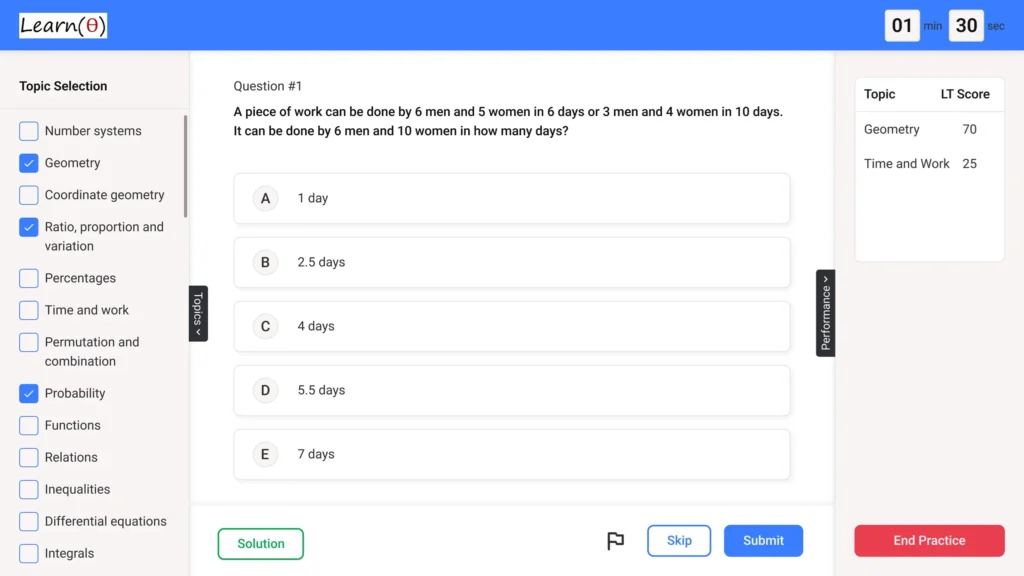
🤖 Adaptive Question Practice

📊 Progress and Insights