
Series: SSC CGL Practice Questions
Q. 1 A series is given with one term missing. Select the correct alternative from the given ones that will complete the series.AZ, BY, CX, DW, ?
Check Solution
Ans: B
Explanation: The pattern involves two separate sequences. The first letters are in alphabetical order: A, B, C, D, then E. The second letters are in reverse alphabetical order: Z, Y, X, W, then V. Combining them gives EV.
Q. 2 A series is given, with one number missing. Choose the number that will complete the series.
7, 21, 63, ?, 567, 1701
Check Solution
Ans: A
Explanation: The series is a geometric progression. Each number is multiplied by 3 to get the next number: 7 * 3 = 21, 21 * 3 = 63. Therefore, the missing number should be 63 * 3 = 189.
Q. 3 Find the missing letter cluster in the sequence: KYBA, FTEE, AOHI, VJKO, ?, LZQA
Check Solution
Ans: A
Explanation: The pattern involves two separate letter sequences.
First Letters:
K, F, A, V, ?, L
The pattern is: Subtract 5, subtract 5, add 21 (or subtract 5 as it wraps around the alphabet), subtract 5, subtract 5. V – 5 = Q
Second Letters:
Y, T, O, J, ?, Z
The pattern is: Subtract 9, subtract 5, subtract 5, subtract 3, subtract 9. J – 3 = E
Third Letters:
B, E, H, K, ?, Q
The pattern is: Add 3, add 3, add 3, add 3, add 3. K + 3 = N
Fourth Letters:
A, E, I, O, ?, A
The pattern is: Add 4, add 4, add 4, add 4, add 4. O + 4 = U
Therefore the missing cluster is QENU.
Correct Option: A
Q. 4 Find the next three-letter group in the sequence: FCC, UFH, OIS, LLX, FOC, ?
Check Solution
Ans: C
Explanation: The sequence follows a pattern based on the alphabetical positions of the letters. Consider the pattern in positions:
First letter: F, U, O, L, F, ? (F-6, U-21, O-15, L-12, F-6)
Second letter: C, F, I, L, O, ? (C-3, F-6, I-9, L-12, O-15)
Third letter: C, H, S, X, C, ? (C-3, H-8, S-19, X-24, C-3)
Looking at the number values for the first letters:
6, 21, 15, 12, 6… The pattern appears to be a decrease, then an increase. Let’s look at the differences: 21-6=15, 15-21 = -6. 12-15 = -3. Then 6-12=-6.
Considering modulo 26 arithmetic, or the alphabet looped back around:
F (6) to U (21) = 15 increase or -11
U (21) to O (15) = -6
O (15) to L (12) = -3
L (12) to F (6) = -6
So, it appears like adding 15, then -6, then -3, then -6. So, we may need to subtract by 3, resulting in 6-3=3, giving us a C. (or 6-3=3 or C)
Looking at the second letters:
3, 6, 9, 12, 15… The pattern is increasing by 3 each time. 15+3=18 or R.
Looking at the third letters:
3, 8, 19, 24, 3… The pattern is a mixed one.
3 to 8, +5.
8 to 19, +11
19 to 24, +5
24 to 3, -21 or -5. Then we can go up by 11.
so 3 + 11= 14. 14 is N.
Hence, the answer is TRN, but TRN isn’t an option. Let’s analyze the pattern a bit better.
First letter:
F(6), U(21), O(15), L(12), F(6). If it is a decrease and then an increase, we could assume that: 6, 21, 15, 12, 6, 21. or U.
Second Letter:
3, 6, 9, 12, 15. The pattern is simply adding 3: So 15+3 is 18, which is R.
Third letter
3, 8, 19, 24, 3… Pattern is mixed. 3, 8, 19, 24, 3. So then this pattern is adding 5, then 11, then 5, then -21, so 3+5 =8, H.
Therefore, TRH or TRN might be an option.
Looking at the differences in position, consider a cyclical series.
6, 21, 15, 12, 6… Could be subtracting 6 or 3 or using differences of values.
So instead we subtract from last position.
Therefore, if we subtract by 6 or add by 20 to get the position,
Subtract 6 or 3 or 3 from the 6 in F, so we go:
6-6=0 -> F?
6-3=3 -> C?
So we can use the pattern of, -3.
The last item F-6.
So we go: 6,21,15,12,6,9. Which equals to I.
So we end up with
F(6), U(21), O(15), L(12), F(6), I(9)
C(3), F(6), I(9), L(12), O(15), R(18)
C(3), H(8), S(19), X(24), C(3), H(8)
Thus, the answer appears to be:
IRH
But no options contain IRH
The best option seems to be to look for consistency in the differences and pattern:
First Letter: F,U,O,L,F. The difference is -15, -6, -3, -6. Then we could have an increase of 15 (which brings us to U)
Second Letter: C, F, I, L, O. Increasing by 3 each time, therefore 15+3 = 18 = R
Third Letter: C,H,S,X,C. Differences: 5, 11, 5, -21 which is adding 11, so 3+11= 14 which is N.
So TRN or URH is probably the answer. URH is probably a more likely answer.
Correct Option: C
Q. 5 Find the word that continues the pattern in the following sequence: CLAY, DIFX, EFKW, FCPV, ?
Check Solution
Ans: A
Explanation: The pattern involves two separate sequences.
* **First Letter:** C, D, E, F, G (Increasing alphabetically)
* **Second Letter:** L, I, F, C, Z (Moving backwards, with steps of 3)
* **Third Letter:** A, X, K, P, U (The letters are decreasing with steps of 3)
* **Fourth Letter:** Y, X, W, V, U (Decreasing alphabetically)
Correct Option: A
Q. 6 Select the letter-cluster from among the given options that can replace the question mark (?) in the following series.
DGJ, CFH, BEF, ADG, ?
Check Solution
Ans: C
Explanation: The pattern involves subtracting 2 from the first letter, 2 from the second, and 1 from the third.
D – 2 = B, G – 2 = E, J – 1 = I (This does not match any of the given series)
Let’s look at the series differently.
D – 1 = C, G – 1 = F, J – 1 = I
C – 1 = B, F – 1 = E, H – 1 = G
B – 1 = A, E – 1 = D, F – 1 = E
A – 1 = Z, D – 1 = C, G – 1 = F
Therefore, the pattern is to subtract 1 from each letter in the prior option.
Therefore, the next letter cluster should be ZCF.
Q. 7 Select the number that can replace the question mark (?) in the following series.2, 9, 28, 65, ?
Check Solution
Ans: D
Explanation: The series follows the pattern: (n^3) + 1, where n starts from 1 and increments by 1.
1^3 + 1 = 2
2^3 + 1 = 9
3^3 + 1 = 28
4^3 + 1 = 65
5^3 + 1 = 126
Q. 8 What letter cluster logically continues the following sequence: AR, CP, ?, GL, IJ, KH?
Check Solution
Ans: B
Explanation: The pattern involves considering the position of each letter in the alphabet.
* A(1) R(18)
* C(3) P(16)
* ?
* G(7) L(12)
* I(9) J(10)
* K(11) H(8)
Looking at the first letter of each pair:
A, C, ?, G, I, K… The sequence is +2, so the missing letter would be E (C+2=E).
Looking at the second letter of each pair:
R, P, ?, L, J, H… The sequence is -2, so the missing letter would be N (P-2=N).
Therefore, the missing letter cluster is EN.
Correct Option: B
Q. 9 What letter cluster logically continues the following sequence: PSV, UXA, ZCF, EHK, ?
Check Solution
Ans: A
Explanation: This is a pattern-based sequence. Let’s analyze the pattern by looking at each position separately:
* **First Letter:** P, U, Z, E, J (P + 5 = U, U + 5 = Z, Z + 5 = E, E + 5 = J) (wrapping around the alphabet)
* **Second Letter:** S, X, C, H, M (S + 5 = X, X + 5 = C, C + 5 = H, H + 5 = M) (wrapping around the alphabet)
* **Third Letter:** V, A, F, K, P (V + 9 = A, A + 5 = F, F + 5 = K, K + 5 = P) (wrapping around the alphabet)
Thus, the next cluster is JMP.
Correct Option: A
Q. 10 What number should come next in the following series?10, 11, 15, 24, 40, ?
Check Solution
Ans: A
Explanation: The pattern is based on adding the previous two numbers in the series, with slight adjustments.
10 + 11 – 6 = 15
11 + 15 – 2 = 24
15 + 24 + 1 = 40
24 + 40 – 0 = 64
Therefore, the next number is approximately 64, which is close to 65.
Another possible pattern involves the differences between consecutive terms:
11-10=1, 15-11=4, 24-15=9, 40-24=16. The differences are squares of integers (1^2, 2^2, 3^2, 4^2). The next difference should be 5^2 = 25. Therefore, 40+25 = 65
Q. 11 What sequence of letters, when inserted into the gaps of the given letter series, will complete the pattern: X _ U _ B _ O _ Z _ X _ U _ B?
Check Solution
Ans: A
Explanation: The pattern is based on a repeating sequence of letters. Let’s analyze the given series: X _ U _ B _ O _ Z _ X _ U _ B. We can see that X U B appears twice. The missing letters are likely to complete a cycle. The complete sequence should be X O U Z B.
Completing the pattern, we get: X O U Z B O X U Z B. Comparing the options with the sequence between the existing ‘X’ and ‘U’, we’re looking for ‘O Z X U B’.
Option A: X O U Z B O X U B.
Option B: X O U Z B Z O.
Option C: Does not fit.
Option D: Does not fit.
Correct Option: A
Next Chapter: Simple and Compound Interest
Crack SSC CGL – with LearnTheta’s AI Platform!

✅ All Topics at One Place
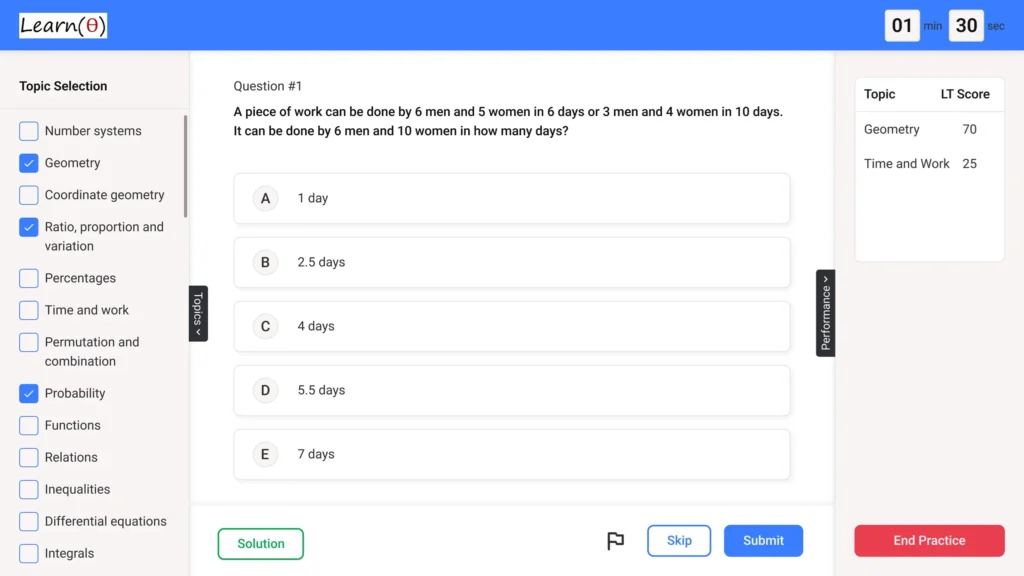
🤖 Adaptive Question Practice

📊 Progress and Insights