
Profit and Loss: SSC CGL Practice Questions
In SSC CGL exam, Profit & Loss questions mainly include CP/SP, profit or loss percentage, discounts, marked price, successive discounts/profits, partnership profit sharing, and false weighing problems. Most questions are shortcut and calculation-based, with direct formula application being very common.
Q. 1 A and B start a business together, with their initial investments in a 4:5 ratio. B withdraws their investment after 10 months. If the business earned a profit of Rs 49,000 in the first year, how much of the profit belongs to B?
Check Solution
Ans: A
Explanation: Let A’s investment be 4x and B’s investment be 5x. B withdraws after 10 months. The profit is divided in the ratio of their investment and the time for which they invested. A invested for 12 months and B for 10 months.
So the profit sharing ratio is (4x * 12) : (5x * 10) = 48:50 = 24:25
Total profit = Rs 49,000.
B’s share = (25/49) * 49000 = 25000
Correct Option: A
Q. 2 A customer is offered two discount options on a Rs. 2,000 purchase: a 30% discount or successive discounts of 25% and 5%. What is the difference in the final prices offered by these two discount methods?
Check Solution
Ans: C
Explanation:
Option 1: 30% discount on Rs. 2,000
Discount amount = (30/100) * 2000 = Rs. 600
Final price = 2000 – 600 = Rs. 1400
Option 2: Successive discounts of 25% and 5%
First discount: 25% on Rs. 2,000
Discount amount = (25/100) * 2000 = Rs. 500
Price after first discount = 2000 – 500 = Rs. 1500
Second discount: 5% on Rs. 1500
Discount amount = (5/100) * 1500 = Rs. 75
Final price = 1500 – 75 = Rs. 1425
Difference in final prices = 1425 – 1400 = Rs. 25
Correct Option: C
Q. 3 A merchant marks up the price of an item by 40% above its cost price. During a clearance sale, he offers a discount of 25% on the marked price. If the cost price of the item is $150, what is the merchant’s profit or loss percentage? (Round your answer to two decimal places)
Check Solution
Ans: B
Explanation:
1. **Calculate the marked price:** The merchant marks up the price by 40% of the cost price ($150). Markup amount = 0.40 * $150 = $60. Marked price = Cost price + Markup amount = $150 + $60 = $210.
2. **Calculate the discount amount:** The discount is 25% of the marked price ($210). Discount amount = 0.25 * $210 = $52.50.
3. **Calculate the selling price:** Selling price = Marked price – Discount amount = $210 – $52.50 = $157.50.
4. **Calculate the profit or loss:** Profit/Loss = Selling price – Cost price = $157.50 – $150 = $7.50. Since the result is positive, it’s a profit.
5. **Calculate the profit percentage:** Profit percentage = (Profit / Cost price) * 100 = ($7.50 / $150) * 100 = 5%.
Q. 4 A person purchases two watches for a combined price of 800 rupees. He sells both watches for the same amount. Watch A is sold at an 18% profit, while watch B is sold at a 22% loss. What was the original price of each watch?
Check Solution
Ans: A
Explanation: Let the cost price of watch A be x and the cost price of watch B be y. We know that x + y = 800. Watch A is sold at an 18% profit, so the selling price is 1.18x. Watch B is sold at a 22% loss, so the selling price is 0.78y. The problem states that the selling prices are equal: 1.18x = 0.78y. Now we have two equations:
1) x + y = 800
2) 1.18x = 0.78y => y = (1.18/0.78)x
Substitute equation 2 into equation 1:
x + (1.18/0.78)x = 800
x(1 + 1.18/0.78) = 800
x(1 + 1.5128) = 800
x(2.5128) = 800
x = 800 / 2.5128
x ≈ 318.37
Now solve for y:
y = 800 – x
y = 800 – 318.37
y = 481.63
Correct Option: A
Q. 5 A retailer sold a product at three-fourths of the marked price and incurred a loss of 10%. If the retailer had sold the product at the marked price, what would have been the profit percentage?
Check Solution
Ans: B
Explanation: Let the marked price be M. The retailer sold the product at (3/4)M. Since there was a 10% loss, this selling price represents 90% of the cost price (CP). Therefore, (3/4)M = 0.9 * CP, so CP = (3/4)M / 0.9 = (3/4)*(10/9)M = (10/12)M = (5/6)M. If the retailer sold the product at the marked price M, the profit would be M – CP = M – (5/6)M = (1/6)M. The profit percentage is (profit/CP) * 100 = ((1/6)M / ((5/6)M)) * 100 = (1/5) * 100 = 20%.
Q. 6 A shopkeeper offers a 28% discount on an item’s marked price and still profits by 20%. If the profit on one item is ₹30.80, what is the selling price of the item?
Check Solution
Ans: D
Explanation: Let the cost price be CP and the marked price be MP. The shopkeeper makes a profit of 20%, so Profit = 20/100 * CP. Given the profit on one item is ₹30.80, so, 0.20 * CP = 30.80. Thus CP = 30.80 / 0.20 = 154. Selling Price (SP) = CP + Profit = 154 + 30.80 = 184.80. The discount is 28% of the marked price. So, SP = MP – 0.28 * MP = MP (1-0.28) = 0.72*MP. Hence, MP = SP / 0.72 = 184.80/0.72 which gives the marked price. We are asked for Selling price.
Correct Option: D
Q. 7 A shopkeeper sells a damaged item originally priced at Rs. 400. He first gives a 10% discount, and then another 10% discount on the discounted price. What is the final selling price of the item?
Check Solution
Ans: A
Explanation: First discount: 10% of 400 = 40. Price after first discount = 400 – 40 = 360. Second discount: 10% of 360 = 36. Price after second discount = 360 – 36 = 324.
Correct Option: A
Q. 8 A shopkeeper sets a price for an item. He offers a 32% discount and still wants a 14% profit. If the marked price (the original price) is ₹342, what was the shopkeeper’s cost to buy the item?
Check Solution
Ans: C
Explanation: Let the cost price be C. The shopkeeper wants a 14% profit, so the selling price (SP) should be 1.14C. The marked price (MP) is ₹342. A 32% discount is offered on the marked price, so SP = MP * (1 – discount rate) = 342 * (1 – 0.32) = 342 * 0.68 = 232.56. Therefore, 1.14C = 232.56. Solving for C: C = 232.56 / 1.14 = 204.
Correct Option: C
Q. 9 A shopkeeper sets a price on an item. After offering a 22% discount, they still make an 11% profit. If the marked price is 888 rupees, what did the shopkeeper originally pay for the item?
Check Solution
Ans: D
Explanation: Let the cost price be C. The marked price is 888 rupees. After a 22% discount, the selling price is 888 * (1 – 0.22) = 888 * 0.78 = 692.64 rupees. The shopkeeper makes an 11% profit, so the selling price is also equal to C * (1 + 0.11) = 1.11C. Therefore, 1.11C = 692.64, and C = 692.64 / 1.11 = 624.
Correct Option: D
Q. 10 A shopkeeper sold a table for Rs. 600 at some profit. If he had sold it for Rs. 450, then his loss would have been half of the initial profit. What was the cost price of the table?
Check Solution
Ans: C
Explanation: Let the cost price be ‘C’, and the profit be ‘P’.
From the first statement, selling price = cost price + profit. So, 600 = C + P => P = 600 – C
From the second statement, selling price = cost price – loss. The loss is half the profit, so Loss = P/2. Thus, 450 = C – P/2
Substitute P = 600 – C into the second equation:
450 = C – (600 – C)/2
900 = 2C – 600 + C
1500 = 3C
C = 500
Q. 11 Amit sells an item for Rs. 369.60 after reducing the marked price by 12%. If he hadn’t discounted the price, he would have made a 20% profit. What was the original cost of the item?
Check Solution
Ans: D
Explanation: Let the marked price be M. After a 12% discount, the selling price is Rs. 369.60. So, 0.88M = 369.60. Therefore, M = 369.60 / 0.88 = Rs. 420. If there was no discount, the selling price would be Rs. 420. Let the original cost be C. A 20% profit means the selling price is 1.20C. So, 1.20C = 420. Hence, C = 420 / 1.20 = Rs. 350.
Correct Option: D
Q. 12 Two successive discounts of x% each result in a total reduction of Rs 587.40 on an item priced at Rs 1500. What would be the selling price if only one discount of x% is applied?
Check Solution
Ans: B
Explanation: The total price reduction with a single discount is Rs 587.40. Therefore, the selling price after a single discount is Rs 1500 – Rs 587.40 = Rs 912.60. Let the two equal discounts be x%. After the first discount, the price is 1500 * (1 – x/100). Applying the second discount to the discounted price: 1500 * (1 – x/100) * (1 – x/100) = 912.60. Solving for (1 – x/100): (1 – x/100)^2 = 912.60 / 1500 = 0.6084. Taking the square root, (1 – x/100) = sqrt(0.6084) = 0.78. Therefore, x/100 = 1 – 0.78 = 0.22, and x = 22%. Now calculate the selling price with only one discount of 22%: 1500 * (1 – 22/100) = 1500 * 0.78 = Rs 1170.
Correct Option: B
Q. 13 An item originally priced at Rs. 10000 is sold for Rs. 6120 after successive discounts of 20%, 10%, and an unknown percentage, k%. What would be the selling price of the same item if a single discount of (k + 20)% is applied?
Check Solution
Ans: A
Explanation: Let’s first calculate the price after the first two discounts.
After 20% discount: 10000 * (1 – 0.20) = 10000 * 0.80 = 8000
After 10% discount: 8000 * (1 – 0.10) = 8000 * 0.90 = 7200
Now, we know that after the third discount of k%, the price is 6120. So,
7200 * (1 – k/100) = 6120
(1 – k/100) = 6120 / 7200
(1 – k/100) = 0.85
k/100 = 1 – 0.85
k/100 = 0.15
k = 15
Now, if a single discount of (k + 20)% = (15 + 20)% = 35% is applied, the selling price will be:
10000 * (1 – 0.35) = 10000 * 0.65 = 6500
Correct Option: A
Q. 14 An item’s price is set 30% above its cost. If a seller offers a 10% discount on the marked price, what is the profit percentage?
Check Solution
Ans: A
Explanation: Let’s assume the cost price is 100. The marked price is 100 + 30% of 100 = 130. The discount is 10% of 130 = 13. The selling price is 130 – 13 = 117. The profit is 117 – 100 = 17. The profit percentage is (17/100) * 100 = 17%.
Correct Option: A
Q. 15 Due to a 20% reduction in the price of oranges, a person can purchase 5 more oranges for Rs. 80. What was the original price of a dozen oranges?
Check Solution
Ans: D
Explanation: Let the original price of an orange be ‘x’.
Due to 20% reduction, the new price is 0.8x.
For Rs. 80, the person could originally buy 80/x oranges.
After the price reduction, the person can buy 80/(0.8x) oranges.
The problem states that the person can buy 5 more oranges. So,
80/(0.8x) – 80/x = 5
100/x – 80/x = 5
20/x = 5
x = 4
The original price of an orange was Rs. 4.
A dozen oranges would cost 12 * 4 = Rs. 48
Q. 16 The marked price of a shirt is Rs. 1800. A retailer offers a 20% discount and still makes a profit of 20%. What is the cost price of the shirt in Rs.?
Check Solution
Ans: A
Explanation: Let the cost price be CP. The retailer makes a 20% profit, so the selling price (SP) is 1.2 * CP. The selling price is also the marked price minus the discount: SP = 1800 * (1 – 0.20) = 1800 * 0.80 = 1440. Therefore, 1.2 * CP = 1440. Solving for CP, CP = 1440 / 1.2 = 1200.
Q. 17 The marked price of a television is Rs. 20,000. A shopkeeper sells it at a discount of 10% and still makes a profit of 8%. What would be the selling price (in Rs.) of the television if the discount offered was 15%?
Check Solution
Ans: A
Explanation:
1. **Calculate the selling price with the initial discount:** The marked price is Rs. 20,000 and the discount is 10%. The selling price is 20000 * (1 – 0.10) = 20000 * 0.90 = Rs. 18,000.
2. **Calculate the cost price:** The shopkeeper makes an 8% profit when selling at Rs. 18,000. This means the selling price (Rs. 18,000) is 108% of the cost price. Let the cost price be CP. So, 1.08 * CP = 18000. Therefore, CP = 18000 / 1.08 = Rs. 16,666.67 (approximately).
3. **Calculate the selling price with a 15% discount:** With a 15% discount on the marked price of Rs. 20,000, the selling price would be 20000 * (1 – 0.15) = 20000 * 0.85 = Rs. 17,000.
Q. 18 Two brass alloys have copper-to-zinc ratios of 8:3 and 15:7. If 5 parts of the first alloy are mixed with 2 parts of the second, what is the copper-to-zinc ratio in the resulting mixture?
Check Solution
Ans: D
Explanation: Let’s calculate the amount of copper and zinc in each alloy and then in the mixture.
Alloy 1: Copper/Zinc = 8:3. In 5 parts of alloy 1, let’s assume the total parts are 8+3=11. So in 1 part we have 8/11 copper and 3/11 zinc. In 5 parts we have 5*(8/11) = 40/11 copper and 5*(3/11) = 15/11 zinc.
Alloy 2: Copper/Zinc = 15:7. In 2 parts of alloy 2, let’s assume the total parts are 15+7=22. So in 1 part we have 15/22 copper and 7/22 zinc. In 2 parts, we have 2*(15/22) = 30/22 = 15/11 copper and 2*(7/22) = 14/22 = 7/11 zinc.
Mixture:
Total copper: 40/11 + 15/11 = 55/11 = 5
Total zinc: 15/11 + 7/11 = 22/11 = 2
Copper to zinc ratio in the mixture: 5:2.
Correct Option: D
Q. 19 Two shopkeepers, A and B, offer discounts on the same product. A offers a 25% discount, while B offers discounts of 20% and then 5%. If A’s discount is Rs. 320 greater than B’s total discount, what is the original price of the product?
Check Solution
Ans: B
Explanation: Let the original price be P. A’s discount is 25% of P, which is 0.25P. B’s first discount is 20% of P, which is 0.20P. After the first discount, the price is P – 0.20P = 0.80P. B’s second discount is 5% of 0.80P, which is 0.05 * 0.80P = 0.04P. B’s total discount is 0.20P + 0.04P = 0.24P. According to the question, A’s discount (0.25P) is Rs. 320 greater than B’s total discount (0.24P). Therefore, 0.25P – 0.24P = 320, which simplifies to 0.01P = 320. Solving for P, we get P = 320 / 0.01 = 32000.
Correct Option: B
Next Chapter: Puzzle
Crack SSC CGL – with LearnTheta’s AI Platform!

✅ All Topics at One Place
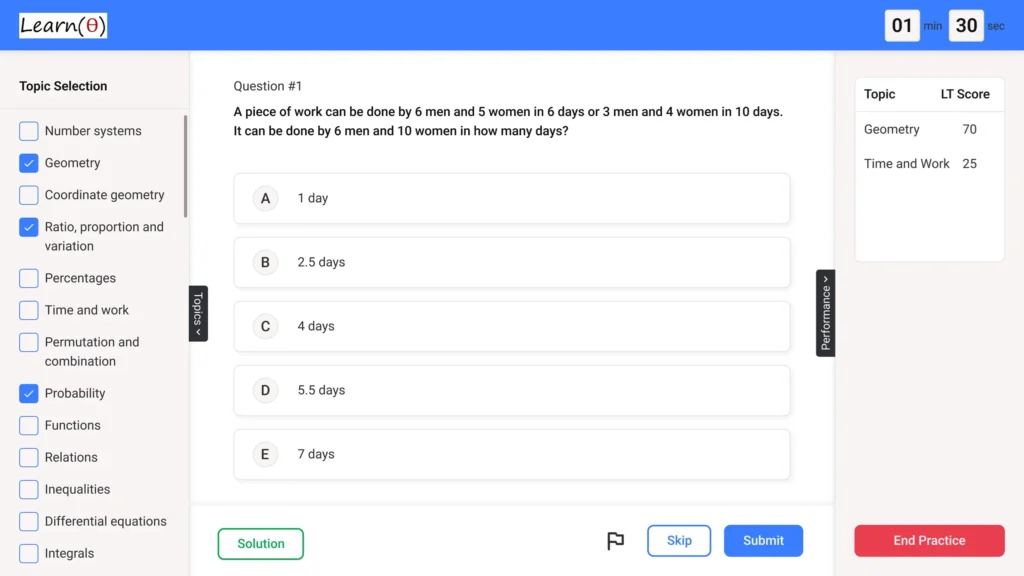
🤖 Adaptive Question Practice
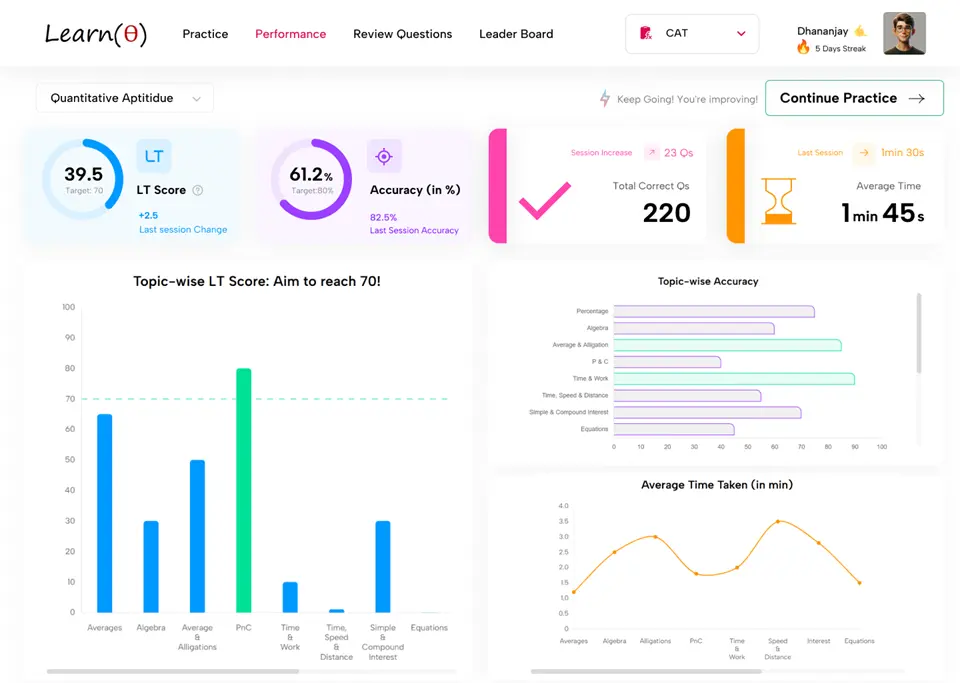
📊 Progress and Insights