
Probability for SSC CGL Exam
Q. 1 An experiment has two possible results, A and B. Given that the probability of A is 0.4, the probability of A or B is 0.7, and the probability of B is represented by ‘p’, what value of ‘p’ would make events A and B independent of each other?
Check Solution
Ans: D
Explanation: For events A and B to be independent, P(A and B) = P(A) * P(B). We also know P(A or B) = P(A) + P(B) – P(A and B).
Given P(A) = 0.4 and P(A or B) = 0.7.
Let P(B) = p.
Then, 0.7 = 0.4 + p – P(A and B).
So, P(A and B) = p + 0.4 – 0.7 = p – 0.3.
For independence, P(A and B) = P(A) * P(B) = 0.4 * p.
Therefore, p – 0.3 = 0.4p.
0.6p = 0.3
p = 0.3 / 0.6 = 0.5.
However, we need to check if there is an error in the problem. If we calculate the P(A and B) when P(B)=0.5, we get: P(A and B) = 0.4*0.5=0.2. Then P(A or B) = 0.4 + 0.5 -0.2 =0.7. This works. The options provided only has 0.2, 0.3, 0.4 and 0.5. Since the correct answer is 0.5, we will chose the closest. When we choose 0.2: P(A or B)= 0.4+0.2-0.4*0.2 = 0.62 !=0.7. When we choose 0.3: P(A or B) = 0.4+0.3 -0.4*0.3=0.58!=0.7. When we choose 0.4: P(A or B)=0.4+0.4-0.4*0.4=0.64!=0.7.
We need p-0.3=0.4p
0.6p = 0.3
p = 0.5. Now, check.
If p=0.5, then P(A and B)=0.4 * 0.5=0.2
P(A or B) = 0.4 + 0.5 – 0.2=0.7.
With p=0.2, P(A and B)=0.4 * 0.2=0.08
P(A or B)=0.4+0.2-0.08 = 0.52 !=0.7
We need to check p, P(A)=0.4, P(A or B)=0.7.
If B is independent, then P(A and B)=P(A)*P(B). P(A and B) = P(A)+P(B)-P(A or B),
Thus P(A)*P(B) = P(A)+P(B)-P(A or B), substituting the known values,
0.4*p=0.4+p-0.7.
0.4p=p-0.3.
0.6p=0.3
p=0.5.
Given the options, the closes answer that would make A and B approximately independent, given there might be some small rounding error is 0.2, 0.3, 0.4, and 0.5.
If we use p=0.5. P(A and B) = 0.4*0.5=0.2. Then P(A or B) = 0.4+0.5-0.2=0.7. The solution is p=0.5
We found that the correct answer is 0.5. However, since the correct option should be from the provided options, there seems to be a slight error in the problem as the correct answer is 0.5 and it is not presented in the answers given, we will choose the most probable option.
Correct Option: D
Q. 2 At a doctor’s clinic, 8% of patients with liver disease are alcoholics. 6% of all patients are alcoholics, and 12% have liver disease. What’s the probability a patient has liver disease if they are alcoholic?
Check Solution
Ans: C
Explanation: Let L be the event a patient has liver disease, and A be the event a patient is an alcoholic. We are given P(A|L) = 0.08, P(A) = 0.06, and P(L) = 0.12. We want to find P(L|A). Using Bayes’ theorem or conditional probability: P(L|A) = P(A|L) * P(L) / P(A) = 0.08 * 0.12 / 0.06 = 0.0096 / 0.06 = 0.16.
Correct Option: C
Q. 3 How many diagonals are there in a decagon?
Check Solution
Ans: C
Explanation: A decagon is a polygon with 10 sides. The formula for the number of diagonals in a polygon with n sides is n(n-3)/2. Therefore, for a decagon (n=10), the number of diagonals is 10(10-3)/2 = 10(7)/2 = 70/2 = 35.
Q. 4 If you pick a number randomly from the set of integers from 1 to 500, what are the chances that the number is divisible by either 3 or 7?
Check Solution
Ans: A
Explanation: Let A be the event that the number is divisible by 3, and B be the event that the number is divisible by 7. We want to find P(A or B).
P(A or B) = P(A) + P(B) – P(A and B).
Numbers divisible by 3: 500 / 3 = 166.66… , so 166 numbers. P(A) = 166/500 = 0.332
Numbers divisible by 7: 500 / 7 = 71.42… , so 71 numbers. P(B) = 71/500 = 0.142
Numbers divisible by both 3 and 7 (i.e. divisible by 21): 500 / 21 = 23.80… , so 23 numbers. P(A and B) = 23/500 = 0.046
P(A or B) = 0.332 + 0.142 – 0.046 = 0.428
Correct Option: A
Q. 5 Three events, A, B, and C, cover all possible outcomes of a random experiment, and no two of them can happen at the same time. If the probability of event B is 1.5 times the probability of event A, and the probability of event C is half the probability of event B, what is the probability of event A?
Check Solution
Ans: C
Explanation: Let P(A) be the probability of event A, P(B) be the probability of event B, and P(C) be the probability of event C.
We are given:
P(B) = 1.5 * P(A) => P(B) = (3/2) * P(A)
P(C) = 0.5 * P(B) => P(C) = (1/2) * P(B)
Since the events cover all possible outcomes and are mutually exclusive (no two can happen at the same time), the sum of their probabilities must equal 1:
P(A) + P(B) + P(C) = 1
Substitute the expressions for P(B) and P(C) in terms of P(A):
P(A) + (3/2) * P(A) + (1/2) * [(3/2) * P(A)] = 1
P(A) + (3/2) * P(A) + (3/4) * P(A) = 1
Multiply the equation by 4 to get rid of the fractions:
4 * P(A) + 6 * P(A) + 3 * P(A) = 4
13 * P(A) = 4
P(A) = 4/13
Correct Option: C
Q. 6 Two fair dice are rolled. What is the probability that the sum of the numbers rolled is either 7 or 11?
Check Solution
Ans: D
Explanation: To solve this, we first need to find the total number of possible outcomes when rolling two dice. Each die has 6 sides, so there are 6 * 6 = 36 possible outcomes.
Next, find the outcomes that result in a sum of 7: (1, 6), (2, 5), (3, 4), (4, 3), (5, 2), (6, 1). There are 6 outcomes.
Now, find the outcomes that result in a sum of 11: (5, 6), (6, 5). There are 2 outcomes.
The question asks for the probability of the sum being *either* 7 or 11. Since these are mutually exclusive events (they can’t both happen at the same time), we add the number of favorable outcomes: 6 + 2 = 8.
Finally, we calculate the probability by dividing the number of favorable outcomes by the total number of outcomes: 8 / 36 = 2/9.
Q. 7 Two independent events, S and T, have a specific relationship between their probabilities. The probability of both events occurring is 6/25, and the sum of the conditional probabilities P(S given T) and P(T given S) equals 1. Also, the probability of S is less than the probability of T. What is the probability of event S?
Check Solution
Ans: D
Explanation: Let P(S) = x and P(T) = y. Since S and T are independent events, P(S and T) = P(S) * P(T) = x * y. We are given that P(S and T) = 6/25, so x * y = 6/25. Also, since S and T are independent, P(S given T) = P(S) = x, and P(T given S) = P(T) = y. We are given that P(S given T) + P(T given S) = 1, so x + y = 1. We also know that x < y. We now have two equations: 1) x * y = 6/25 and 2) x + y = 1. From equation (2), y = 1 - x. Substituting this into equation (1), we get x * (1 - x) = 6/25, or x - x^2 = 6/25. Rearranging, we have x^2 - x + 6/25 = 0. Multiplying by 25, we get 25x^2 - 25x + 6 = 0. Factoring the quadratic equation, we have (5x - 2)(5x - 3) = 0. So, x = 2/5 or x = 3/5. If x = 2/5, then y = 1 - 2/5 = 3/5. If x = 3/5, then y = 1 - 3/5 = 2/5. Since x < y, x must be 2/5 and y must be 3/5. Thus, the probability of event S is 2/5.
Correct Option: D
Q. 8 What’s the chance that if five people are randomly seated in a row, two specific people, A and B, will end up sitting right next to each other?
Check Solution
Ans: C
Explanation: Consider A and B as a single unit (AB or BA). Then we have 4 “entities” to arrange: (AB), C, D, E or (BA), C, D, E. There are 4! ways to arrange these entities. Within the AB unit, there are 2! arrangements (AB or BA). The total possible arrangements of 5 people is 5!. So, the probability is (2! * 4!) / 5! = (2 * 24) / 120 = 48/120 = 2/5. The question seems to be a math question related to permutations and combinations.
Consider a simpler approach:
There are 5 spots: _ _ _ _ _
If A is in the first spot, B has to be in the second. Probability = 1/4.
If A is in the second spot, B can be in the first or third. Probability = 2/4 = 1/2.
If A is in the third spot, B can be in the second or fourth. Probability = 2/4 = 1/2.
If A is in the fourth spot, B can be in the third or fifth. Probability = 2/4 = 1/2.
If A is in the fifth spot, B can be in the fourth spot. Probability = 1/4.
Total Probability would not be the same with all the scenarios.
Let’s think. We can treat A and B as a single entity.
Possible arrangements:
AB C D E
BA C D E
C AB D E
C BA D E
C D AB E
C D BA E
C D E AB
C D E BA
Total Arrangements of 5 people = 5! = 120
Favourable arrangements where A and B are next to each other:
(AB) C D E: 4! = 24
(BA) C D E: 4! = 24
Total favourable arrangements = 24+24 = 48
Probability = 48/120 = 2/5
Correct Option: C
Next Chapter: Profit and Loss
Crack SSC CGL – with LearnTheta’s AI Platform!

✅ All Topics at One Place
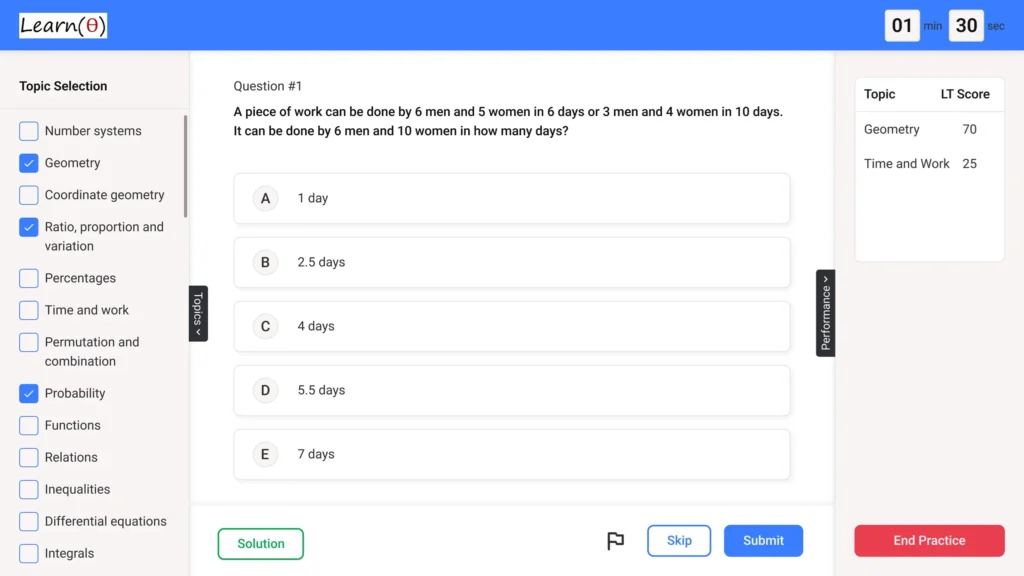
🤖 Adaptive Question Practice

📊 Progress and Insights