
Number systems: SSC CGL Exam
Q. 1 A 10-digit number, 75462A97B6, is divisible by 72. Find the value of $\sqrt{8A – 4B}$.
Check Solution
Ans: C
Explanation:
A number is divisible by 72 if it is divisible by both 8 and 9.
Divisibility rule for 8: The last three digits of the number must be divisible by 8. So, 97B6 should be divisible by 8. We can test values for B.
If B = 0, 9706/8 = Not an integer
If B = 1, 9716/8 = Not an integer
If B = 2, 9726/8 = Not an integer
If B = 3, 9736/8 = 1217. So, B = 3
Divisibility rule for 9: The sum of the digits must be divisible by 9.
So, 7 + 5 + 4 + 6 + 2 + A + 9 + 7 + 3 + 6 = 49 + A must be divisible by 9.
If A = 1, 49 + 1 = 50, not divisible by 9.
If A = 2, 49 + 2 = 51, not divisible by 9.
If A = 3, 49 + 3 = 52, not divisible by 9.
If A = 4, 49 + 4 = 53, not divisible by 9.
If A = 5, 49 + 5 = 54, divisible by 9.
So, A = 5 and B = 3.
Now, we can find the value of $\sqrt{8A – 4B}$.
$\sqrt{8(5) – 4(3)} = \sqrt{40 – 12} = \sqrt{28}$
Correct Option: C
Q. 2 A nine-digit number, 7698x138y, is perfectly divisible by 72. Given this, what is the value of the square root of (4x + y)?
Check Solution
Ans: B
Explanation:
A number divisible by 72 must be divisible by both 8 and 9 (since 72 = 8 x 9 and 8 and 9 are coprime).
Divisibility by 8: A number is divisible by 8 if the last three digits are divisible by 8. So, 38y must be divisible by 8. Testing values for y (0 to 9), we find that 384 is divisible by 8 (384/8 = 48). Therefore, y = 4.
Divisibility by 9: A number is divisible by 9 if the sum of its digits is divisible by 9. So, 7 + 6 + 9 + 8 + x + 1 + 3 + 8 + y must be divisible by 9. Substituting y = 4, we have: 7 + 6 + 9 + 8 + x + 1 + 3 + 8 + 4 = 46 + x. For 46 + x to be divisible by 9, x must be 8, because 46 + 8 = 54 which is divisible by 9.
Now we have x = 8 and y = 4. We are asked for the square root of (4x + y).
4x + y = (4 * 8) + 4 = 32 + 4 = 36
The square root of 36 is 6.
Correct Option: B
Q. 3 What is the smallest positive whole number that needs to be added to 3627 to make the result perfectly divisible by 4, 5, 6, and 8?
Check Solution
Ans: C
Explanation: To find the smallest number to add, we need to find the least common multiple (LCM) of 4, 5, 6, and 8. Prime factorizing each number: 4 = 2^2, 5 = 5, 6 = 2 * 3, 8 = 2^3. The LCM is the product of the highest powers of all prime factors, which is 2^3 * 3 * 5 = 8 * 3 * 5 = 120. Now, divide 3627 by 120: 3627 / 120 = 30 with a remainder of 27. To make the result divisible by 120, we need to add a number to 3627 such that the result is a multiple of 120. The next multiple of 120 after 3627 is 30 * 120 + 120 = 3600 + 120 = 3720. The difference is 3720 – 3627 = 93.
Alternatively we can do 120 – 27 = 93.
Correct Option: C
Q. 4 A number of the form 8A5146B is perfectly divisible by 88. Determine the value of A raised to the power of B.
Check Solution
Ans: C
Explanation: For a number to be divisible by 88, it must be divisible by both 8 and 11 (since 88 = 8 x 11, and 8 and 11 are coprime).
Divisibility by 8: A number is divisible by 8 if the last three digits are divisible by 8. So, 46B must be divisible by 8. Testing values for B:
– If B = 0, 460/8 = 57.5 (not divisible)
– If B = 4, 464/8 = 58 (divisible)
– If B = 8, 468/8 = 58.5 (not divisible)
So, B = 4.
Divisibility by 11: A number is divisible by 11 if the difference between the sum of the digits at odd places and the sum of the digits at even places is either 0 or a multiple of 11.
Our number is 8A5146B, with B=4, so it’s 8A51464
Odd places: 8 + 5 + 4 + 4 = 21
Even places: A + 1 + 6 = A + 7
Difference: 21 – (A + 7) = 14 – A
We need 14 – A to be divisible by 11. The possible values are 0 or 11 or -11 etc.
– If 14 – A = 0, then A = 14 (not possible as A is a digit).
– If 14 – A = 11, then A = 3.
– If 14 – A = -11, then A = 25 (not possible).
So, A = 3.
Therefore, A = 3 and B = 4. We need to find AB = 34 = 81.
Correct Option: C
Q. 5 What is the remainder when 8378 is divided by 75?
Check Solution
Ans: C
Explanation: To find the remainder when 8378 is divided by 75, we can perform long division or use modular arithmetic.
Divide 8378 by 75:
8378 = 75 * 111 + 53
So, the remainder is 53.
Q. 6 A two-digit number has a units digit that’s 2 more than its tens digit. Also, if you multiply the number itself by the sum of its digits, you get 460. Find the original two-digit number.
Check Solution
Ans: C
Explanation: Let the tens digit be ‘x’ and the units digit be ‘x+2’. The two-digit number can be represented as 10x + (x+2). The sum of the digits is x + (x+2) = 2x+2. The problem states that the number multiplied by the sum of its digits equals 460. Therefore, (10x + x + 2) * (2x + 2) = 460 which simplifies to (11x+2) * (2x+2) = 460 or 22x^2 + 26x + 4 = 460 or 22x^2 + 26x – 456=0, which further reduces to 11x^2 + 13x – 228 = 0. Solving this quadratic equation leads to x=4 (We can ignore negative value). Thus, the tens digit is 4, and the units digit is 4+2=6. The original number is 46.
Alternatively we can solve it using options:
A. 64. Sum of digits: 10. 64*10 = 640 != 460
B. 48. Sum of digits: 12. 48*12 = 576 != 460
C. 46. Sum of digits: 10. 46*10 = 460. The tens digit is 4, units digit is 6, which is 2 more than tens digit.
D. 36. Sum of digits: 9. 36*9 = 324 != 460
Correct Option: C
Q. 7 An 8-digit number, 888x53y4, is divisible by 72. Find the value of 7x + 2y, using the largest possible value for y.
Check Solution
Ans: C
Explanation: A number divisible by 72 must be divisible by both 8 and 9.
Divisibility rule for 8: The last three digits must be divisible by 8. So, 3y4 must be divisible by 8.
If y = 0, 304 is divisible by 8.
If y = 1, 314 is not divisible by 8.
If y = 2, 324 is not divisible by 8.
If y = 3, 334 is not divisible by 8.
If y = 4, 344 is divisible by 8.
If y = 5, 354 is not divisible by 8.
If y = 6, 364 is not divisible by 8.
If y = 7, 374 is not divisible by 8.
If y = 8, 384 is divisible by 8.
If y = 9, 394 is not divisible by 8.
So, y can be 0, 4, or 8. We want the largest possible value for y, so y = 8.
Then the number is 888×5384.
Divisibility rule for 9: The sum of the digits must be divisible by 9.
8 + 8 + 8 + x + 5 + 3 + 8 + 4 = 44 + x
We need 44 + x to be divisible by 9.
If x = 1, 44 + 1 = 45, which is divisible by 9.
If x = 10, that is not a valid digit.
So, x = 1.
Therefore, x = 1 and y = 8.
Now, 7x + 2y = 7(1) + 2(8) = 7 + 16 = 23.
Correct Option: C
Q. 8 Find the digit represented by ‘x’ in the seven-digit number 55350×2, given that the number is perfectly divisible by 72.
Check Solution
Ans: A
Explanation: A number is divisible by 72 if it is divisible by both 8 and 9.
Divisibility rule for 8: The last three digits of the number must be divisible by 8. So, 0x2 must be divisible by 8. Testing values for x:
– If x=0, 002 is not divisible by 8.
– If x=1, 012 is not divisible by 8.
– If x=2, 022 is not divisible by 8.
– If x=3, 032 is divisible by 8.
– If x=4, 042 is not divisible by 8.
– If x=5, 052 is not divisible by 8.
– If x=6, 062 is not divisible by 8.
– If x=7, 072 is divisible by 8.
– If x=8, 082 is not divisible by 8.
– If x=9, 092 is not divisible by 8.
So, x can be either 3 or 7.
Divisibility rule for 9: The sum of the digits must be divisible by 9.
If x=3, the sum of the digits is 5+5+3+5+0+3+2 = 23, which is not divisible by 9.
If x=7, the sum of the digits is 5+5+3+5+0+7+2 = 27, which is divisible by 9.
Therefore, x=7.
Correct Option: A
Q. 9 Find the digit represented by ‘x’ in the seven-digit number 91876×2, given that the number is perfectly divisible by 72.
Check Solution
Ans: A
Explanation: A number divisible by 72 must be divisible by both 8 and 9 (since 72 = 8 x 9 and 8 and 9 are co-prime).
Divisibility rule for 8: The last three digits of the number must be divisible by 8. So, 6×2 must be divisible by 8. Let’s test the options:
* If x = 0, we have 602. 602/8 = 75.25 (not divisible by 8)
* If x = 2, we have 622. 622/8 = 77.75 (not divisible by 8)
* If x = 3, we have 632. 632/8 = 79 (divisible by 8)
* If x = 5, we have 652. 652/8 = 81.5 (not divisible by 8)
So x = 3 satisfies the divisibility rule of 8.
Divisibility rule for 9: The sum of the digits must be divisible by 9. With x=3, the number is 9187632. The sum of the digits is 9 + 1 + 8 + 7 + 6 + 3 + 2 = 36. Since 36 is divisible by 9, the number is divisible by 9.
Since the number is divisible by both 8 and 9, it is divisible by 72.
Correct Option: A
Q. 10 Find the least 4-digit number that leaves a remainder of 3 when divided by 6, 8, 10, and 12.
Check Solution
Ans: D
Explanation:
1. Find the Least Common Multiple (LCM) of 6, 8, 10, and 12.
* Prime factorize each number: 6 = 2 x 3, 8 = 2^3, 10 = 2 x 5, 12 = 2^2 x 3
* LCM = 2^3 x 3 x 5 = 8 x 3 x 5 = 120
2. Find a multiple of 120 that is a 4-digit number. Start by dividing the smallest 4-digit number (1000) by 120: 1000 / 120 = 8.33…
3. Multiply 120 by the next whole number, which is 9: 120 x 9 = 1080.
4. Add the remainder (3) to the multiple of the LCM: 1080 + 3 = 1083.
Q. 11 Find the missing digit, represented by ‘x’, in the number 5656×52, so that the entire seven-digit number is perfectly divisible by 72.
Check Solution
Ans: B
Explanation: For a number to be divisible by 72, it must be divisible by both 8 and 9 (since 72 = 8 x 9 and 8 and 9 are relatively prime).
Divisibility by 8: A number is divisible by 8 if the last three digits are divisible by 8. So, x52 must be divisible by 8. Let’s test the given options for x:
* If x = 4, the number is 452. 452/8 = 56.5 (not divisible)
* If x = 7, the number is 752. 752/8 = 94 (divisible)
* If x = 5, the number is 552. 552/8 = 69 (divisible)
* If x = 8, the number is 852. 852/8 = 106.5 (not divisible)
So, x could be either 7 or 5.
Divisibility by 9: A number is divisible by 9 if the sum of its digits is divisible by 9.
* If x=7, the number is 5656752. The sum of digits = 5+6+5+6+7+5+2 = 36. 36/9=4. (divisible)
* If x=5, the number is 5656552. The sum of digits = 5+6+5+6+5+5+2 = 34. 34/9 has a remainder. (not divisible)
Therefore, x must be 7.
Correct Option: B
Q. 12 Find the sum of all numbers between 400 and 500 that are perfectly divisible by 6, 12, and 16.
Check Solution
Ans: A
Explanation: First, we need to find the least common multiple (LCM) of 6, 12, and 16. The prime factorizations are:
– 6 = 2 x 3
– 12 = 2 x 2 x 3 = 2^2 x 3
– 16 = 2 x 2 x 2 x 2 = 2^4
The LCM is found by taking the highest power of each prime factor: LCM(6, 12, 16) = 2^4 x 3 = 16 x 3 = 48.
Now, we need to find the multiples of 48 between 400 and 500.
– Divide 400 by 48: 400 / 48 = 8.33… So the first multiple is 48 * 9 = 432
– Divide 500 by 48: 500 / 48 = 10.41… So the last multiple is 48 * 10 = 480
The multiples of 48 between 400 and 500 are 432 and 480.
Now, sum them up: 432 + 480 = 912.
Correct Option: A
Q. 13 If the number 723×2 is completely divisible by 4, then the smallest integer in place of x will be:
Check Solution
Ans: B
Explanation: A number is divisible by 4 if the number formed by its last two digits is divisible by 4. In this case, we need to check the divisibility of x2 by 4.
If x = 0, the number becomes 02, which is 2. 2 is not divisible by 4.
If x = 1, the number becomes 12. 12 is divisible by 4.
If x = 2, the number becomes 22. 22 is not divisible by 4.
If x = 3, the number becomes 32. 32 is divisible by 4.
Since the question asks for the *smallest* integer for x, the answer is 1.
Q. 14 If you divide 2468 by 37, what’s the leftover amount?
Check Solution
Ans: A
Explanation: Divide 2468 by 37.
2468 / 37 = 66 with a remainder of 26.
Correct Option: A
Next Chapter: Ordering and Ranking
Crack SSC CGL – with LearnTheta’s AI Platform!

✅ All Topics at One Place
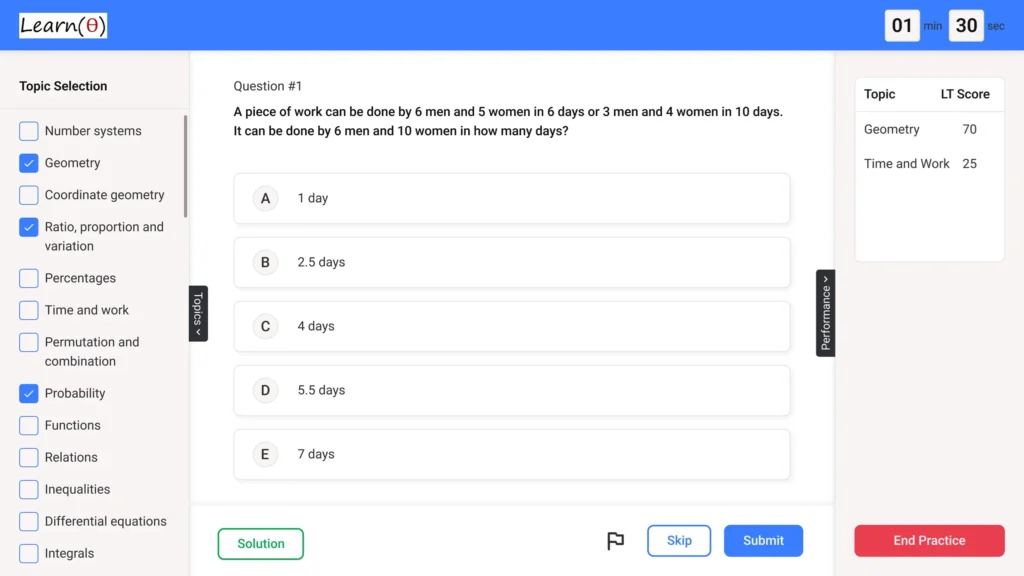
🤖 Adaptive Question Practice

📊 Progress and Insights