
CBSE Class 10 Maths Notes: Triangles
Similarity of Triangles
This section explores the concept of similar triangles.
Definitions
Similar triangles have the same shape but not necessarily the same size. Their corresponding angles are equal, and the ratio of their corresponding sides is proportional.
Examples and Non-Examples
Examples:
- Equilateral triangles of different sizes.
- Two right-angled triangles with one common acute angle.
Non-Examples:
- A right-angled triangle and an obtuse-angled triangle.
- A square and a rectangle (unless they are also similar).
Basic Proportionality Theorem (Thales’ Theorem)
This theorem establishes a fundamental relationship between parallel lines and the sides of a triangle.
Core Principles
If a line is drawn parallel to one side of a triangle, it divides the other two sides in the same ratio.
Proof
Consider triangle $ABC$, and let $DE$ be parallel to $BC$. We can prove that $\frac{AD}{DB} = \frac{AE}{EC}$. The proof involves using the area of triangles. Details of the proof can be found in your textbook.
Use of the Theorem
The theorem is used to find unknown lengths in triangles when parallel lines are present.
Converse of the Basic Proportionality Theorem
Statement
If a line divides any two sides of a triangle in the same ratio, then the line is parallel to the third side.
Note: This is the converse of the Basic Proportionality Theorem, and its proof is often omitted.
Criteria for Triangle Similarity
These criteria provide conditions for determining if two triangles are similar.
Similarity Criteria
- AA (Angle-Angle) Similarity: If two angles of one triangle are respectively equal to two angles of another triangle, then the two triangles are similar.
- SAS (Side-Angle-Side) Similarity: If one angle of a triangle is equal to one angle of another triangle, and the sides including these angles are proportional, then the two triangles are similar.
- SSS (Side-Side-Side) Similarity: If the sides of one triangle are proportional to the sides of the other triangle, then the two triangles are similar.
Applications
These criteria are used to prove the similarity of triangles and to solve problems involving lengths of sides and angles.
Solving Geometric Problems Using Similarity
Key Techniques
Similarity can be used to solve problems involving:
- Length Ratios: Finding unknown lengths by setting up proportions. If two triangles are similar, the ratios of corresponding sides are equal.
- Corresponding Sides: Identifying and using the proportional relationships between corresponding sides.
- Heights: Using similarity to find the heights of objects, like buildings or trees, by using shadows or other measurable distances.
Further Reading
- Similarity of Triangles: Concept & Conditions
- Criteria for Similarity of Triangles
- Basic Proportionality Theorem (Thales Theorem) & its Converse
- Areas of Similar Triangles: Ratio Property
- Pythagoras Theorem & its Converse
Practice Triangles Extra Questions
Refer Triangles NCERT Solutions
Refer Class 10 Math Notes & CBSE Syllabus
Conquer Maths & Science – with LearnTheta’s AI-Practice!

✅ All Topics at One Place
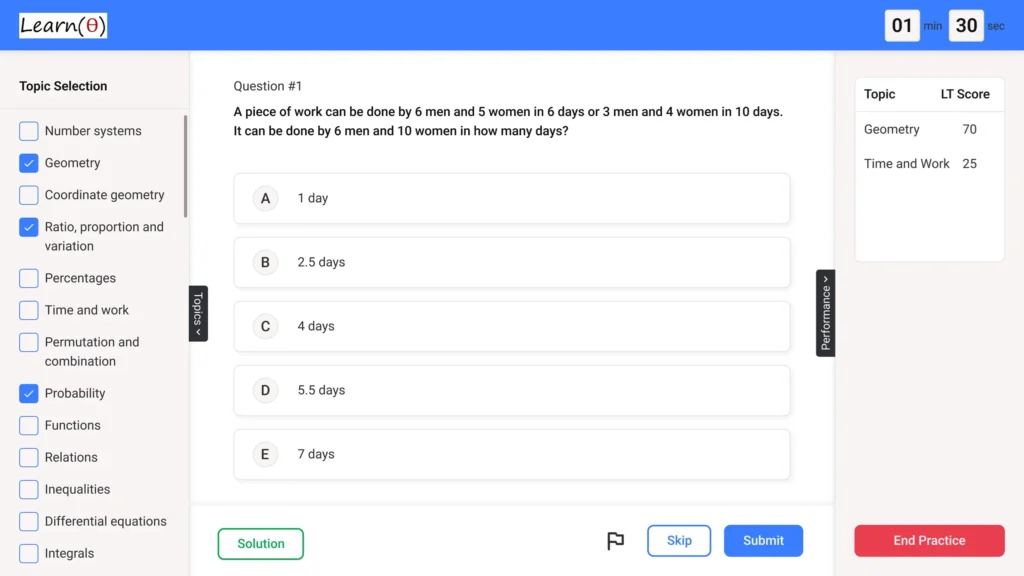
🤖 Adaptive Question Practice

📊 Progress and Insights